Disclaimer: Information found on CryptoreNews is those of writers quoted. It does not represent the opinions of CryptoreNews on whether to sell, buy or hold any investments. You are advised to conduct your own research before making any investment decisions. Use provided information at your own risk.
CryptoreNews covers fintech, blockchain and Bitcoin bringing you the latest crypto news and analyses on the future of money.

Bitcoin value could potentially reach $20,000 within the next four months, according to Philip Swift.

Bitcoin (BTC) has moved past its bear market, yet the upcoming months could witness a decline back to $20,000.
This is the perspective of Philip Swift, an experienced Bitcoin market analyst who co-founded the trading platform DecenTrader and the data resource Look Into Bitcoin.
In his recent discussion with Cointelegraph, Swift examines the potential near- to long-term trajectory for BTC price movements.
Having forecasted the conclusion of the bear market at the end of 2022, Swift maintains his assessment of underlying price resilience while remaining cautious about the possibility of a more significant correction than last week’s 10% drop.
Bulls encounter numerous challenges on their path to achieving new all-time highs, he noted, with government policies posing particular concerns regarding potential price suppression.
Nevertheless, there are ample reasons to believe that, for the time being, the bottom has been reached, and a robust growth phase is anticipated for Bitcoin in the latter half of the year.
Cointelegraph (CT): In our previous interview in October, you suggested that the Bitcoin bear market would conclude in three months. Do you believe it is over for good?
Philip Swift (PS): Yes.
It truly felt as though we were nearing maximum pain back in October, and we experienced the final capitulation shortly thereafter in November. BTC then began to trend upward in January, three months following our interview.
This chart illustrates how the current bear market has closely mirrored previous cycles in terms of timing, indicating that human behavior remains consistent.
However, this does not imply that we cannot face a significant correction in the coming months. We might encounter some volatility and fluctuations after an exceptional Q1 2023, during which BTC surged by 80%. I would not be surprised if we need to take a breather for a while.
CT: Given that Bitcoin rose by 80% in Q1, has BTC’s performance in 2023 caught you off guard?
PS: It is not uncommon for Bitcoin to make substantial moves like that following an extended period of stagnation. As the price climbed from the lows, we observed that funding rates remained flat or negative, indicating significant skepticism among derivative traders.
This contributed to BTC’s price continuing to rise all the way to $30,000 through a series of short squeezes.
CT: A considerable number of market participants remain doubtful about this year’s rally and anticipate a drop back to $20,000 or worse. To what extent do you concur with them?
PS: It is certainly a possibility, as that would represent a -25% decline from current levels. For a volatile asset like Bitcoin, such a scenario could easily unfold within the next three to four months. Beyond that timeframe, I believe it becomes increasingly improbable, as I expect the halving narrative to gain traction later in the year, which should enhance buying pressure.
Related: Bitcoin price stabilizes near $27K — What could trigger the next movement?
CT: We have witnessed various regulatory shocks from which Bitcoin has repeatedly rebounded in recent months. Do you think the market can continue to withstand such “mini” black swan events?
PS: I do, as long as these mini black swans are specific and not widespread across the industry. To elaborate, my greatest concern for Bitcoin is a coordinated effort by major governments to eliminate the fiat banking on and off-ramps that support the ecosystem.
“I recognize that Bitcoin is designed to endure in isolation, but I believe that if such a coordinated initiative is executed effectively, it would significantly suppress prices for an extended period.”
The current regulatory environment in the U.S. is not particularly encouraging. It is certainly something to monitor over the next few years.
CT: What is your perspective on the U.S. banking crisis and its repercussions? Are we likely to face more shock events in the near to mid-term?
Related Posts
PS: We will have to see if the recent banking sector developments were merely the beginning of larger issues. However, I believe such occurrences ultimately serve as a positive catalyst for Bitcoin — especially among younger individuals, who will continue to question why they should keep their savings in a bank with custodial risks instead of a decentralized self-custodied asset like Bitcoin.
“In the end, I think that problems in the banking sector related to customer deposits are bullish for Bitcoin in the long run.”
CT: Assuming all factors remain constant, how do you foresee BTC/USD performing this quarter and beyond? Is it premature to discuss a pre-halving buildup?
PS: I believe we may require some sideways movement for a few months following the impressive Q1 Bitcoin experienced. Toward the end of the year, late Q3 into Q4, I anticipate the pre-halving narrative will gain momentum, which should positively influence the price.
Additionally, that should provide sufficient time for the market to recover post-FTX. We should also have addressed much of the Mt. Gox selling risk. Any remaining selling should be assessed and factored into the market by that time.
CT: Filbfilb (CEO of DecenTrader) recently published an analysis of how Bitcoin might behave during the next halving cycle and reaffirmed $180,000 as his primary target. What is your position on the next cycle’s peak?
PS: It is certainly a possibility. I expect long-term holders to begin selling their Bitcoin as the price surpasses $80,000.
“That will introduce new supply into the market. Eventually, there will be an excess of supply that demand cannot absorb. I do anticipate that to exceed $100,000.”
Precisely where is challenging to determine. In 2017, we witnessed a price surge from $10,000 to the $20,000 peak in less than two weeks! Many tend to overlook that. If we experience another blow-off top like that, such volatility makes it extremely difficult or nearly impossible to pinpoint the exact peak.
“I believe a realistic range would be $120,000–$210,000.”
CT: Which BTC price metrics currently capture your interest?
PS: Bull market comparison: valuable for understanding our timing perspective.
- 1yr HODL Wave: Indicates that long-term holders have accumulated and will not sell in large quantities until the price reaches a new all-time high.
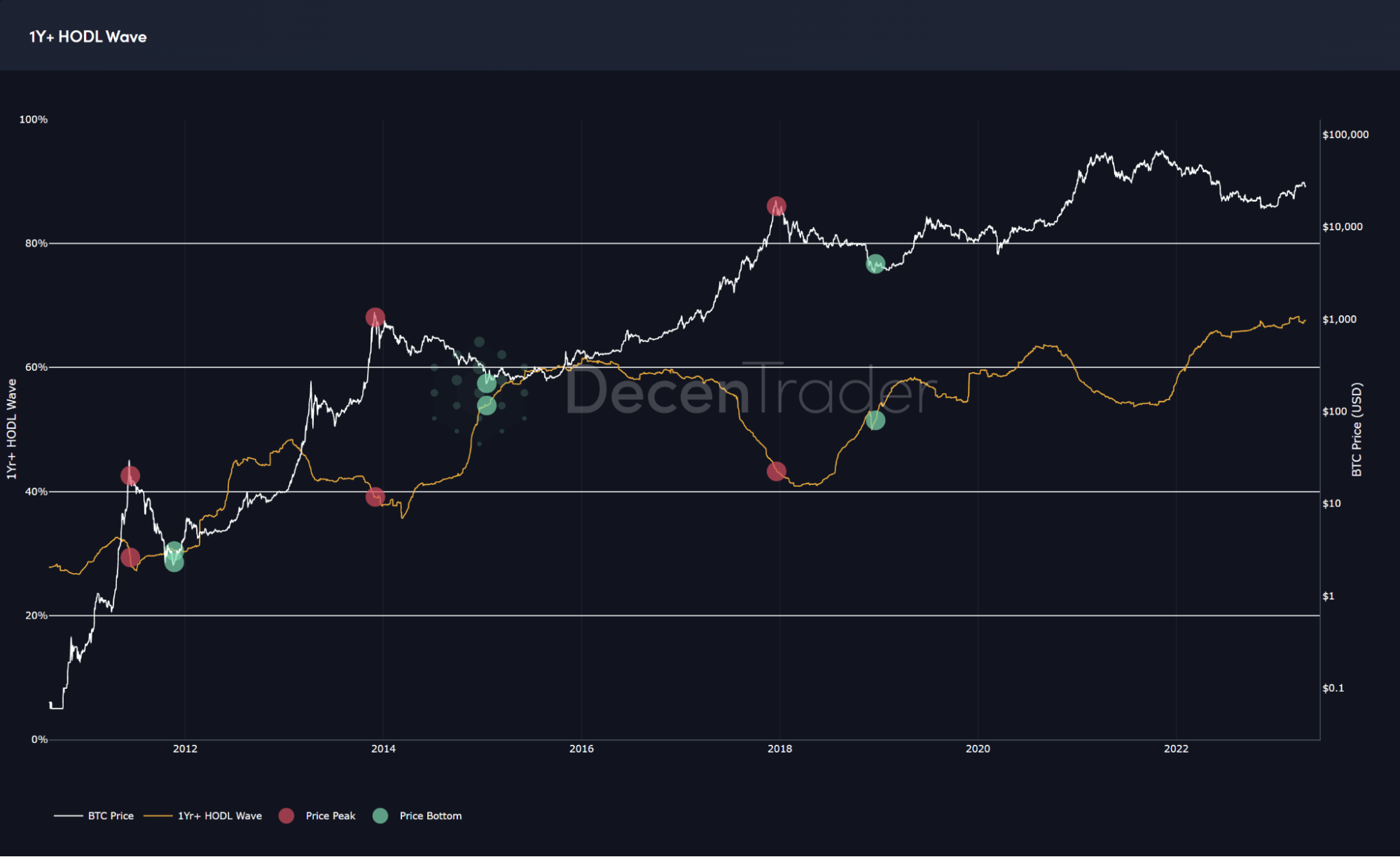 Bitcoin 1-year HODL Wave chart. Source: Decentrader
- MVRV Z-Score: Reflects levels of market-wide “profit” — the difference between market cap and realized cap. Currently, the market has just returned to profit as the Z-score (blue line) has moved above the green accumulation zone. There is still a considerable distance to cover before approaching a market peak.
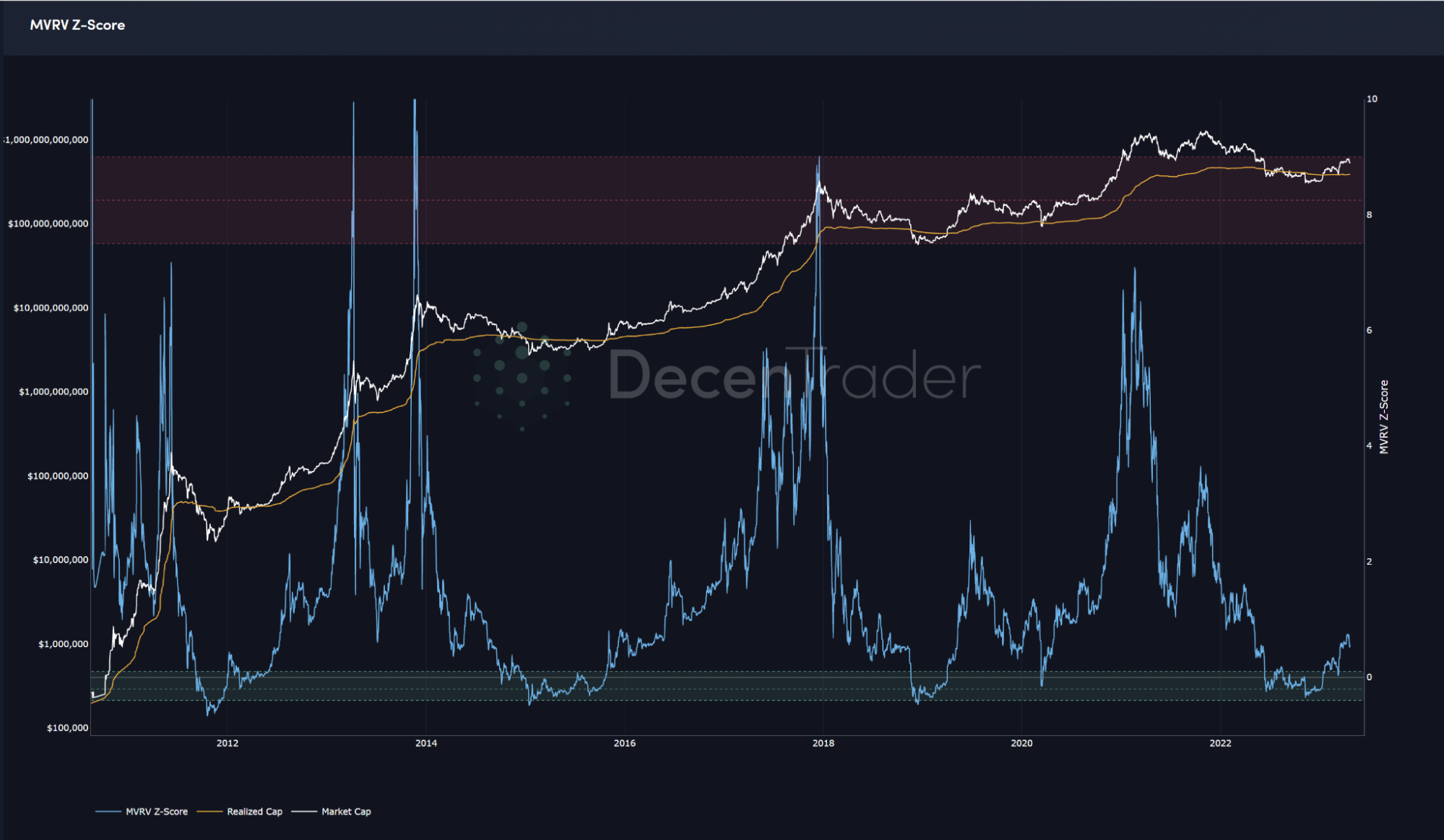 Bitcoin MVRV Z-Score chart. Source: DecenTrader
CT: Is the NFT market defunct?
PS: No, but it is currently experiencing a significant downturn.
- While quality collections are generally stable in USD terms, nearly all major collections have declined in comparison to Ether (ETH) over the past several months.
- Volumes have significantly decreased since the highs of the bull market — $150 million per week compared to the bull market peaks of $1 billion.
- We are even observing NFT influencers on Twitter shifting their focus to other topics like AI. This does not imply that those influencers are not optimistic about NFTs in the long term, but rather that interest in short- to mid-term NFT prices has evidently diminished.
“That said, we believe we may soon be approaching the latter stages of the NFT bear market.”
While there may be additional general market challenges, we anticipate that strategic investors will increasingly seek quality NFTs at discounted prices. This could offer some relief for a select number of collections in the near future.
Magazine: Crypto regulation: Does SEC Chair Gary Gensler have the final say?
This article does not provide investment advice or recommendations. Every investment and trading decision carries risk, and readers should conduct their own research before making a choice.
