Disclaimer: Information found on CryptoreNews is those of writers quoted. It does not represent the opinions of CryptoreNews on whether to sell, buy or hold any investments. You are advised to conduct your own research before making any investment decisions. Use provided information at your own risk.
CryptoreNews covers fintech, blockchain and Bitcoin bringing you the latest crypto news and analyses on the future of money.


The International Energy Agency (IEA) announced on Tuesday that it will hold an extraordinary meeting of its member nations to deliberate on the release of emergency oil reserves.
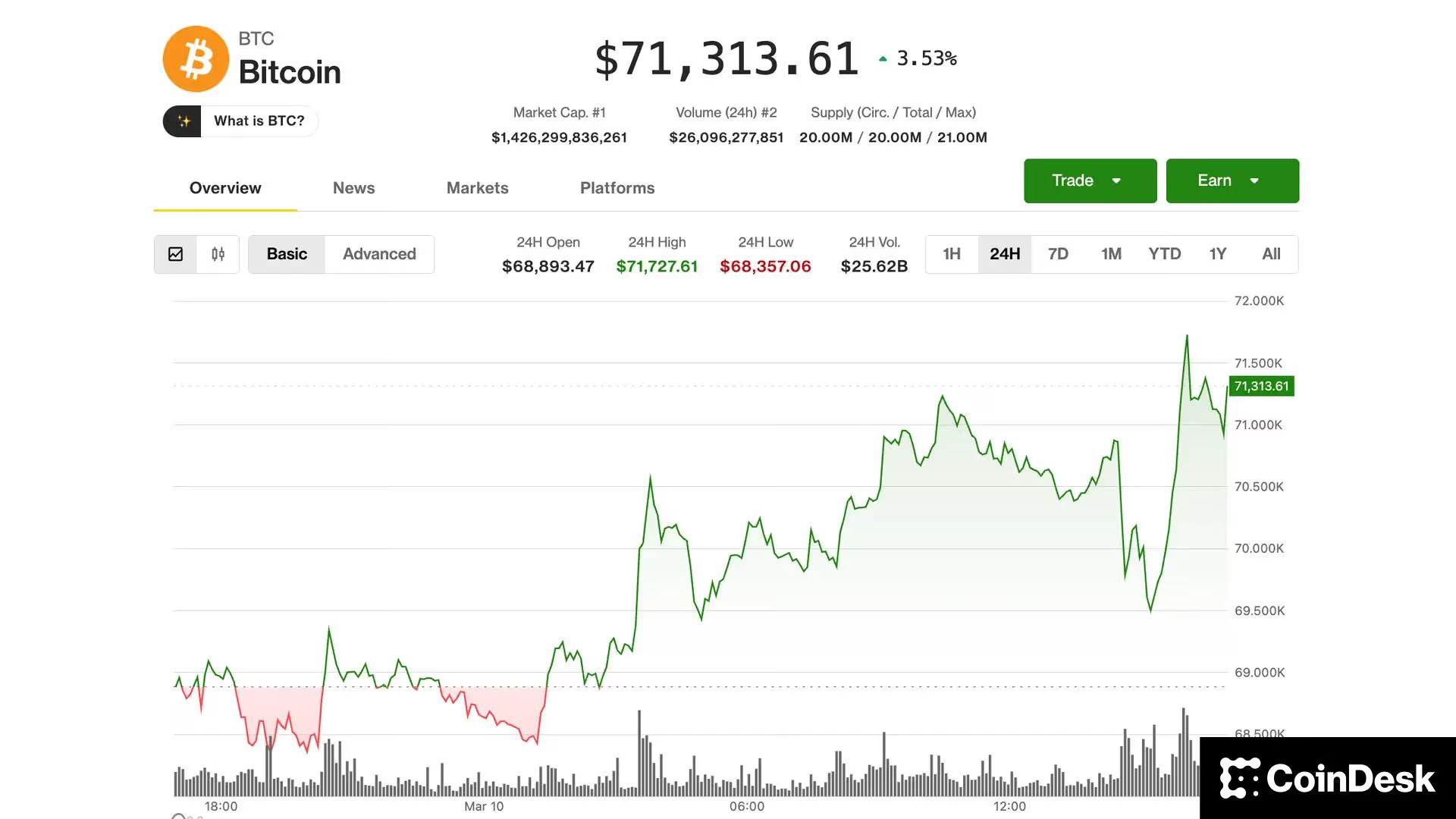 Bitcoin (BTC) price on March 10 (Coindesk)
What to know:
- Cryptocurrencies surged as diminishing concerns over an oil supply disruption, aided by the IEA’s potential emergency reserve release, boosted risk appetite across worldwide markets.
- Bitcoin surpassed $71,500 at one point during Tuesday morning trading in the U.S., with other major tokens such as XRP, dogecoin, SUI, and HYPE also rising.
- Bitcoin is beginning to show signs of decoupling from software and technology stocks, performing better than equities amid recent macroeconomic instability — a sign described as “cautiously optimistic” by one analyst.
On Tuesday, cryptocurrencies continued their upward trend as reduced worries about a possible oil supply disruption enhanced risk appetite across global markets.
This shift in sentiment followed the IEA’s announcement of an extraordinary meeting of its member countries to discuss the possibility of releasing emergency oil reserves.
Bitcoin reached above $71,500 for the first time since Thursday, before settling back to the current price of $71,300, reflecting a 3.2% increase over the last 24 hours. The broader CoinDesk 20 Index also showed a similar rise, with XRP (XRP), , , and Hyperliquid’s native token (HYPE) leading the charge among significant crypto assets.
WTI crude oil prices continued to decline following this news, falling to $82 after previously reaching nearly $120 over the weekend. Concurrently, the S&P 500 and the tech-heavy Nasdaq 100 experienced an approximate 0.5% increase at midday.
Many crypto-related stocks reflected this upward trend. Circle (CRCL), a stablecoin issuer, gained another 6%, now nearly doubling in value over the past two weeks, while digital asset infrastructure company BitGo (BTGO) rose more than 8% and blockchain firm Figure (FIGR) climbed by 12%.
Related Posts
Following the announcement of Nigel Farage joining U.K. bitcoin treasury firm Stack BTC (STAK) on Monday, that stock has soared over 200%.
Bitcoin decoupling from software
Bitcoin seems to be reducing its correlation with the software stock ETF (IGV), as BlackRock’s IBIT has increased by approximately 3% in the past 24 hours, while IGV has decreased by over 2%.
However, over the last five days, IGV has risen about 1.5%, whereas IBIT has dropped roughly 2%, indicating IBIT may still need to catch up if it is to restore its correlation with software equities.
A diminishing correlation could also be significant, as it may indicate bitcoin starting to trade more independently from software and technology stocks, potentially evolving into a less correlated asset during times of macroeconomic uncertainty. It continues to outperform both gold and U.S. equities since the onset of the conflict.
‘Cautiously optimistic’ for BTC
Looking at the broader picture, bitcoin’s recent price movements have shown considerable resilience despite ongoing macroeconomic challenges, according to James Harris, CEO of the crypto yield platform Tesseract Group.
After a brief dip into the low-$60,000 range, BTC rebounded even as larger risk markets grappled with geopolitical instability, he noted. At the same time, ETF inflows have remained generally supportive, and a significant deleveraging earlier in the month helped to rectify excessive positioning in the derivatives markets.
The combination of diminished sentiment, cleared-out leverage, and support around the $66,000 level suggests that bitcoin might be entering a phase of bottoming, according to Harris. Nonetheless, there is still downside risk as the crypto market remains vulnerable.
"If support in the mid-$60k range fails, we could easily see another test lower, but for now we remain cautiously optimistic on BTC," he remarked.
