Disclaimer: Information found on CryptoreNews is those of writers quoted. It does not represent the opinions of CryptoreNews on whether to sell, buy or hold any investments. You are advised to conduct your own research before making any investment decisions. Use provided information at your own risk.
CryptoreNews covers fintech, blockchain and Bitcoin bringing you the latest crypto news and analyses on the future of money.



Bitcoin Mining Difficulty Hits New High at 103.92 Trillion
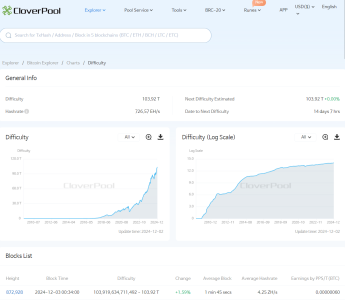
The mining difficulty of Bitcoin—a metric indicating the complexity of mining a new block—has reached an unprecedented level of 103.92 trillion (T) following a 1.59% adjustment at block height 872,928, as reported by CloverPool. This increase signifies a notable achievement for the Bitcoin network, highlighting its expanding computational capacity and security.
In conjunction with this rise, the network’s average computing power, or hash rate, is now recorded at an impressive 726.57 exahashes per second (EH/s), showcasing the intensifying competition among miners to obtain block rewards.
Understanding Bitcoin Mining Difficulty
1. What Is Mining Difficulty?
Bitcoin’s mining difficulty adjusts roughly every 2,016 blocks, or about every two weeks, to ensure a stable block time of 10 minutes. This metric indicates the amount of computational effort necessary to mine a block, directly linked to the network’s hash rate.
2. Why Does It Increase?
The mining difficulty escalates when:
- Hash Rate Increases: A surge in computational power heightens competition among miners.
- Network Security Enhances: A higher difficulty level fortifies the network by minimizing vulnerabilities to attacks.
Current Mining Difficulty Milestone: Key Figures
- Record Difficulty: 103.92T, reflecting a 1.59% rise from the last adjustment.
- Hash Rate: 726.57 EH/s, indicating the network’s average computational capability.
These statistics emphasize the strength and increasing decentralization of the Bitcoin network, as more miners enter the ecosystem to vie for rewards.
Factors Contributing to the Difficulty Increase
1. Increased Mining Activity
- Global Expansion: Miners around the globe have intensified their operations, driven by the recovering cryptocurrency market.
- New Hardware Adoption: Innovations in mining technology, such as energy-efficient ASICs (Application-Specific Integrated Circuits), have enhanced overall network hash power.
2. Rising Bitcoin Prices
- Profitability for Miners: The ongoing price surge of Bitcoin makes mining more profitable, encouraging additional participants to join the sector.
- Post-Halving Impact: Following Bitcoin’s 2024 halving, the competition for reduced block rewards (3.125 BTC) has intensified, leading to increased difficulty.
3. Institutional Investments in Mining
- Large-Scale Operations: Institutional investors have made substantial investments in mining farms, especially in areas with low electricity costs.
- Sustainable Energy Trends: A shift towards renewable energy sources has made mining operations more scalable and socially responsible.
Implications for Bitcoin Miners
1. Increased Competition
- Miners are experiencing heightened competition, with only the most efficient operations likely to remain profitable.
- Those utilizing outdated or less efficient equipment may find it difficult to cover their operational expenses.
2. Rising Operational Costs
- Higher difficulty necessitates more energy and computational power, leading to increased costs for mining operations.
- Miners in regions with elevated electricity prices may struggle to maintain profitability.
3. Network Stability and Security
- The heightened difficulty reinforces Bitcoin’s blockchain by enhancing its resistance to attacks, thereby improving its long-term stability.
Impact on the Broader Cryptocurrency Market
1. Bitcoin Price Correlation
Although mining difficulty does not directly affect Bitcoin’s price, it often mirrors broader market confidence.
- Positive Sentiment: A record difficulty indicates strong engagement and confidence in Bitcoin’s long-term value.
- Potential Price Effects: Sustained mining activity may lead to scarcity, which could drive upward price momentum.
Related Posts
2. Decentralization
- The increase in hash rate and difficulty signifies the network’s growing decentralization, diminishing reliance on a few dominant miners.
3. Influence on Altcoins
- As Bitcoin mining becomes more competitive, smaller miners may shift to altcoins, potentially enhancing activity and value in alternative networks.
Technological Advances Supporting Mining Growth
1. Energy-Efficient Hardware
- The implementation of next-generation ASIC miners has significantly elevated hash rates while lowering energy consumption.
2. Renewable Energy Integration
- Miners are utilizing solar, wind, and hydroelectric power to mitigate costs and enhance sustainability.
3. Mining Pool Collaboration
- Collaborative mining pools enable smaller miners to participate effectively, contributing to overall network expansion.
Historical Context: Difficulty Milestones
1. Early Days of Bitcoin
- In 2009, Bitcoin’s mining difficulty was set at 1, a stark contrast to the current record of 103.92T.
- Mining could be conducted on standard CPUs, illustrating the significant evolution of the network.
2. Major Difficulty Surges
- 2017 Bull Run: Difficulty saw a substantial increase during Bitcoin’s first mainstream bull market.
- 2021 Peak: Another significant rise occurred alongside Bitcoin’s ascent to $69,000.
- 2024 Recovery: The current milestone reflects renewed growth and activity following the halving.
What’s Next for Bitcoin Mining?
1. Continued Hash Rate Growth
- As more miners join the network, the hash rate is anticipated to increase further, prompting subsequent difficulty adjustments.
2. Geographic Shifts in Mining
- Areas with low-cost, renewable energy (e.g., Texas, Scandinavia) are likely to attract more mining operations.
3. Long-Term Security
- Increased difficulty bolsters Bitcoin’s defense against attacks, reinforcing its status as the most secure blockchain.
Investor and Miner Strategies
1. Miners:
- Adopt Efficient Hardware: Invest in cutting-edge mining rigs to maintain competitiveness.
- Optimize Energy Costs: Investigate renewable energy solutions to lower expenses.
- Join Mining Pools: Engage in pools to share rewards and reduce risks.
2. Investors:
- Monitor Difficulty Trends: Use mining difficulty as a gauge of network health and activity.
- Assess Mining Stocks: Companies involved in Bitcoin mining may provide indirect exposure to its growth.
- Diversify Portfolio: Consider altcoins that may benefit from shifts in mining activity.
Conclusion: A Milestone for Bitcoin’s Resilience
The record-high Bitcoin mining difficulty of 103.92T highlights the network’s strength, security, and increasing global engagement. While this milestone indicates heightened competition and operational costs for miners, it also reflects confidence in Bitcoin’s long-term value.
As the cryptocurrency market progresses, the rising difficulty stands as a testament to Bitcoin’s lasting strength as the leading decentralized blockchain. For miners and investors, adapting to these changes will be crucial for navigating the increasingly competitive Bitcoin ecosystem.
Stay updated on significant developments in Bitcoin and cryptocurrency trends by exploring our article on latest news, where we analyze the factors influencing the digital asset landscape.
