Disclaimer: Information found on CryptoreNews is those of writers quoted. It does not represent the opinions of CryptoreNews on whether to sell, buy or hold any investments. You are advised to conduct your own research before making any investment decisions. Use provided information at your own risk.
CryptoreNews covers fintech, blockchain and Bitcoin bringing you the latest crypto news and analyses on the future of money.

Bitcoin maintains $70,000, beginning to demonstrate comparative resilience against equities, the software industry, and gold.

Bitcoin has risen approximately 7% from the lows observed on Sunday, despite equities and gold remaining relatively stable. Analysts attribute this to seller fatigue, a shift in gold correlation, and enhanced ETF inflows.
 Bitcoin exhibiting notable strength this week (marcelkessler/Pixabay)
Key points:
- Bitcoin has increased to $70,400 in subdued trading on Wednesday, surpassing the major stock indices overall, particularly outpacing the software sector with which its performance has recently been closely aligned.
- Experts indicate that bitcoin’s restrained response to headlines regarding Iran and its declining correlation with software stocks indicate seller fatigue and a market that may be stabilizing.
- A newly established positive correlation with gold and a resurgence in spot bitcoin ETF inflows, particularly from BlackRock’s IBIT, are supporting the outlook for a broader recovery in the second quarter.
Bitcoin’s robustness amidst the latest wave of global macro uncertainty is starting to attract attention on trading desks.
The leading cryptocurrency climbed to just below $71,000, reflecting an approximate 7% rise from the lows seen on Sunday night, even as geopolitical tensions heightened due to the Iran situation and markets faced risks ranging from oil supply issues to stress in private credit sectors.
This relative strength is becoming increasingly noticeable. The Nasdaq 100 and S&P 500 have remained relatively flat during this period, while gold — often viewed as a safe haven during crises — has recorded only slight gains. In examining performance so far this March, Bitcoin stands out as the only one among the three showing increases.
Bitcoin is also beginning to display early indications of diverging from its close correlation with struggling software stocks. Over the last five days, BlackRock’s spot bitcoin ETF (IBIT) has risen 3.75%, in contrast to the iShares Expanded Tech-Software ETF (IGV), which has declined by 2.45%.
This price movement is leading analysts to cautiously anticipate that the cryptocurrency market may be reaching a stabilization point after a prolonged period of declines.
Seller fatigue
Aurelie Barthere, principal research analyst at Nansen, noted that one encouraging sign is the minimal reaction of BTC to new geopolitical developments.
Earlier this week, a brief surge of optimism lifted both equities and cryptocurrency alongside decreasing oil prices, indicating that markets were tentatively factoring in a possible de-escalation in the Iran conflict. However, as the session advanced, that optimism diminished, and risk assets retraced some of their gains.
“Bitcoin’s downside sensitivity has been relatively contained,” she remarked, highlighting that some traditional benchmarks such as the Euro Stoxx index experienced sharper declines during the same timeframe.
Related Posts
This resilience implies that the marginal seller in bitcoin may be less aggressive compared to equities, Barthere added.
Changing correlation with gold
Another noteworthy shift capturing traders’ interest is the evolving relationship between bitcoin and gold.
As per Bryan Tan, a trader at crypto trading firm Wintermute, the BTC–gold correlation has transitioned to a positive stance, increasing to +0.16 from -0.49 just a week ago.
During the initial stages of the Middle East conflict, bitcoin declined while gold appreciated in a typical risk-off reaction, Tan pointed out. More recently, both assets have surged together as the U.S. dollar weakened, indicating that investors may be starting to recognize them as beneficiaries of dollar weakness rather than opposing risk assets.
“If this correlation continues to trend positively, it will alter the narrative surrounding BTC in a conflict context from ‘sell the risk asset’ to a more nuanced perspective,” Tan remarked.
ETF inflows improve
The recent uptick in bitcoin ETF inflows may also be contributing to the recent strength.
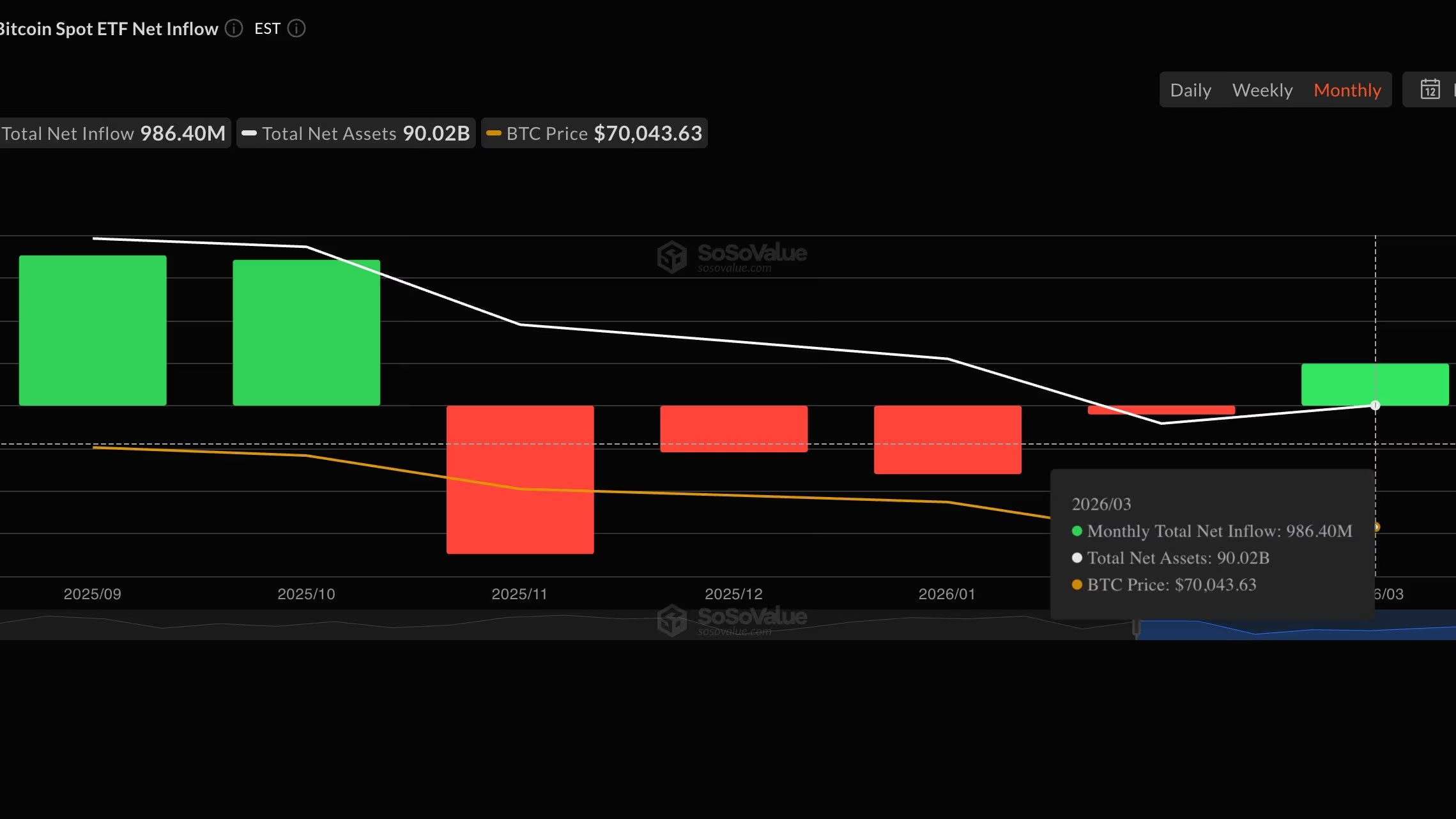 U.S.-listed bitcoin ETF flows per month (SoSoValue)
Bitcoin ETF flows had been on a downward trend for months following the peak in October. However, data from the last two weeks indicates a significant recovery, as noted by Joe Edwards, head of research at Enigma, especially with steady inflows into BlackRock’s IBIT fund, which is the largest of the bitcoin ETFs.
A sustained rebound in ETF demand could be crucial for bitcoin, he added. Many analysts believe that bitcoin’s next growth phase relies on access to larger institutional capital pools, such as ETF investors in brokerage accounts. Given this context, the recent period of outflows was concerning, Edwards stated.
The “positive news,” he mentioned, is that there are signs indicating the end of that phase.
IBIT has drawn nearly $1 billion in new inflows thus far in March, following a loss of over $3 billion between November and February, according to data from SoSoValue.
If this trend continues in the upcoming weeks, Edwards contended, it could bolster a broader bitcoin recovery into the second quarter.
