Disclaimer: Information found on CryptoreNews is those of writers quoted. It does not represent the opinions of CryptoreNews on whether to sell, buy or hold any investments. You are advised to conduct your own research before making any investment decisions. Use provided information at your own risk.
CryptoreNews covers fintech, blockchain and Bitcoin bringing you the latest crypto news and analyses on the future of money.


Bitcoin (BTC) has been attempting to surpass the $27,500 resistance level for the past week, but has not succeeded. A contributing factor to Bitcoin’s limited upward movement is the potential risk of a U.S. default, as the government faces challenges in securing approval for an increase in the debt ceiling from Congress.
Nevertheless, some analysts and investors contend that the U.S. debt ceiling impasse is merely a "performance" since, in the end, more funds will enter the markets.
The US Debt Ceiling discussions are all performance.
They're going to print the dollar into oblivion.
You need to own hard assets to safeguard your wealth. #Bitcoin is the fastest horse in the race.— MacroJack (@macrojack21) May 17, 2023
MacroJack highlights the connection between Bitcoin’s digital scarcity and the subsequent logical outcome: increased inflationary pressure. The stimulus measures, which involve raising the government debt limit, may initially appear beneficial as they prevent a default and promote greater economic activity. However, the unintended effects could lead to future budget limitations due to rising debt interest payments.
Bitcoin price rises while gold hits a 45-day low
Bitcoin’s rise above $27,000 occurred while gold declined by 2.5% from May 15 to May 18, reaching its lowest point in 45 days at $1,970. Concurrently, the U.S. Dollar Index (DYX), which assesses the currency against a selection of foreign currencies, achieved its highest level in two months on May 18, indicating that the U.S. dollar strengthened compared to its international counterparts.
This information should not be seen as a sign of confidence in the government’s capability to avert a shutdown, as a U.S. debt default would adversely affect the global economy. For example, Eurozone nations hold $1.54 trillion in U.S. Treasuries, followed by Japan with $1.1 trillion, China with $860 billion, and the United Kingdom with $668 billion.
Robust macroeconomic data accounts for the resilience of equity markets
While the global economy may weaken in the upcoming months, recent macroeconomic indicators have been largely positive, allowing the S&P 500 index to maintain modest gains in May, remaining just 13% below its all-time peak.
For instance, China’s retail sales increased by 18.4% year-over-year in April, while the Eurozone’s gross domestic product for the first quarter rose by 1.3% compared to the previous year. In the U.S., retail sales climbed by 0.5% year-over-year in April, slightly below expectations but not indicative of a recession.
Let’s examine Bitcoin derivatives metrics to gain a clearer understanding of how professional traders are positioned in the current market landscape.
Bitcoin margin and futures indicate bullish momentum
Related Posts
Margin markets offer insights into the positioning of professional traders as they enable investors to borrow cryptocurrency to amplify their positions.
For example, OKX provides a margin lending indicator based on the stablecoin/BTC ratio. Traders can enhance their exposure by borrowing stablecoins to purchase Bitcoin. Conversely, Bitcoin borrowers can only speculate on a decline in the price of the cryptocurrency.
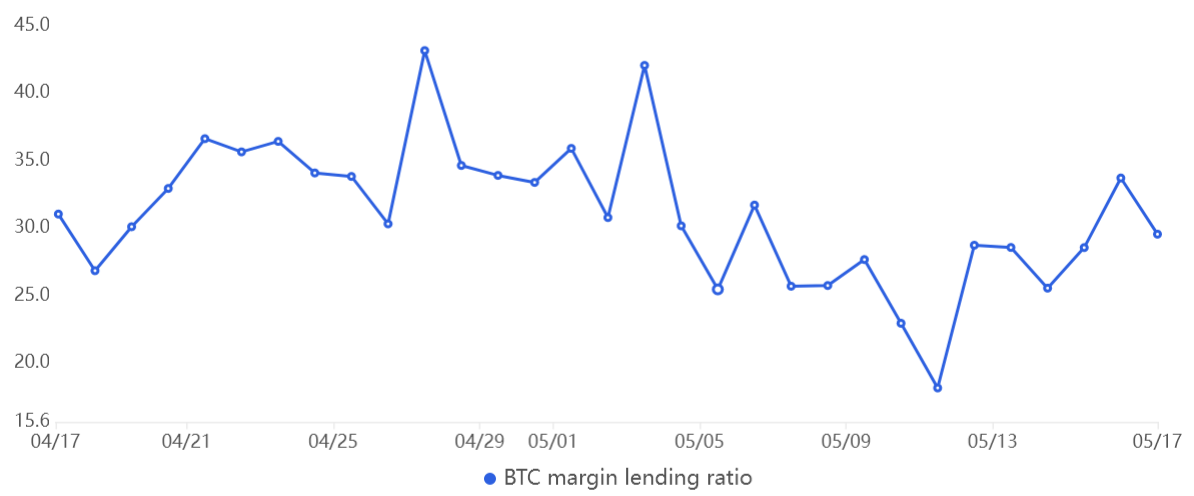 OKX stablecoin/BTC margin lending ratio. Source: OKX
The chart above illustrates that the margin lending ratio for OKX traders increased between May 12 and May 17. This data aligns with Bitcoin’s price recovery during that timeframe, although it is not concerning as the current margin lending ratio of 31 approaches its 30-day average.
Investors should also evaluate the BTC futures long-to-short metric, as it eliminates external factors that may have solely influenced the margin markets. There can be occasional methodological variations between exchanges, so readers should focus on changes rather than absolute values.
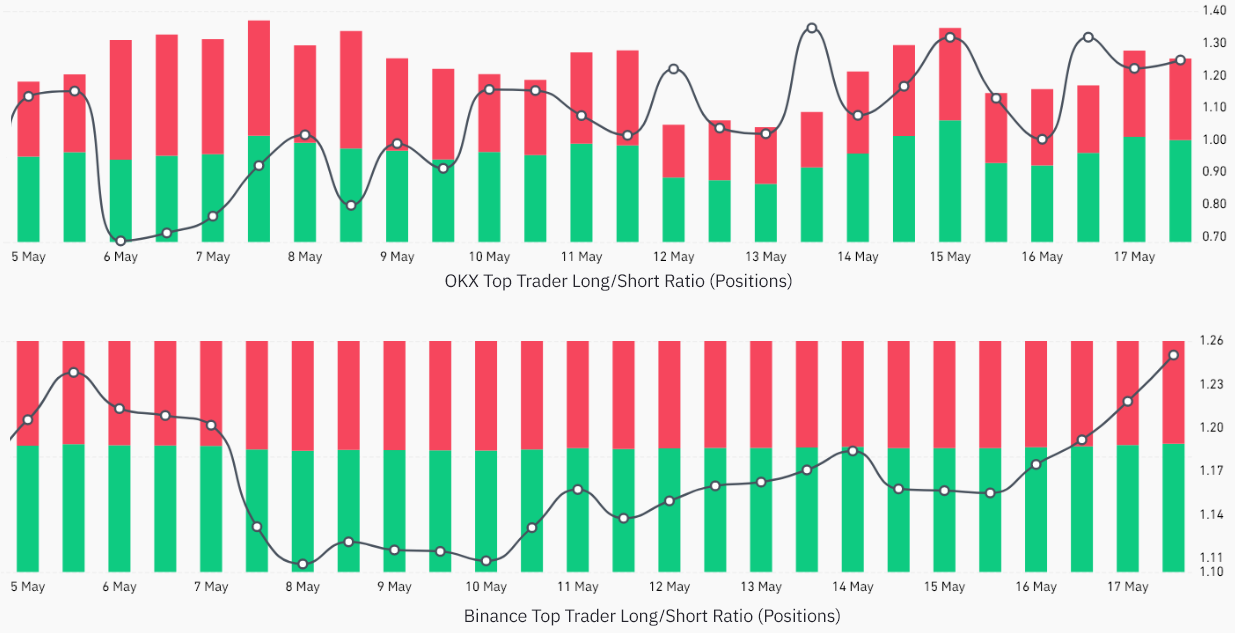 Exchanges’ top traders Bitcoin long-to-short ratio. Source: Coinglass
Despite Bitcoin experiencing an 8% decline since May 5, professional traders have recently increased their bullish positions to their highest level in two weeks, according to the long-to-short indicator.
For instance, the ratio for OKX rose from 1.08 on May 12 to 1.25 on May 18. Similarly, at the Binance exchange, the long-to-short ratio increased from 1.14 on May 12 to the current 1.25.
Related: Bitcoin price capitulation below $26K possible as Friday’s BTC options expiry looms
Bitcoin bulls are in a favorable position as there has been limited demand from short-sellers and no indication of excessive leverage from buyers. In other words, Bitcoin’s market structure appears bullish, suggesting a likelihood of a rally toward $28,000 if the U.S. debt ceiling deadlock persists.
This article is for informational purposes only and is not intended to be construed as legal or investment advice. The views, thoughts, and opinions expressed herein are solely those of the author and do not necessarily reflect or represent the views and opinions of Cointelegraph.
This article does not contain investment advice or recommendations. Every investment and trading decision carries risk, and readers should conduct their own research before making any decisions.
