Disclaimer: Information found on CryptoreNews is those of writers quoted. It does not represent the opinions of CryptoreNews on whether to sell, buy or hold any investments. You are advised to conduct your own research before making any investment decisions. Use provided information at your own risk.
CryptoreNews covers fintech, blockchain and Bitcoin bringing you the latest crypto news and analyses on the future of money.

Bitcoin futures open interest reaches highest point of 2023 as BTC trading volume hits annual low — What’s the reason?

Bitcoin traders are currently dissatisfied with the recent price movements, particularly due to the failure of the price to exceed the $30,500 threshold over the past month. This discontent is intensified by the delays and pending reviews of several applications for spot Bitcoin exchange-traded funds (ETFs) by regulators.
Notably, there has been a significant increase in the open interest for Bitcoin’s futures contracts, which likely signifies heightened demand from institutional traders. Conversely, activity in the derivatives markets has been subdued. This disparity in market behavior has resulted in mixed feelings among investors, complicating efforts to gain sufficient momentum for trading at or above the $31,000 mark.
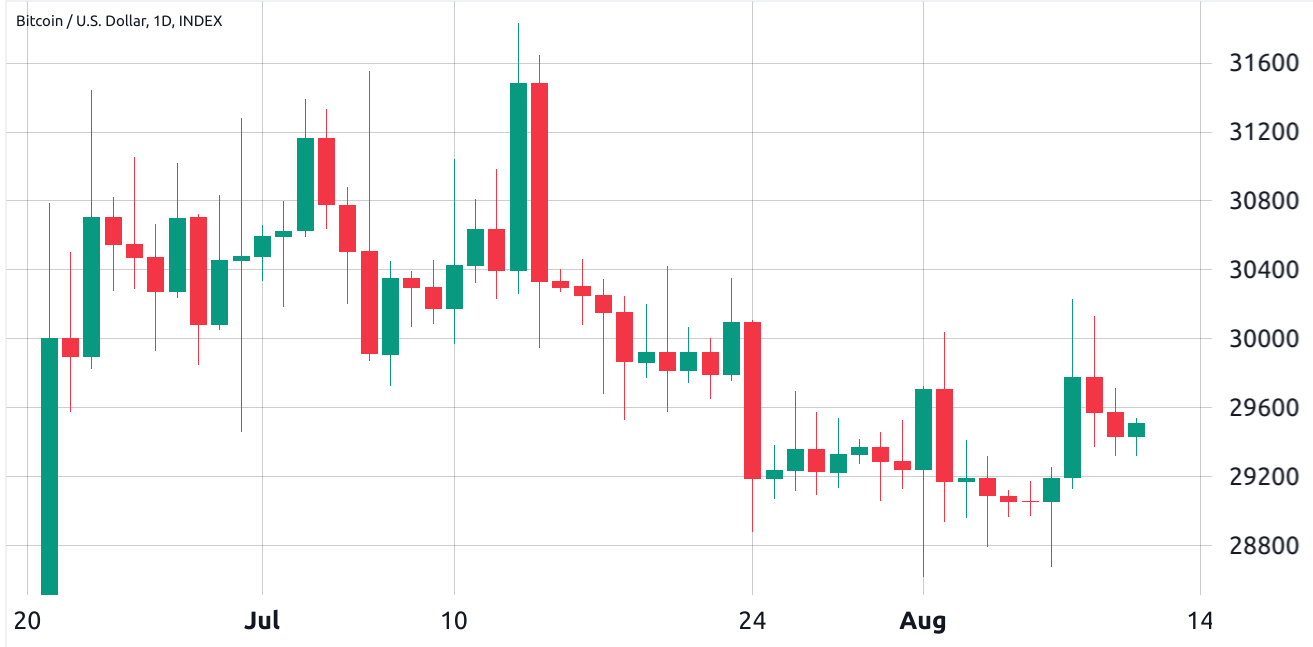 Bitcoin 1-day price index in USD. Source: TradingView
The primary reason cited by numerous analysts for the absence of buyers pushing Bitcoin (BTC) above the $30,000 level is the reports regarding the United States Department of Justice contemplating fraud charges against Binance. Furthermore, the U.S. Securities and Exchange Commission and the Commodity Futures Trading Commission are currently pursuing their own legal actions against the exchange and its founder, Changpeng “CZ” Zhao.
Macroeconomic factors partially clarify Bitcoin investors’ unease
From a broader perspective, there is an additional concern regarding the potential global economic downturn prompted by central banks’ attempts to manage inflation. The latest U.S. core Consumer Price Index figures, which exclude food and energy prices, recorded a 4.7% increase compared to the previous year, following a 4.8% rise in June. This information supports the ongoing efforts to tighten the economy, favoring investments in fixed-income, short-term bonds, and cash positions.
Consequently, despite the consensus indicating that the Federal Reserve will maintain the interest rate cap at 5.5% during the forthcoming September meeting, investors lack the incentive to expand their positions in risk-on markets. This hesitation arises from the increasing probability of a recession, as evidenced by the 1.4% year-over-year decline in eurozone retail sales in June and the U.S. ISM Manufacturing PMI registering at 46.4 in July, signaling a contraction.
When analyzing the price as an indicator, it becomes clear that Bitcoin investors are currently not exhibiting substantial confidence in the likelihood of a near-term approval for a spot ETF. Simultaneously, there is a marked sense of pessimism regarding the ongoing legal challenges faced by Binance and the potential consequences of these issues. Regardless of the specific cause, the overall trend of Bitcoin’s price over the past 50 days has been predominantly negative, with frequent approaches to the $29,000 support level.
Bitcoin derivatives are crucial for price direction
Related Posts
The Bitcoin futures market plays a vital role within the trading ecosystem. This market includes cryptocurrency-exclusive derivatives exchanges such as Binance, Bybit, and OKX, as well as established traditional financial platforms like the Chicago Mercantile Exchange. Essentially, futures contracts are financial agreements between two parties where actual BTC does not change hands. However, the allure of leverage allows this market to exceed the trading volumes typically observed in standard buying and selling.
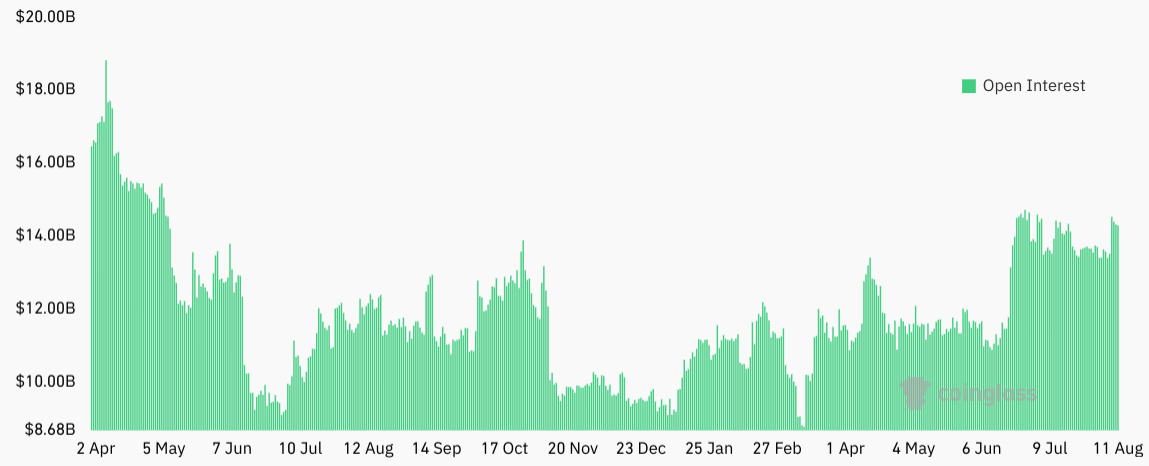 Bitcoin futures aggregate open interest in USD. Source: CoinGlass
Data from CoinGlass indicates that on Aug. 8, trading activity within this market surged to around $14.5 billion, nearing levels reminiscent of those seen in May 2022. It could be suggested that these contracts are consistently balanced between buyers (longs) and sellers (shorts). However, the growth of this market enables larger investors to engage and attracts traders employing various strategies, including “cash and carry” methods and miners seeking risk management.
Nonetheless, the increasing number of active contracts, as reflected in open interest, does not necessarily correlate with heightened trading activity within the futures market. In fact, the volume associated with Bitcoin futures has been on a downward trend over the past seven months.
Related: 5 things crypto must get right for mainstream adoption to happen
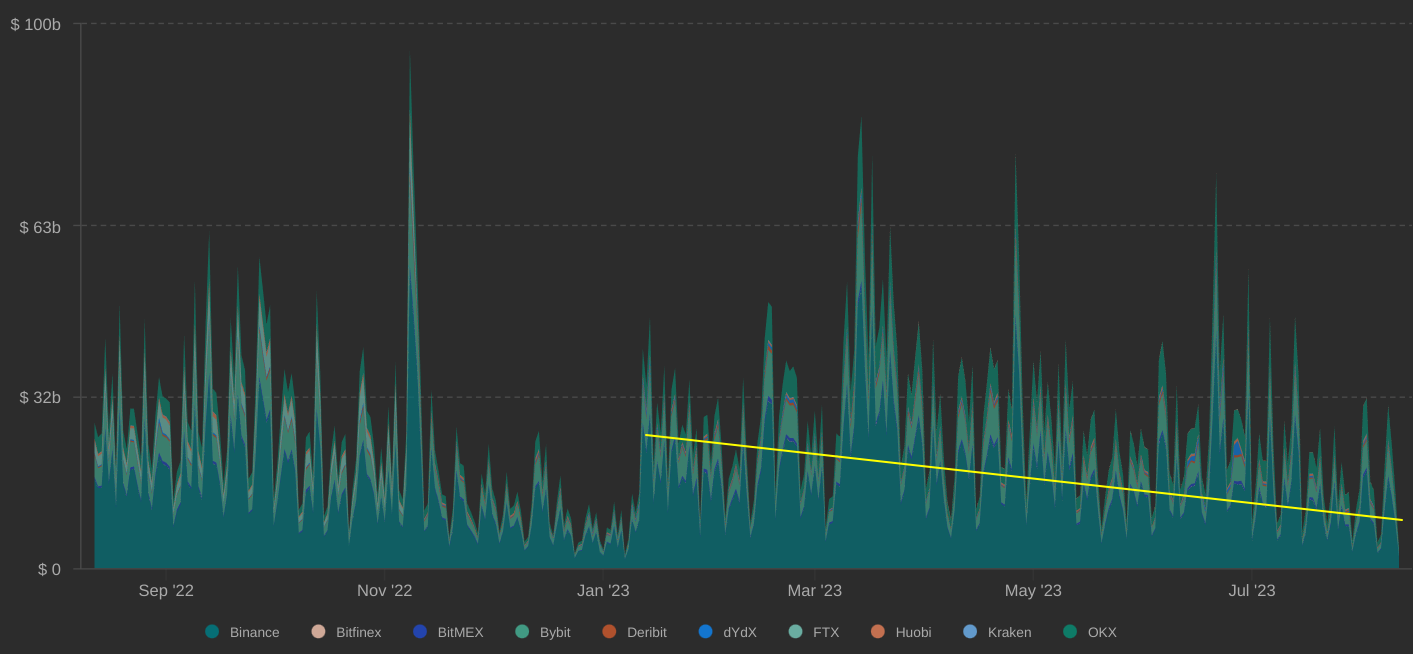 Bitcoin futures aggregate volume in USD. Source: Coinalyze
Recent data reveals that trading volumes for BTC futures have fallen to their lowest levels since December 2022, averaging below $7 billion per day. This indicates that traders are either fully hedged against risks and are not inclined to make further moves at the current price levels or have redirected their attention to other markets with greater volatility or better prospects for significant changes.
The situation can be summarized as follows: Until there is clear confirmation regarding the ETF decision and more defined regulations concerning exchanges like Binance and Coinbase due to their conflicts with regulators, traders utilizing Bitcoin derivatives appear to lack the motivation to engage in additional trades. These critical events, combined with the uncertainty in the broader economy, help explain the diminished trading activities, even as more individuals monitor the situation and the price remains around $29,500.
This article is for general information purposes and is not intended to be and should not be taken as legal or investment advice. The views, thoughts, and opinions expressed here are the author’s alone and do not necessarily reflect or represent the views and opinions of Cointelegraph.
