Disclaimer: Information found on CryptoreNews is those of writers quoted. It does not represent the opinions of CryptoreNews on whether to sell, buy or hold any investments. You are advised to conduct your own research before making any investment decisions. Use provided information at your own risk.
CryptoreNews covers fintech, blockchain and Bitcoin bringing you the latest crypto news and analyses on the future of money.

Bitcoin Exchange Reserves Reach Lowest Level in Six Years Due to Increased ETF Adoption and Investor Withdrawals

Bitcoin Exchange Reserves Hit Six-Year Low Amid Rising ETF Adoption and Investor Withdrawals
Bitcoin exchange reserves have decreased to 2.3 million BTC, representing their lowest point since November 2018, as reported by CryptoQuant. This decline is attributed to various factors, including the increase in Bitcoin’s price, substantial withdrawals by investors, and the rising acceptance of Bitcoin exchange-traded funds (ETFs) as a substitute for conventional exchanges.
According to Crypto Briefing, Bitcoin withdrawals from exchanges are occurring at an impressive rate, with $2.7 billion worth of BTC being withdrawn weekly. The total monthly outflow has reached around $7.58 billion, indicating a change in how investors are handling their Bitcoin assets.
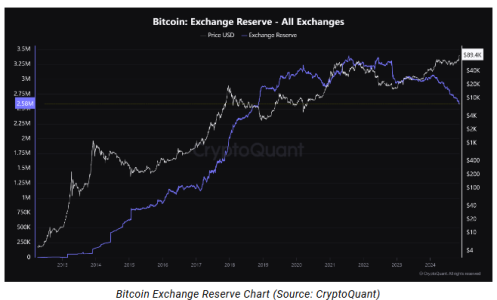
Why Are Bitcoin Exchange Reserves Declining?
The consistent reduction in Bitcoin reserves on exchanges is driven by several interconnected factors:
1. Rising Bitcoin Prices
As Bitcoin’s price has surged—currently approaching the $100,000 mark—investors are increasingly moving their BTC from exchanges to cold wallets for long-term storage. This trend aligns with expectations of ongoing price appreciation, as holders secure their assets in anticipation of future profits.
2. Increased ETF Adoption
The introduction and swift uptake of spot Bitcoin ETFs have offered investors a regulated and convenient method to gain exposure to Bitcoin. Rather than holding Bitcoin directly on exchanges, many investors are opting for ETFs, which provide simpler custody options and are viewed as more secure.
3. Shift Toward Decentralized Storage
The rise of self-custody solutions and hardware wallets has enabled more investors to keep Bitcoin outside centralized exchanges. This transition reflects a broader movement towards decentralization and a decreased dependence on third-party platforms.
4. Regulatory Concerns
Uncertainty regarding exchange regulations has prompted some investors to withdraw their assets. The collapse of significant platforms like FTX has also raised awareness of counterparty risk, leading to a preference for self-custody.
Key Data Points
| Metric | Value |
|---|---|
| Current BTC Reserves | 2.3 million (lowest since Nov. 2018) |
| Weekly Withdrawals | $2.7 billion worth of BTC |
| Monthly Outflow | $7.58 billion |
Implications for the Bitcoin Market
The reduction in exchange reserves carries significant implications for the wider Bitcoin market:
1. Reduced Selling Pressure
With fewer Bitcoin available on exchanges, the chances of large-scale sell-offs diminish. This decreased supply on trading platforms supports price stability and creates upward pressure as demand increases.
Related Posts
2. Market Maturation
The growing adoption of Bitcoin ETFs and self-custody solutions signifies a maturing market. Investors are selecting diversified and secure methods to manage their holdings, moving beyond traditional exchange-based approaches.
3. Impact on Liquidity
While the drop in exchange reserves indicates strong holding sentiment, it may also lead to reduced liquidity. Lower liquidity can result in increased price volatility, especially during times of heightened trading activity.
Historical Context: Bitcoin Exchange Reserves
The current trend resembles earlier periods when Bitcoin reserves on exchanges saw significant declines:
- 2018: Exchange reserves peaked as the crypto market faced a downturn, with investors liquidating assets during the bear market.
- 2020-2021: Reserves began to decrease as the market rebounded and long-term holding increased, spurred by institutional interest.
- 2024: The ongoing reduction in reserves is unprecedented, reflecting the combined effects of price increases, ETF adoption, and a preference for decentralized storage.
Analyst Perspectives
<pIndustry analysts interpret the decrease in Bitcoin exchange reserves as a positive indicator:
- James Check, a market strategist, remarked:
“The significant drop in Bitcoin held on exchanges is a sign of strong conviction among investors. It suggests that holders are confident in Bitcoin’s long-term value.”
- Sarah Lane, a blockchain analyst, emphasized the influence of ETFs:
“Spot Bitcoin ETFs are transforming how investors engage with Bitcoin. As ETFs become more accessible, we’re likely to see further declines in exchange reserves.”
How This Affects Investors
For investors, the reduction in exchange reserves highlights the necessity of understanding market dynamics and selecting appropriate storage solutions:
1. Consider Self-Custody
If you’re holding Bitcoin for the long term, consider moving it to a secure hardware wallet or decentralized custody solution to mitigate counterparty risk.
2. Monitor ETF Trends
The expansion of Bitcoin ETFs presents a regulated alternative to direct holdings. Assess whether ETFs align with your investment objectives, particularly if you’re seeking a more straightforward option.
3. Stay Informed
Keep an eye on exchange reserve trends, as they provide insights into market sentiment and potential price fluctuations.
Conclusion
The persistent decline in Bitcoin exchange reserves, now at a six-year low of 2.3 million BTC, reflects a mix of rising prices, increased ETF adoption, and a shift towards self-custody. This trend underscores the changing preferences of Bitcoin investors and highlights the growing sophistication of the cryptocurrency market.
For Bitcoin holders, the emphasis should remain on long-term strategies and securing assets in ways that correspond with their risk tolerance and investment objectives.
For further insights into Bitcoin’s market dynamics, explore our article on how ETFs and self-custody are reshaping crypto investment.
