Disclaimer: Information found on CryptoreNews is those of writers quoted. It does not represent the opinions of CryptoreNews on whether to sell, buy or hold any investments. You are advised to conduct your own research before making any investment decisions. Use provided information at your own risk.
CryptoreNews covers fintech, blockchain and Bitcoin bringing you the latest crypto news and analyses on the future of money.


An appellate court in the United States instructed the Securities and Exchange Commission in August to reevaluate its rejection of Grayscale’s proposal for a Bitcoin exchange-traded fund (ETF). A lesser-known outcome of this ruling is that it could potentially allow for $600 billion in fresh capital to flow into the cryptocurrency market.
ETFs offer investors a regulated means to gain exposure to various asset classes, including Bitcoin (BTC). The endorsement of a Bitcoin ETF could make investment in the cryptocurrency sector more accessible, similar to how the iShares MSCI Brazil ETF and the VanEck Brazil Small-Cap ETF have made investing in the Brazilian market more inclusive.
Despite some challenges, market analysts predict the possibility of Bitcoin ETF approval by early 2024. A Bitcoin ETF could unleash an estimated $600 billion in new demand, as noted in a September report by analysts at Bernstein, which would more than double the current fully diluted market cap of approximately $550 billion for Bitcoin.
Related: 10 years later, still no Bitcoin ETF — but who cares?
However, these forecasts are speculative, with the actual results hinging on various factors such as market conditions, corporate strategies, and regulatory actions. The SEC has notably postponed its decision on Cathie Wood’s Ark 21Shares Bitcoin ETF application multiple times. In August, Wood indicated her anticipation of these delays, expressing her belief that the SEC would approve several Bitcoin ETFs at once. Yet, on Sept. 26, the SEC further extended the decision timeline to Jan. 10.
SEC Chair Gary Gensler’s postponements and rejections of Bitcoin ETF applications have attracted criticism and heightened investor discontent. A bipartisan coalition of lawmakers urged Gensler this month to grant prompt approval for an ETF, contending that following the Grayscale court ruling, there is no justification for denying spot crypto ETFs, which they argue would bolster investor protections. This congressional pressure adds complexity to the path toward Bitcoin ETF approval, contributing to the uncertainty as the ARK 21Shares Bitcoin ETF decision date nears.
Alongside the SEC’s considerations regarding Bitcoin ETFs, significant entities in the crypto sector are actively advocating for new regulations. Coinbase, for example, is leading one of the most substantial lobbying efforts in the crypto industry, seeking to gain support from lawmakers for the establishment of new rules. As we continue to monitor these developments, it becomes increasingly evident that the future of crypto regulations is a contentious issue.
Recent events indicate the possibility of further delays in the overall approval of Bitcoin ETFs. James Seyffart, a Bloomberg ETF analyst, speculated that the SEC’s recent actions may have diminished the likelihood of ETF approval in 2023. Filings from major firms such as BlackRock, Bitwise, and Wisdomtree are scheduled for review in the third week of October. However, the SEC’s recent decisions regarding ARK 21Shares have led to speculation that other filings set for review in mid-October — including those from VanEck, Invesco, Fidelity, and Valkyrie — might also face delays. Thus, it remains uncertain whether there will be any significant updates on these applications in the near future.
To gain a clearer understanding of the implications of these ETFs, it is essential to explore the concept of assets under management (AUM), which signifies the total market value of the financial assets managed by an entity or adviser on behalf of their clients. This vital metric in the investment landscape serves as a performance indicator. Consider the following table for additional insights.
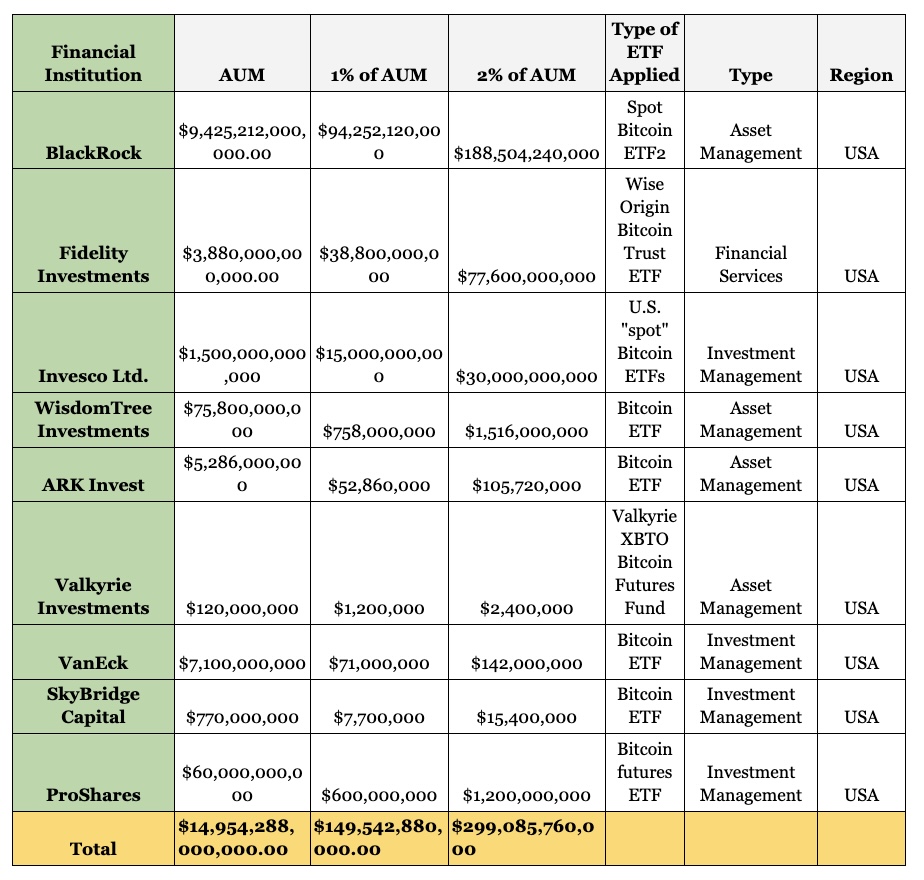
Financial institutions with higher AUM, such as BlackRock, could generate increased revenue from management fees if they successfully launch a Bitcoin ETF.
As competition in the Bitcoin ETF market escalates, it may lead to a reduction in management fees, affecting revenue.
Related Posts
Investment firms impose these fees for managing funds, typically ranging from 0.2% to 2%. A trend of declining management fees has been observed recently due to heightened competition, cost-efficient investment strategies, and investor demand for transparency.
How does Grayscale generate revenue from ETFs?
Grayscale derives its revenue from its exchange-traded funds, including the proposed Bitcoin ETF, through management fees. These fees are calculated as a percentage of the total AUM.
For its existing product, the Grayscale Bitcoin Trust (GBTC), the company charges an annual fee of 2%.
Let’s illustrate how this operates with some actual figures. If we consider the reported $16.2 billion in assets within the Bitcoin Trust and apply the 2% management fee, it implies that Grayscale would earn $324 million annually in management fees from the Bitcoin Trust alone.
If Grayscale succeeds in converting GBTC to a Bitcoin ETF, the AUM could potentially rise due to the attractiveness of ETFs to institutional investors, thereby increasing management fees. However, Grayscale intends to reduce fees upon conversion to an ETF, although specific amounts have not been disclosed.
Related: BlackRock’s misguided effort to create ‘Crypto for Dummies’
The conversion is contingent upon SEC approval. Grayscale recently achieved a legal victory against the SEC, paving the way for spot Bitcoin ETF approval. Concurrently, the SEC extended its decision-making timeline on ARK 21Shares Bitcoin ETF.
Approval of a Bitcoin ETF would represent a significant advancement toward mainstream acceptance of crypto. The court ruling challenges the SEC’s exclusive authority over digital assets, indicating that other entities such as courts and Congress can influence crypto regulations. This could result in broader acceptance of crypto, making Bitcoin investment more accessible and regulated, thereby attracting additional capital to the crypto market.
The potential approval could also have geopolitical ramifications, establishing a precedent for other nations and accelerating global cryptocurrency adoption.
Of course, numerous obstacles remain, despite the court’s ruling. However, it marked progress, and rewards await those willing to embrace change.
Constantin Kogan is a co-founder of BullPerks and GamesPad, a partner at BitBull Capital, the founder of Adwivo, and a former managing director at Wave Financial. He holds a Ph.D. in sociology from National Pedagogical Dragomanov University in Kyiv, a master’s degree in education, and is fluent in five languages (English, Russian, Ukrainian, French, and Hebrew). He has been an enthusiast and investor in blockchain technology since 2012.
This article is intended for general informational purposes and should not be construed as legal or investment advice. The views, thoughts, and opinions expressed herein are solely those of the author and do not necessarily reflect or represent the views and opinions of Cointelegraph.
