Disclaimer: Information found on CryptoreNews is those of writers quoted. It does not represent the opinions of CryptoreNews on whether to sell, buy or hold any investments. You are advised to conduct your own research before making any investment decisions. Use provided information at your own risk.
CryptoreNews covers fintech, blockchain and Bitcoin bringing you the latest crypto news and analyses on the future of money.

Bitcoin ETF submissions: Which entities are applying and the anticipated timeline for SEC decisions

The competition to introduce the first spot-traded Bitcoin (BTC) exchange-traded fund (ETF) in the United States has attracted significant financial entities such as BlackRock, Fidelity, and VanEck.
Although the U.S. Securities and Exchange Commission (SEC) initially approved a Bitcoin-linked Futures ETF in October 2021, the current submissions pertain to spot Bitcoin ETFs. Following Grayscale’s recent legal success against the SEC regarding its spot Bitcoin ETF application, many now consider the approval of these investment vehicles more probable.
BlackRock’s involvement — the largest asset manager globally with over $8 trillion in assets under management — has encouraged several other firms to refile for a spot Bitcoin ETF.
Many of these asset managers were compelled to either retract their spot Bitcoin ETF applications or risk rejection due to the SEC’s concerns regarding a spot-derived ETF. Below are the primary Bitcoin ETF applicants:
- BlackRock: BlackRock submitted its application for a spot Bitcoin ETF on June 15, with Coinbase serving as the crypto custodian and spot market data provider, while BNY Mellon acts as its cash custodian. This filing surprised both the crypto and traditional finance sectors, especially since the firm’s CEO, Larry Fink, had previously labeled BTC as an index for money laundering. On July 15, the SEC officially accepted BlackRock’s spot Bitcoin ETF application for review.
- WisdomTree: The New York-based asset manager initially filed for a spot Bitcoin ETF in the U.S. on December 8, 2021, which the SEC rejected in 2022. The agency stated that the ETF did not meet investor protection standards; however, following BlackRock’s entry into the spot Bitcoin ETF competition, WisdomTree refiled with the SEC on July 19.
- Valkyrie Investments: Valkyrie filed its first application for a spot Bitcoin ETF in January 2021 but, like many other asset managers, faced rejection from the SEC. With renewed interest in a spot Bitcoin ETF, Valkyrie refiled its application on June 21. The ETF would reference the Chicago Mercantile Exchange’s (CME) Bitcoin price and trade on NYSE Arca, with Xapo as the crypto custodian.
- ARK Invest: ARK submitted an application for its ARK 21Shares Bitcoin ETF in June 2021. ARK Invest has collaborated with Swiss ETF provider 21Shares to launch the fund, which will debut on the Chicago Board Options Exchange (Cboe) BZX Exchange under the ticker symbol ARKB if approved.
- VanEck: VanEck is among the earliest Bitcoin ETF applicants, having made its first filing in 2018. The asset manager withdrew its application in September 2019 and attempted again with the SEC in December 2020, with shares of the trust intended to trade on the Cboe BZX Exchange. The firm submitted a new application in July 2023.
- Fidelity/Wise Origin: Fidelity Investments first sought approval for a spot Bitcoin ETF in 2021 and refiled for its Wise Origin Bitcoin Trust on July 19, 2023. The Wise Origin Bitcoin Trust would have Fidelity Service Company as the administrator, while Fidelity Digital Assets will serve as the BTC custodian.
- Invesco Galaxy Bitcoin ETF: Invesco initially filed for its Invesco Galaxy Bitcoin ETF in partnership with Galaxy Digital on September 22, 2021. The joint venture refiled its application in July. This Bitcoin ETF would be “physically backed” by Bitcoin, with Invesco Capital Management as the sponsor.
- Bitwise: Bitwise first applied for a spot Bitcoin ETF in October 2021 but was rejected by the SEC. The asset manager refiled its application in August 2023.
- GlobalX: Fund manager GlobalX entered the ETF competition in 2021 alongside several other financial giants by filing for a spot Bitcoin ETF. The firm refiled its application in August 2023, becoming the ninth applicant, and named Coinbase as its surveillance-sharing partner.
In light of Grayscale’s recent legal success and the surge in new applications, ETF analysts at Bloomberg have increased their projected approval likelihood for a spot Bitcoin ETF to 75% from 65%.
NEW: @JSeyff & I are raising our odds to 75% for spot bitcoin ETFs launching this year (95% by the end of ’24). While we considered Grayscale’s win in our previous 65% odds, the unanimous and decisive nature of the ruling exceeded expectations and leaves the SEC with “very little wiggle room” via @NYCStein pic.twitter.com/IyEGmWjuHa
— Eric Balchunas (@EricBalchunas) August 30, 2023
As anticipated, the SEC has postponed its decision regarding all seven applicants. Analysts had suggested that the SEC might not reach a conclusion on an ETF until early 2024, as the final deadlines approach (listed below).
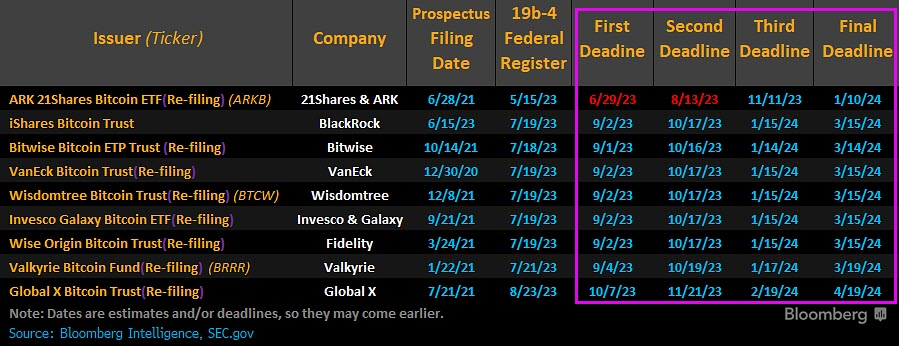 Spot Bitcoin ETF decision deadlines. Source: Bloomberg/Twitter
John Glover, chief investment officer at crypto lending platform Ledn, informed Cointelegraph that the ARK 21Shares “verdict scheduled for January 10 will be the first real indicator of whether the SEC is prepared to begin approving these types of applications. The final deadline will arrive at that time, necessitating a decision one way or another.”
Why has the SEC rejected spot Bitcoin ETFs in the past?
In its earlier rejection of VanEck’s spot Bitcoin ETF, the SEC asserted that the Bitcoin market lacks the size and maturity necessary to support ETF market demand. The commission also noted that price volatility and insufficient trading surveillance could render the market susceptible to fraud and manipulation.
However, with BlackRock’s entry, market observers have begun to believe that the likelihood of a spot Bitcoin ETF receiving approval is favorable.
Recent: AI could revolutionize human resources, but there are risks
One significant factor hindering the approval of a spot ETF is the nature of the fund.
A futures ETF is based on futures contracts rather than the digital asset itself, which is a crucial distinction. The futures markets are already heavily regulated to mitigate market manipulation, making it easier for the SEC to approve such ETFs.
Central to these spot ETF rejections is the issuer’s obligation to establish a “surveillance-sharing agreement” with a sufficiently large and regulated Bitcoin-related market. Such agreements are essential for ensuring that the SEC can conduct thorough investigations in the event of any market irregularities.
Related Posts
A Bitfinex Alpha analyst stated to Cointelegraph that one of the primary concerns behind the rejection of spot Bitcoin ETFs is the regulator’s capacity to monitor and continuously ensure asset safety and custody. However, for this to occur, the U.S. requires more regulatory and legal infrastructure before the “SEC or other involved parties would be comfortable allowing an ETF provider to manage it.”
“If not, then the entire purpose of an ETF (which is to avoid dealing with digital asset wallets or crypto exchanges) is undermined. Therefore, it would not be accurate to claim that spot Bitcoin ETFs do not present manipulation concerns in the SEC’s perspective. The ProShares Bitcoin ETF disapproval from 2018 illustrates this very point. Another concern regarding the document’s content was the Bitcoin market’s capacity to handle the volume that would be introduced through a spot ETF,” the analyst added.
The SEC primarily focuses on the robustness of trading venues. The regulator oversees futures exchanges such as the CME and the Cboe, and any futures ETFs will be limited to trading exclusively on those regulated platforms. In contrast, there are no SEC-regulated spot exchanges.
Nonetheless, not everyone concurs with the SEC’s assumptions regarding the vulnerabilities of the spot crypto ETF market. James Koutoulas, the founder of a futures-focused hedge fund Typhon, remarked to Cointelegraph:
“I can confirm that crypto futures are significantly inferior to spot in terms of tracking error. The notion that a U.S. regulator can provide adequate ‘surveillance’ against market manipulation in a global 12-figure market is unrealistic. So, honestly, it likely comes down to shifting responsibility to the CFTC rather than maintaining accountability. Given the SEC has an ‘investor protection’ mandate.”
He further stated that by persistently rejecting the simplest products like a BTC ETF, the “SEC continues to drive demand for crypto offshore and to unregulated entities. While a BTC ETF may not be flawless, it is considerably safer than purchasing BTC through Gensler’s family friend SBF [Sam Bankman-Fried] at FTX.”
Richard Gardener, CEO of tech infrastructure firm Modulus, believes that futures ETFs have long been perceived as more acceptable to regulators and that the decision regarding a spot ETF is a matter of when, not if.
He conveyed to Cointelegraph that a spot BTC ETF is “on the horizon, sooner rather than later, and the substantial investment from major players like BlackRock and Fidelity indicates this. As long as the major players are pursuing it, the industry is viewed as viable in the long term, despite any short-term challenges. If the SEC continues to hesitate, politicians will be compelled to act and formulate their own solutions to the crypto dilemma.”
Ether futures ETF have more chances of approval
While crypto enthusiasts would prefer to see spot ETFs, which would validate crypto as an asset class, U.S. regulators appear more inclined to endorse futures ETFs.
Bloomberg analysts have forecasted that the likelihood of approval for an Ether (ETH) futures-derived ETF exceeds 90%, with nearly a dozen institutions awaiting approval.
Magazine: How to protect your crypto in a volatile market: Bitcoin OGs and experts weigh in
Financial media reports have suggested a strong possibility of the SEC approving an Ether futures-based ETF as early as October.
This is not surprising to us; we had indicated they would approve Ether Futures early in the race. It’s gratifying to be validated. Now, what does it imply for spot? It’s hard to say beyond it demonstrates that their views/policy/tolerance can shift. https://t.co/JXCxNUpj2U
— Eric Balchunas (@EricBalchunas) August 17, 2023
Ken Timsit, managing director at blockchain startup accelerator Cronos Labs, informed Cointelegraph that the “thesis supporting futures is that futures would allow investors to signal expected price movements, which in turn would help mitigate the volatility of Bitcoin and Ethereum prices and counterbalance the significant price fluctuations we have observed recently.”
Doug Schwenk, CEO of Digital Asset Research, stated to Cointelegraph that the “near-term psychological impact would likely provide a boost to crypto markets as further evidence that regulators remain open to evolving the listed space and continued optimism for the elusive spot ETF.”
Collect this article as an NFT to preserve this moment in history and show your support for independent journalism in the crypto space.
