Disclaimer: Information found on CryptoreNews is those of writers quoted. It does not represent the opinions of CryptoreNews on whether to sell, buy or hold any investments. You are advised to conduct your own research before making any investment decisions. Use provided information at your own risk.
CryptoreNews covers fintech, blockchain and Bitcoin bringing you the latest crypto news and analyses on the future of money.


Bitcoin saw a 5% rise after testing the $25,000 support level on September 11. However, this breakout rally does not definitively signify a triumph for bulls. To contextualize today’s price movement, Bitcoin (BTC) has experienced a 15% drop since July. In comparison, the S&P 500 index and gold have remained relatively stable during this timeframe.
This underperformance highlights Bitcoin’s difficulty in gaining traction, despite notable catalysts such as MicroStrategy’s intention to purchase an additional $750 million in BTC and the numerous requests for Bitcoin spot exchange-traded funds (ETFs) from major asset management firms. Nevertheless, Bitcoin derivatives indicate that bulls are optimistic that $25,000 represents a bottom and allows for potential price increases.
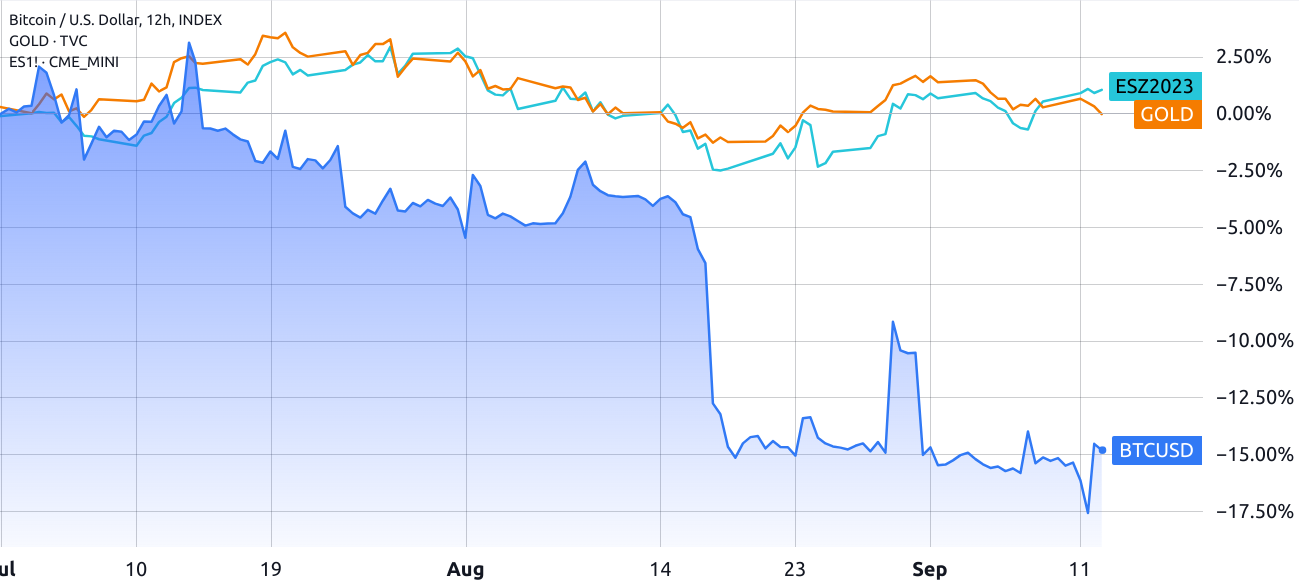 Bitcoin/USD compared to gold and S&P 500 futures, 12-hour time frame. Source: TradingView
Some believe that Bitcoin’s key drivers for 2024 remain intact, particularly the potential for a spot ETF and the decrease in new supply following the April 2024 halving. Furthermore, some immediate risks in the cryptocurrency markets have lessened after the United States Securities and Exchange Commission faced partial setbacks in three separate cases involving Grayscale, Ripple, and the decentralized exchange Uniswap.
Conversely, bears have their own advantages, including ongoing legal challenges against major exchanges like Binance and Coinbase. Additionally, the financial difficulties of Digital Currency Group, following the bankruptcy of one of its subsidiaries in January 2023, pose a concern. The group is encumbered with debts exceeding $3.5 billion, which could lead to the liquidation of funds managed by Grayscale, including the Grayscale Bitcoin Trust.
An examination of derivatives metrics will provide further insight into how professional traders are positioned under the current market conditions.
Bitcoin futures and options metrics remained stable despite the correction
Bitcoin monthly futures generally trade at a slight premium to spot markets, suggesting that sellers are demanding more to postpone settlement. Consequently, BTC futures contracts typically trade at a 5 to 10% annualized premium — a scenario known as contango, which is not exclusive to crypto markets.
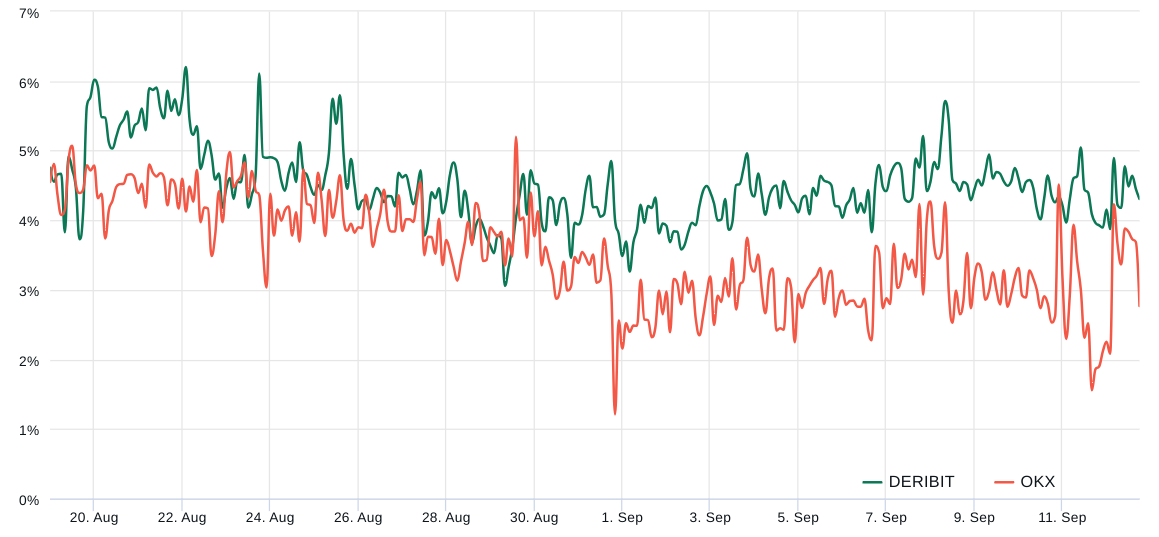 Bitcoin 1-month futures annualized premium. Source: Laevitas
Related Posts
It is important to note that the demand for leveraged BTC long and short positions through futures contracts did not significantly influence the decline below the $25,000 level on September 11. However, the BTC futures premium continues to remain below the 5% neutral threshold. This metric stays in the neutral-to-bearish range, indicating a lack of interest in leveraged long positions.
To further assess market sentiment, examining the options markets is beneficial, as the 25% delta skew can evaluate whether the retest of the $25,000 level has made investors more optimistic. In essence, if traders anticipate a decline in Bitcoin’s price, the skew metric will rise above 7%, while periods of enthusiasm typically exhibit a -7% skew.
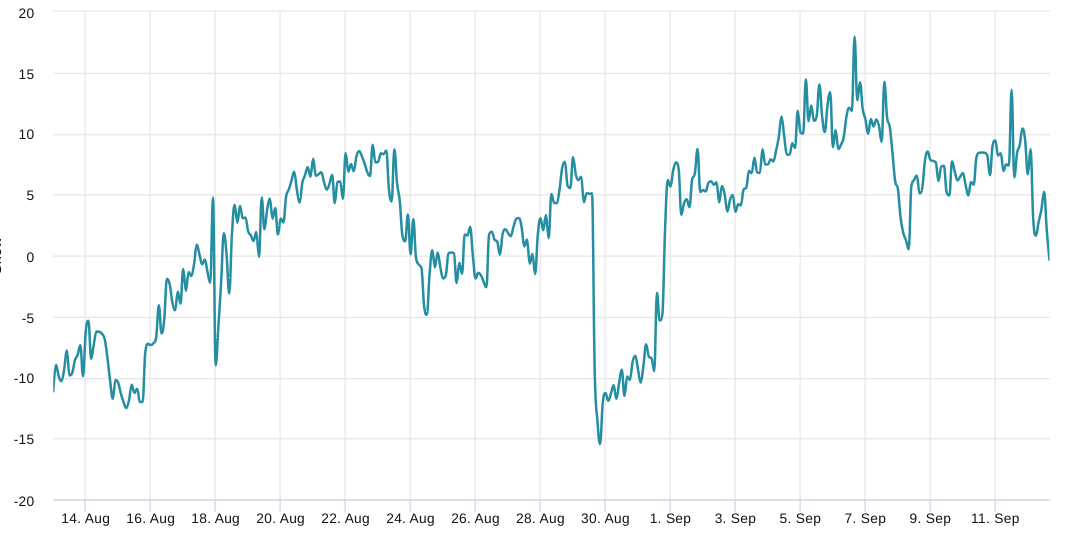 Bitcoin 30-day options 25% delta skew. Source: Laevitas
The situation experienced a significant change on September 11, as the 25% delta skew metric — which had previously indicated a 9% premium on protective put options, suggesting investors were anticipating a correction — has now stabilized at zero. This reflects balanced pricing between call and put options, indicating equal probabilities for both bullish and bearish price movements.
Macroeconomic uncertainty favors bears, but BTC bulls remain optimistic
In light of the uncertainty surrounding macroeconomic factors, particularly with the upcoming release of the Consumer Price Index report on September 13 and retail sales data on September 14, it is probable that crypto traders will exercise caution and prefer a “return to the mean.” In this context, the mean signifies the prevailing trading range of $25,500 to $26,200 observed over the past few weeks.
However, from a bullish standpoint, the resilience of derivatives markets during the dip below $25,000 is a positive indicator. In other words, if bears had strong conviction, one would expect a greater demand for put options and a negative BTC futures premium, referred to as “backwardation.”
Ultimately, both bulls and bears possess significant triggers that could affect Bitcoin’s price, but predicting the timing of events such as court rulings and ETF decisions is complex. This dual uncertainty likely accounts for the resilience of derivatives metrics, as both sides remain cautious to avoid excessive exposure.
This article is for informational purposes only and is not intended to be and should not be construed as legal or investment advice. The views, thoughts, and opinions expressed herein are solely those of the author and do not necessarily reflect or represent the views and opinions of Cointelegraph.
