Disclaimer: Information found on CryptoreNews is those of writers quoted. It does not represent the opinions of CryptoreNews on whether to sell, buy or hold any investments. You are advised to conduct your own research before making any investment decisions. Use provided information at your own risk.
CryptoreNews covers fintech, blockchain and Bitcoin bringing you the latest crypto news and analyses on the future of money.

Bitcoin continues to outperform the US dollar amid rising egg prices, according to Federal Reserve data.

According to the U.S. Federal Reserve, Bitcoin (BTC) is outpacing inflation compared to the United States dollar, albeit unintentionally.
In a blog entry initially published in June 2022 and subsequently revised, the St. Louis Fed examines the cost of a dozen eggs when purchased with BTC versus dollars, yielding unexpected findings.
Bitcoin vs. U.S. dollar: “Eggflation” remains unchanged
While Bitcoin holders likely have more advantageous uses for their BTC than buying eggs, this specific topic is the focus of a dedicated Fed blog post that aims to illustrate Bitcoin’s relatively weak purchasing power against the dollar.
To illustrate this, the anonymous author tracked the price of a dozen eggs in both BTC and U.S. dollars since January 2021.
“The price varies significantly, ranging from 2829 to 6086 [satoshis], which is considerably more than the fluctuations observed in the U.S. dollar price,” the post concludes.
“Additionally, one must factor in a bitcoin transaction fee, which has recently averaged around $2 but can occasionally exceed $50. Ideally, if you were making this purchase with bitcoin, you would want to buy a significantly larger quantity of eggs.”
Nonetheless, the included charts indicate that since reaching a peak in both currencies in December 2022, the number of satoshis needed to buy the same dozen eggs has decreased more than the equivalent amount in U.S. dollars.
As of August 2023, the latest month for which Fed data is available, BTC holders require 70% fewer sats for the purchase, compared to 58% fewer dollars.
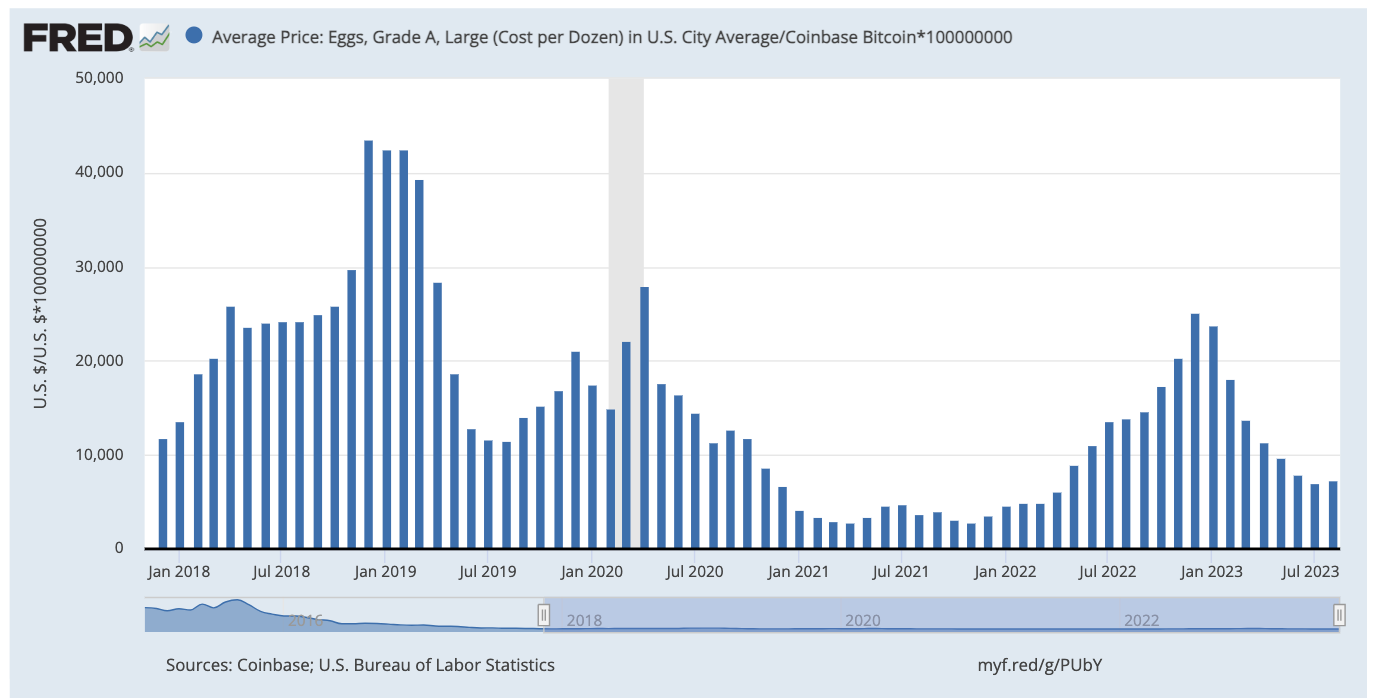 Average price of a dozen eggs in satoshis chart (screenshot). Source: St. Louis Fed
Related Posts
Compared to the beginning of 2021, the price of eggs has risen for both currencies — 39% for USD and 73% for BTC. However, this arbitrary timeframe comparison is less informative.
At that time, BTC/USD was trading at nearly the same levels as it is now, while the U.S. Consumer Price Index (CPI) year-on-year increase was below the Fed’s own 2% target. With that situation now behind us, only a long-term analysis offers genuine insight into Bitcoin’s performance.
The price of eggs is significantly lower than it was during Bitcoin’s last pre-halving year in 2019. The “eggflation” observed in 2023 is a minor fluctuation in the broader context.
In dollar terms, the trend shows substantial price increases — for instance, the average price in mid-2019 was just above $1.20 per dozen, which is 40% less than the current price.
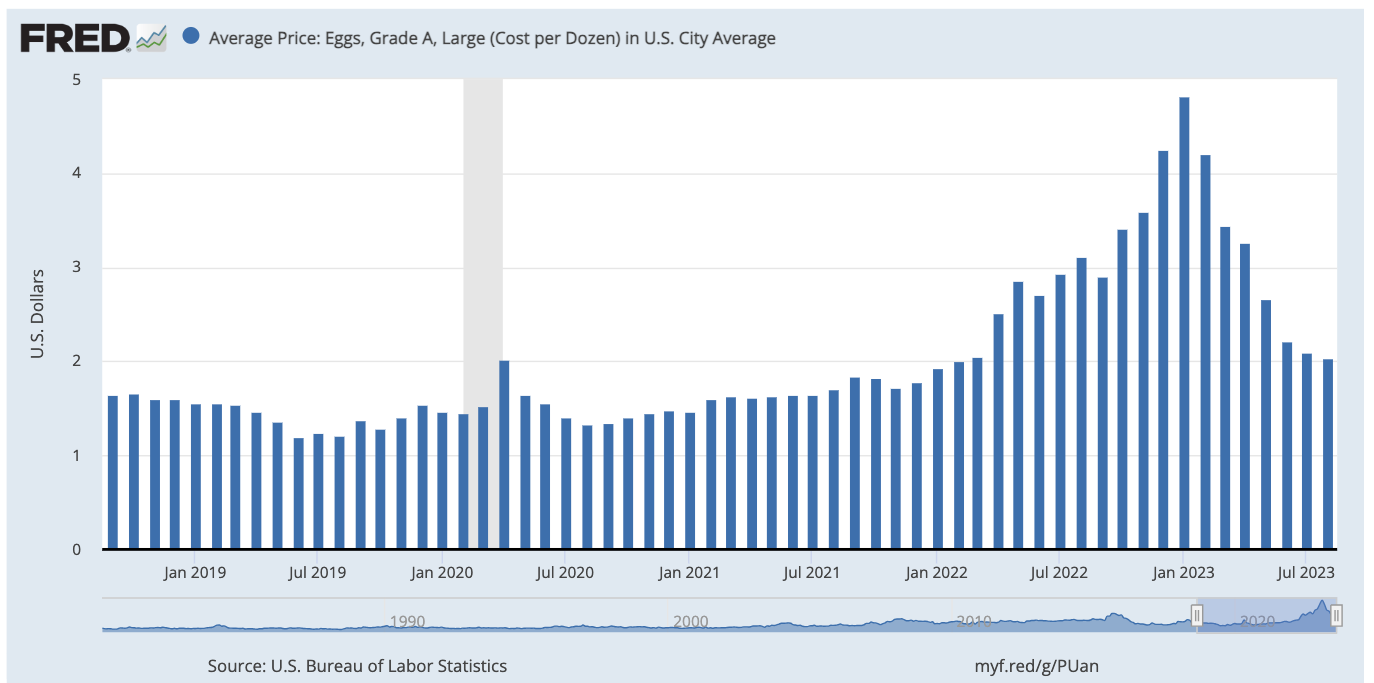 Average price of a dozen eggs in USD chart (screenshot). Source: St. Louis Fed
Recession appears imminent
As reported by Cointelegraph, there is growing focus on the U.S. dollar this month as the dollar index (DXY) approaches one-year highs.
Related: Bitcoin bull market awaits as US faces ‘bear steepener’ — Arthur Hayes
Analysts suggest that actions by foreign nations may aim to correct the imbalance as their currencies weaken, while underlying indicators show warning signs for the U.S. economy.
The likelihood of a recession in 2024 is increasing, with the Fed’s own data indicating nearly a 60% chance in September, as bond yields surge in a phenomenon known as “bear steepening.”
This article does not provide investment advice or recommendations. Every investment and trading decision carries risk, and readers should perform their own research before making any decisions.
