Disclaimer: Information found on CryptoreNews is those of writers quoted. It does not represent the opinions of CryptoreNews on whether to sell, buy or hold any investments. You are advised to conduct your own research before making any investment decisions. Use provided information at your own risk.
CryptoreNews covers fintech, blockchain and Bitcoin bringing you the latest crypto news and analyses on the future of money.

Attention Bitcoin developers: Google indicates that post-quantum transition must be completed by 2029.

The tech giant has established a corporate deadline to transition all authentication services to quantum-resistant cryptography, affirming the timeline Ethereum has been progressing toward for eight years. Bitcoin’s response to date has been a lack of commentary.

What to know:
- Google has established a 2029 deadline to transition its authentication services to post-quantum cryptography, indicating that quantum threats to existing encryption and digital signatures are arising more swiftly than previously anticipated by many in the crypto space.
- Ethereum has dedicated eight years to developing a comprehensive, multi-fork strategy for post-quantum security and is actively operating weekly test networks, while Bitcoin lacks a unified plan, financial backing, or an agreed timeline for a similar shift.
- Security specialists and even notable Bitcoin supporters now largely concur that elliptic curve cryptography is likely to be compromised by quantum computers in the medium term, leading to concerns about Bitcoin’s decentralized governance being able to adapt in a timely manner.
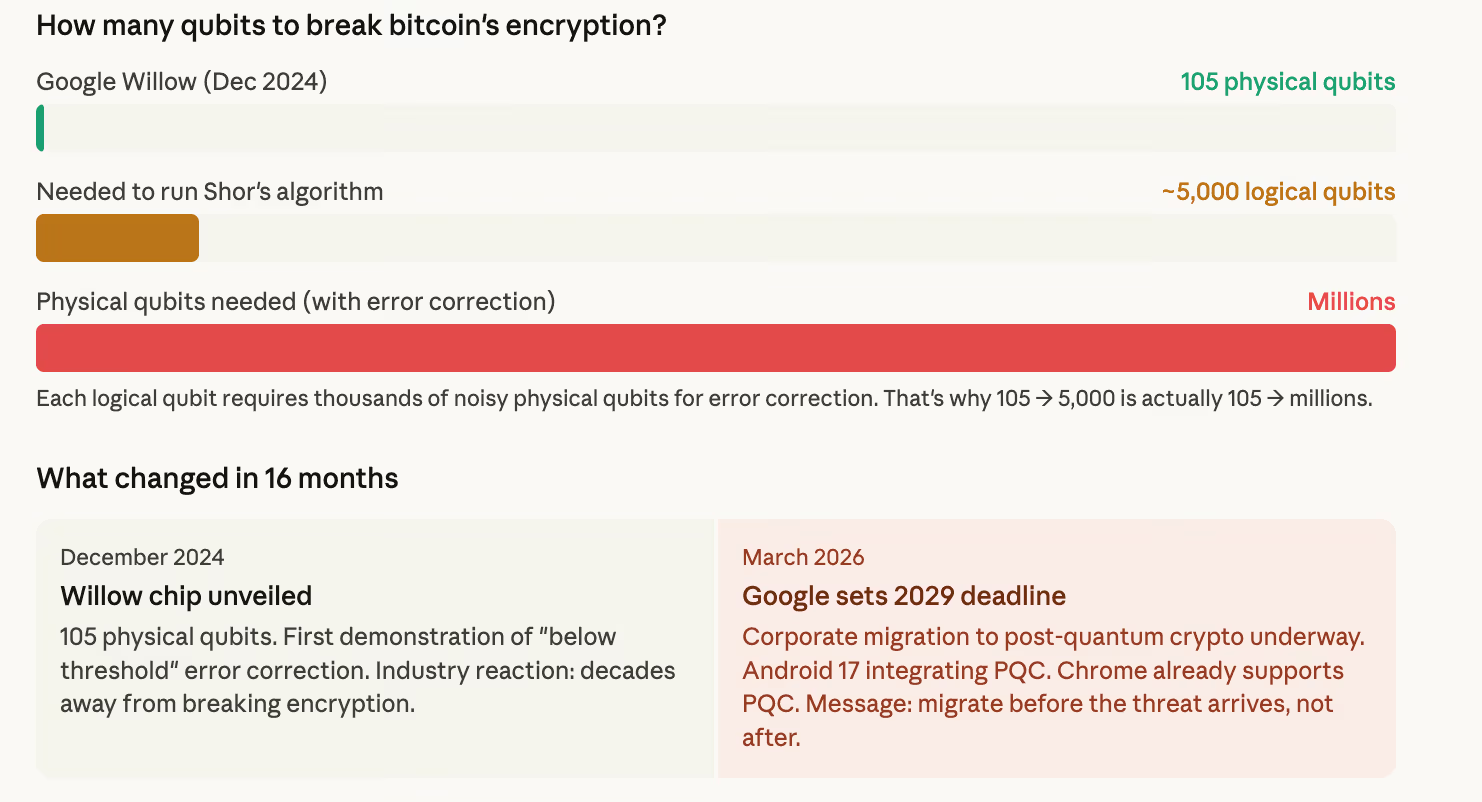
The crypto sector’s initial reaction was a belief that the quantum computing threat was still far off when Google introduced its Willow quantum chip in December 2024.
Bitcoin employs SHA-256 for mining and ECDSA for signatures, both of which are theoretically susceptible to quantum decryption, but the prevailing view was that the threat was decades away. Overcoming encryption would necessitate millions of physical qubits (a unit of information in quantum systems). At that time, Willow only had 105.
That narrative has seen some adjustment sixteen months later, with Google no longer dismissing the situation.
This week, the company revealed it is instituting a 2029 deadline for moving its authentication services to post-quantum cryptography, citing advancements in quantum hardware, error correction, and estimates for factoring resources.
Google’s security engineering team stated that quantum computers "will pose a significant threat to current cryptographic standards, particularly to encryption and digital signatures," and emphasized that the risk to digital signatures specifically "necessitates the transition to PQC before a cryptographically relevant quantum computer is realized."
These dangers are not merely hypothetical. The Android 17 mobile operating system is integrating post-quantum digital signature protection. Chrome already facilitates post-quantum key exchange. Google Cloud provides post-quantum solutions to enterprise clients.
Here’s why it matters
Traditional computers handle information as bits, each representing either a 0 or a 1, and tackle problems by evaluating options sequentially. Quantum computers utilize qubits, which can exist as both 0 and 1 at the same time, a characteristic known as superposition, enabling them to investigate numerous possibilities simultaneously.
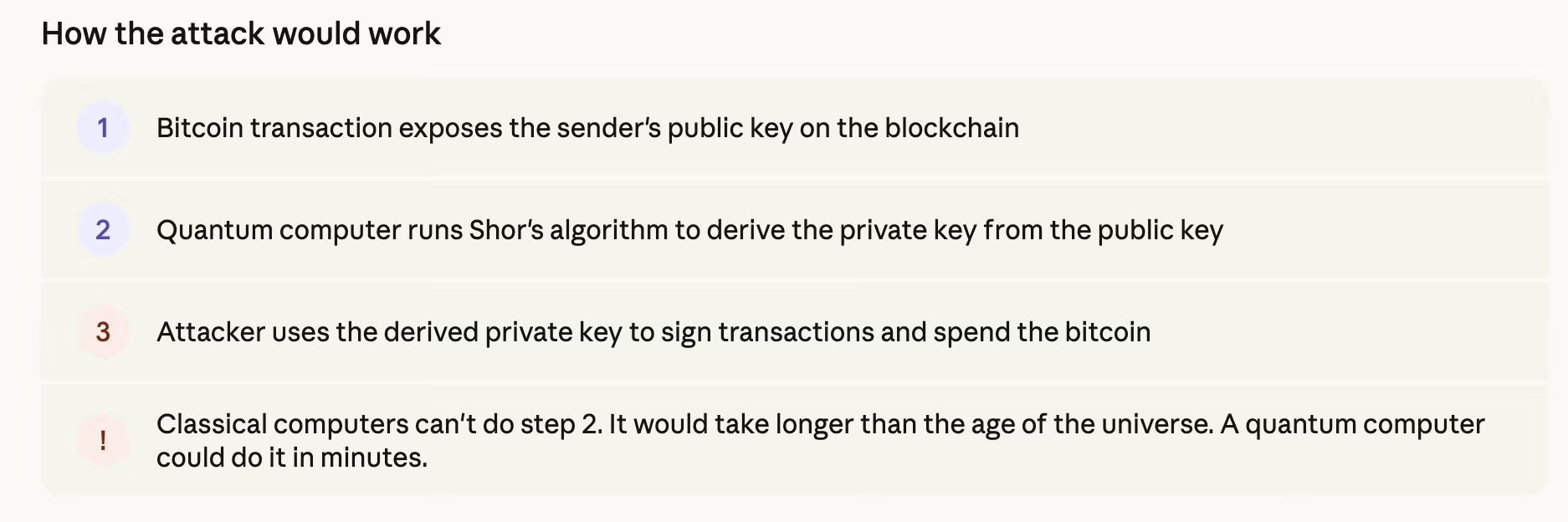
For most routine activities, the advantage is minor. However, for certain challenges like factoring the large prime numbers that are the foundation of modern encryption, a sufficiently advanced quantum computer could resolve in minutes what would take a classical machine longer than the lifespan of the universe.
Related Posts
Bitcoin relies on ECDSA (Elliptic Curve Digital Signature Algorithm) to authenticate transactions, which is precisely the type of cryptography that Google identified as needing transition before a quantum computer capable of breaching it becomes available.
A sufficiently robust quantum computer executing Shor’s algorithm could extract private keys from public keys, enabling an attacker to utilize any bitcoin associated with a public key that has been revealed on the blockchain.
Shor’s algorithm is a quantum computing technique that can solve the mathematics safeguarding passwords and wallets significantly faster than traditional computers.
When CoinDesk reported on Willow in December 2024, the calculations were promising. Chris Osborn, founder of the Solana ecosystem project Dialect, clearly articulated at that moment: approximately 5,000 logical qubits are necessary to execute Shor’s algorithm against present encryption, and each logical qubit requires thousands of physical qubits for error correction.
This indicated millions of physical qubits, in contrast to Willow’s 105. The disparity appeared considerable.
What has shifted is not the count of qubits. It is the trajectory of error correction and the institutional reaction. Google transitioned from exhibiting "below threshold" error correction, indicating they could convert noisy physical qubits into functional logical ones for the first time, to establishing a corporate migration deadline in just 16 months.
When the organization that manufactures quantum computers encourages developers to transition by 2029, it signals that the gap is closing more rapidly than publicly anticipated.
Ethereum co-founder Vitalik Buterin was already urging for urgency in October 2024, a month prior to the Willow announcement.
"Quantum computing specialists like Scott Aaronson have also recently begun to take the potential of quantum computers functioning effectively in the medium term much more earnestly," Buterin noted at that time.
"This has implications across the entire Ethereum roadmap: it implies that every component of the Ethereum protocol reliant on elliptic curves will need to have some hash-based or otherwise quantum-resistant substitute."
How Ethereum and Bitcoin developers are responding
The disparity in responses from the two largest blockchain networks is stark.
The Ethereum Foundation has taken this as a call to action and developed accordingly. Eight years of effort are now evident in the weekly deployment of devnets and a public roadmap with specific fork-level details.
Bitcoin’s governance framework makes such a coordinated response structurally more challenging. There is no Ethereum Foundation counterpart to finance and guide a multi-year
