Disclaimer: Information found on CryptoreNews is those of writers quoted. It does not represent the opinions of CryptoreNews on whether to sell, buy or hold any investments. You are advised to conduct your own research before making any investment decisions. Use provided information at your own risk.
CryptoreNews covers fintech, blockchain and Bitcoin bringing you the latest crypto news and analyses on the future of money.

Ark Invest, led by Cathie Wood, states that quantum computing poses a long-term risk to bitcoin rather than an immediate danger.

Current quantum computers are not poised to breach Bitcoin’s cryptographic security, and any significant threat is expected to develop gradually, allowing the network to evolve.
 Quantum Computing (Getty Images)
Key points:
- Ark Invest indicated that present quantum computers do not possess the necessary power to compromise Bitcoin’s cryptography, and significant advancements are expected to first impact general internet security.
- Approximately 35% of the Bitcoin supply is located in address types that are theoretically at risk from potential future quantum attacks, although around 1.7 million BTC is presumed to be already lost.
- Any quantum-related threats will likely manifest through observable technological advancements over time, providing Bitcoin developers with the opportunity to roll out upgrades like post-quantum cryptography, as stated in the report.
Asset management firm Ark Invest asserts that quantum computing is a long-term factor to consider regarding Bitcoin security, but it does not currently pose an immediate risk.
In a report released on Wednesday, co-authored with Unchained, the investment firm emphasized that existing quantum computers are significantly below the threshold required to breach Bitcoin’s cryptography, which utilizes elliptic curve encryption for wallet security.
“Current quantum systems lack the capabilities necessary to compromise Bitcoin,” noted the report’s authors Dhruv Bansal, co-founder and CSO at Unchained; Tom Honzik, director of custody research at Unchained; and David Puell, research trading analyst and associate portfolio manager for digital assets at Ark Invest.
Even if quantum systems eventually attain such capabilities, the threats are likely to develop at a slow pace and entail substantial costs for attackers, according to the report.
One primary reason Bitcoin is not facing an immediate risk is that a significant quantum computing breakthrough would likely initially disrupt broader internet security, prompting coordinated actions from governments, tech firms, and financial institutions before it could affect Bitcoin.
Related Posts
This report arrives as long-term investors consider the possibility that advancements in quantum computing could one day undermine the cryptographic foundations of Bitcoin, igniting speculation about a potential security crisis.
Earlier this year, a notable portfolio strategist at Jefferies, Christopher Wood, suggested that investors should reduce their Bitcoin allocation by 10% in favor of gold, citing quantum threats. This recommendation unsettled investors and caused turmoil in the digital asset market.
35% of the supply at risk
While experts generally concur that such capabilities remain distant, the potential for powerful quantum machines to eventually break private keys or older wallet formats has raised investor concerns regarding long-term risks to Bitcoin and the larger digital asset ecosystem.
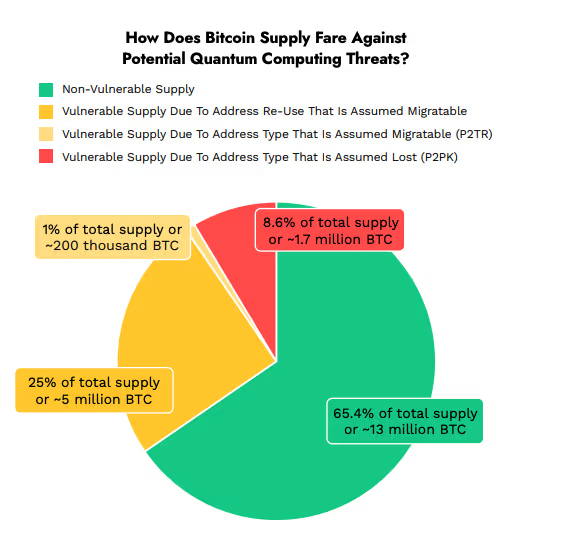 Quantum threat for bitcoin wallets (Ark Invest)
Ark’s analysis estimated that approximately 35% of Bitcoin’s supply is held in address types that are theoretically susceptible to future quantum assaults, which includes around 1.7 million BTC thought to be lost and an estimated 5.2 million BTC that could be relocated to more secure wallets.
Among these wallets, roughly 1 million BTC is associated with Satoshi Nakamoto, the founder of the Bitcoin network.
Nevertheless, rather than encountering a sudden “Q-day,” Ark Invest anticipates these developments to occur in multiple phases over several years. Some investors worry that the first attack could take place before 2030, while others believe it may be “decades away,” as noted in the report.
