Disclaimer: Information found on CryptoreNews is those of writers quoted. It does not represent the opinions of CryptoreNews on whether to sell, buy or hold any investments. You are advised to conduct your own research before making any investment decisions. Use provided information at your own risk.
CryptoreNews covers fintech, blockchain and Bitcoin bringing you the latest crypto news and analyses on the future of money.

Analyst suggests Bitcoin remains a valuable option for portfolio diversification despite its trading patterns resembling those of technology stocks.

The primary discussion has transitioned from whether bitcoin can endure to whether it can serve as a sovereign reserve asset, as critics evaluate it using institutional criteria.
 (Anne Nygård/Unsplash/Modified by CoinDesk)
What to know:
- Although Bitcoin’s correlation with major stock indices is high (around 0.5), equities account for only about 25% of its price fluctuations.
- The main discussion has transitioned from whether bitcoin can endure to whether it can act as a sovereign reserve asset, as critics evaluate it using institutional criteria.
- Bitcoin’s expansion is not reliant on central bank adoption. Its value arises from its globally distributed, politically neutral network and its acceptance by individual users.
Bitcoin’s recent trend to move in tandem with U.S. equities does not diminish its role as a portfolio diversifier.
This is according to financial services and infrastructure company NYDIG. In a weekly market note, Greg Cipolaro, the firm’s global head of research, stated that correlations between bitcoin and stock indices such as the S&P 500, the Nasdaq 100, and the software-heavy IGV ETF have increased in recent months.
This change has led some market analysts to suggest that the cryptocurrency now behaves like a proxy for technology stocks. However, Cipolaro challenges this perspective.
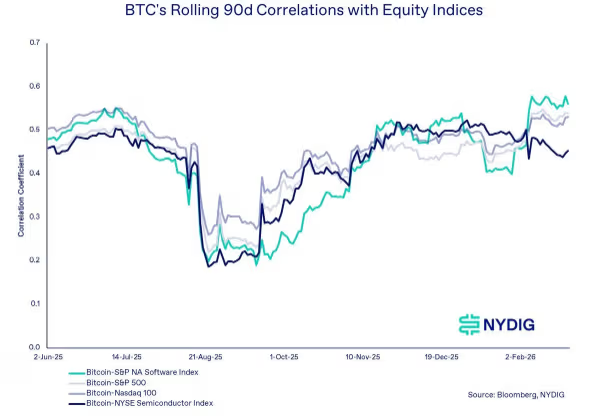
Even with correlations around 0.5, equities account for only a minor portion of bitcoin’s fluctuations, Cipolaro noted. Statistically, this indicates that approximately one-fourth of price alterations are influenced by stock market elements, while the remaining three-quarters relate to factors specific to the crypto market.
These factors encompass capital inflows into bitcoin funds, changes in derivatives positioning, trends in network adoption, and regulatory changes.
Related Posts
Cipolaro commented that the recent price alignment likely reflects the present macroeconomic environment rather than a fundamental merging of asset classes. Both bitcoin and growth stocks react to liquidity conditions and investor risk appetite.
“This distinction reinforces bitcoin’s position as a portfolio diversifier,” Cipolaro stated. “While cross-asset correlations with equities are presently elevated, they are still far from being definitive of bitcoin’s returns.”
Bitcoin’s evolving role
NYDIG’s report also addressed recent remarks from notable investors. Chamath Palihapitiya and Ray Dalio have ignited discussions regarding whether early proponents have changed their views on the asset. Cipolaro contended instead that the discourse has evolved, from whether bitcoin could survive to whether it could function as a reserve asset for central banks.
Palihapitiya, an initial supporter who in 2013 referred to bitcoin as “Gold 2.0,” recently questioned if the asset meets the requirements of sovereign balance sheets.
Dalio has voiced similar concerns for years, highlighting volatility, regulatory risks, and long-term technological challenges such as advancements in quantum computing.
Cipolaro indicated that these critiques reflect shifting expectations as bitcoin transitions from a retail-driven asset to one that is held by institutions. Nevertheless, he asserted that bitcoin’s long-term growth does not hinge on central bank adoption.
Instead, the network has broadened from individual users to family offices, asset managers, and exchange-traded funds, a trajectory that contrasts with many past financial innovations that began with institutional capital.
Central bank ownership may ultimately further validate the asset class, but it is not a necessary condition for ongoing growth,” Cipolaro wrote. “
"Bitcoin’s worth is derived from its globally distributed network, political neutrality, and technical and economic characteristics that facilitate censorship-resistant value transfer, digital scarcity, and independent functioning free from any singular government, institution, or monetary authority," the report concluded.
Read more: Crypto bulls slam Ray Dalio’s ‘tired narratives’ in defense of bitcoin’s future
