Disclaimer: Information found on CryptoreNews is those of writers quoted. It does not represent the opinions of CryptoreNews on whether to sell, buy or hold any investments. You are advised to conduct your own research before making any investment decisions. Use provided information at your own risk.
CryptoreNews covers fintech, blockchain and Bitcoin bringing you the latest crypto news and analyses on the future of money.


“It excels at addressing inquiries related to Bitcoin and economics — at least more effectively than GPT-4,” Aleksandar Svetski informed Cointelegraph during a lively Bitcoin Amsterdam event.
The entrepreneur, author, and founder of Spirit of Satoshi, a unique artificial intelligence (AI) large language model (LLM), begins to detail the challenging path his small startup has navigated to develop its Bitcoin-focused AI chatbot.
The model is the outcome of a labor-intensive training process aimed at producing responses grounded in credible Bitcoin literature, the Austrian school of economics, and libertarian principles. Still in its early stages, Spirit of Satoshi embodies ideals derived from a “well-curated Bitcoin corpus,” which includes materials such as Saifedean Ammous’ acclaimed book The Bitcoin Standard.
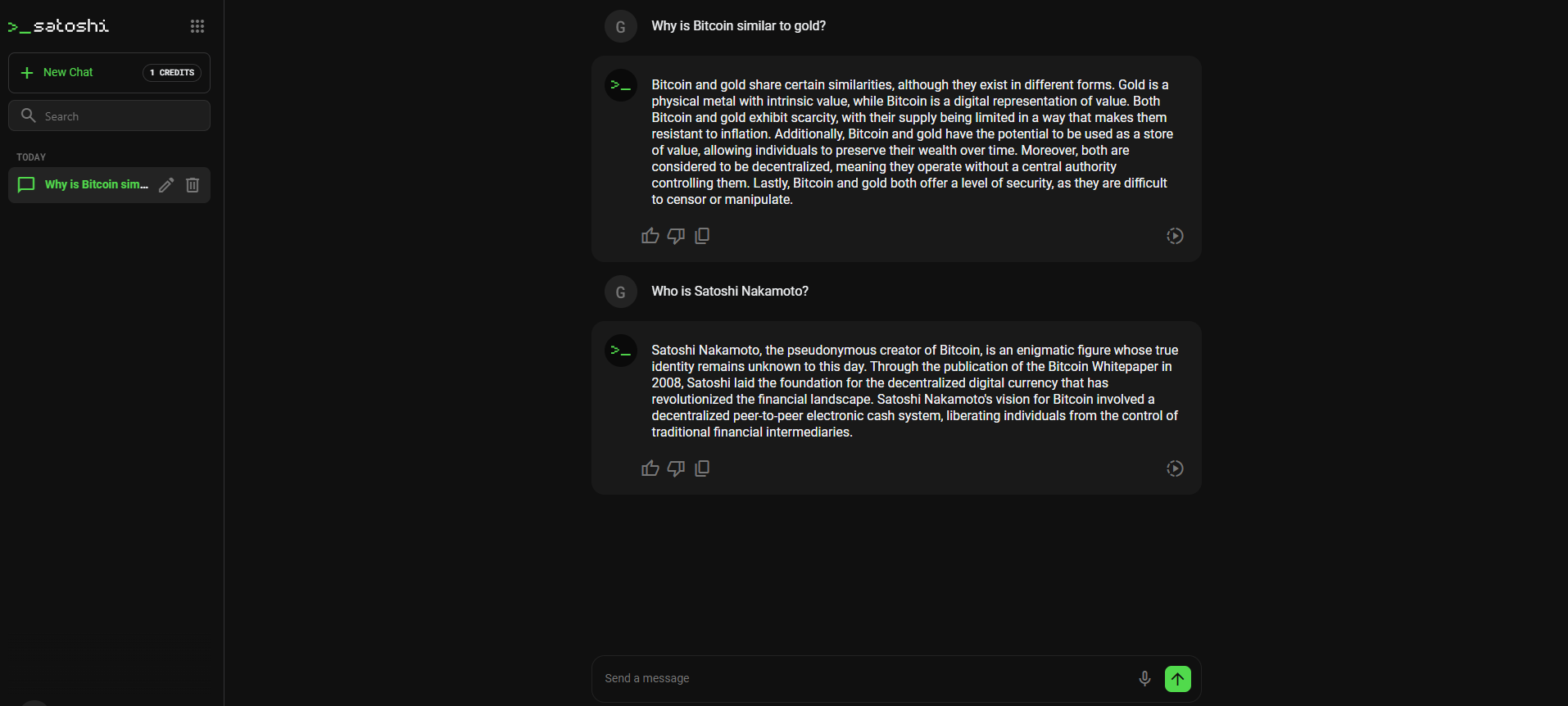 Spirit of Satoshi’s interface resembles that of ChatGPT, while its outputs reflect a Bitcoin-focused theme. Source: Spirit of Satoshi
Svetski clarified that the primary challenge in developing the model was not only curating pertinent information from books, research papers, and podcasts but also steering the model to produce responses through a comprehensive training regimen. He noted that a prevalent misunderstanding about LLMs is that they function like search engines:
“They are merely probabilistically arranging words in a manner that reflects the patterns within the model. Thus, it’s not actually sourcing anything.”
This is partly why AI chatbots occasionally “hallucinate,” Svetski explained, and why creating an LLM necessitates a focus on training it to adopt a specific style of response. Spirit of Satoshi is not flawless either, at least not in its current form.
“Our model will also hallucinate. It’s also going to produce inaccuracies, but it will articulate responses more akin to what a Bitcoiner would express.”
Having established a broad yet focused repository of Bitcoin-related information and data, Svetski’s team has begun supplying the model with tens of thousands of question-and-answer pairs through programmatic techniques. Nonetheless, a human component remains essential to assist Spirit of Satoshi in generating responses that could have originated from its namesake.
Related: Bitcoin Amsterdam: BTC shines in depths of crypto bear market
The ongoing enhancement of the model is drawing on the broader Bitcoin community as a result. Spirit of Satoshi utilizes an incentive mechanism that enables the public to verify, create, and validate data for the model.
Related Posts
By using credentials from the Lightning Network, Nostr, or email addresses, a “proof-of-knowledge” system allows users to earn satoshis for contributing to the model’s training.
This process employs a consensus model that will automatically impose penalties if users generate “junk data.” Svetski described it as the vital “human” aspect to enhance Spirit of Satoshi’s outputs:
“It’s producing remarkable content; it’s the final piece to elevate your content from 80% good to 95% good. And that significantly impacts the quality of the model.”
The distinction between responses produced by Spirit of Satoshi and ChatGPT is evident, according to Svetski. The latter is trained on mainstream interpretations of Bitcoin (BTC) and concepts such as inflation:
“If we inquire about inflation, ChatGPT will assert that it is indicative of a healthy economy. However, that’s incorrect; inflation signifies systemic issues, such as a decline in purchasing power.”
Svetski indicated that this scenario was part of the fundamental purpose behind Spirit of Satoshi, retraining the LLM to reflect the subtleties that characterize the mindset of the Bitcoin movement:
“If you ask about inflation, our model should respond, ‘No, inflation is detrimental to the economy because it discourages savings,’ or ‘Savings have a ripple effect on individuals’ time preference.’”
The future of the platform appears quite flexible, according to its founder. Spirit of Satoshi could serve as a learning resource or online tutor integrated into educational platforms or online universities. It might also serve as the foundation for the “ultimate Bitcoin influencer” through its BTC-focused outputs:
“I envision it becoming the go-to resource for the next 100 million or 500 million individuals eager to learn about Bitcoin — the starting point for their initial understanding.”
Spirit of Satoshi was developed based on an existing open-source model that possesses inherent capabilities in English and a “Wikipedia-type of bias.” This bias was addressed by structuring the model’s responses to align with its Bitcoin and Austrian economics data sets.
Magazine: ‘Elegant and ass-backward’: Jameson Lopp’s first impression of Bitcoin
