Disclaimer: Information found on CryptoreNews is those of writers quoted. It does not represent the opinions of CryptoreNews on whether to sell, buy or hold any investments. You are advised to conduct your own research before making any investment decisions. Use provided information at your own risk.
CryptoreNews covers fintech, blockchain and Bitcoin bringing you the latest crypto news and analyses on the future of money.

A significant disparity between network utilization and token valuation is the key issue currently affecting XRP.

Daily transactions on XRPL have increased to 2.7 million, AMM pools have surged to 27,000, and the value of tokenized assets rose by 35% over the past month. XRP has decreased by 26% this year.
Key points:
- Transaction activity on the XRP Ledger has reached over 2.7 million daily payments and close to 27,000 AMM pools, despite XRP’s price being 62% lower than its peak in late 2025.
- The growth of the ledger is largely attributed to Ripple’s RLUSD stablecoin and tokenized assets that utilize XRP temporarily as a bridge currency, enhancing transaction volumes without establishing persistent demand or scarcity for the token.
- While XRP’s DeFi presence and DEX transaction volumes are relatively minor compared to its $84 billion market capitalization, the ledger’s $461 million in tokenized real-world assets and increasing institutional flows support a longer-term bullish outlook on tokenization.
The XRP Ledger is currently experiencing unprecedented levels of activity, although traders have not yet adjusted.
Successful daily payments on XRPL have recently reached a 12-month peak of over 2.7 million, a notable increase from about 1 million in late 2025, based on data from XRPSCAN. The network handles between 2 and 2.8 million transactions daily at a rate of 20 to 26 transactions per second.
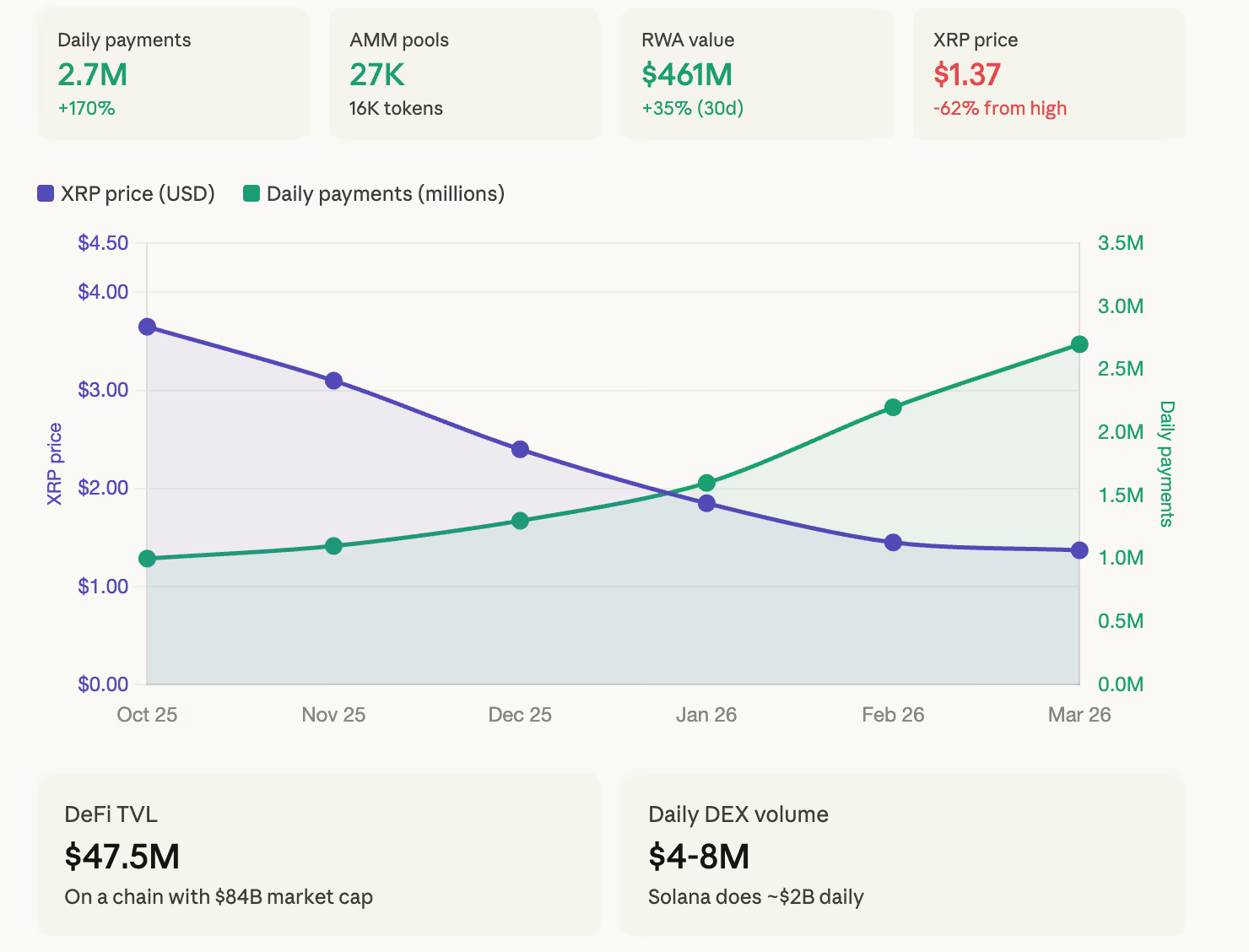
Automated market maker pools have grown to nearly 27,000 active pools, accommodating more than 16,000 distinct tokens. The value of tokenized real-world assets on the ledger has risen to $461 million, marking a 35% increase in the last 30 days, according to RWA.xyz. The volume of stablecoin transactions in the same timeframe reached $1.19 billion.
XRP is currently priced at $1.37, reflecting a 26% decline year-to-date, and is 62% lower than its late-2025 peak of $3.65.
The disparity between the ledger’s performance and the token’s valuation is a significant aspect of the current XRP landscape, yet the market has not provided clarity on this issue.
The prevailing cryptocurrency theory suggests that increased network activity enhances token value. Higher usage translates to greater demand for the native asset, which typically elevates prices. This principle was evident for Ethereum during the DeFi surge and for Solana amid the meme coin frenzy.
Related Posts
However, XRP appears to be deviating from this norm. All indicators that should influence a utility token are on the rise, yet its price continues to fall.
The most probable explanation is structural. The escalating activity on XRPL is increasingly fueled by RLUSD, Ripple’s stablecoin, and tokenized assets that utilize XRP as a bridge currency but fail to generate enduring demand for the token.
A transaction that employs XRP for a brief period to finalize a cross-border payment between fiat currencies does not create the same buying pressure as staking ETH for an extended duration or locking SOL in a DeFi protocol. The network may be busier, but the token remains liquid and transient. Activity increases, yet scarcity does not.
The DeFi metrics illustrate this contrast starkly. DeFiLlama reports that XRPL’s total value locked stands at $47.54 million. This represents the entirety of the DeFi ecosystem on a blockchain whose native token boasts an $84 billion market cap.
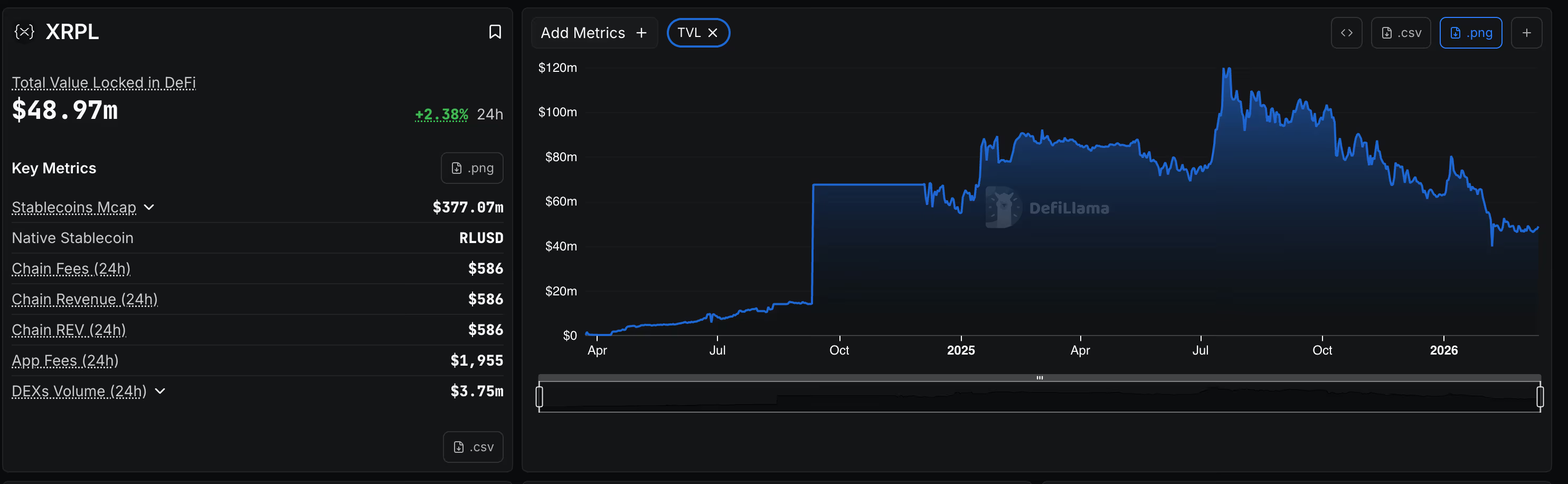
In contrast, Solana has approximately $4 billion in total value locked, while Ethereum exceeds $40 billion. XRP’s DeFi component is negligible compared to its valuation, indicating that the market cap is primarily influenced by speculative investments and ETF expectations rather than capital tied up in productive on-chain activities.
The native DEX presents a similar situation. Daily transaction volumes range from $4 million to $8 million based on recent figures, which is modest for any Layer 1 blockchain and particularly low for one ranked fifth in market capitalization.
The growth of AMM pools is significant, with 27,000 pools and 12 million XRP deposited, but the monetary value of that liquidity remains limited in relation to the scale of the token’s market.
The real-world asset scenario is the one area where the data genuinely bolsters the bullish argument. With $461 million in distributed asset value and $1.5 billion in represented asset value, XRPL surpasses several larger chains in specific tokenization segments.
The stablecoin market cap on the ledger stands at $339 million with 35,800 holders. The 30-day RWA transfer volume of $149 million, which has increased by over 1,300%, indicates actual institutional engagement rather than wash trading. Should the tokenization narrative materialize in the coming years, XRPL possesses an advantage that many rivals do not.
Historically, March averages an 18% return for XRP, and the support range of $1.27 to $1.30 has remained intact through numerous tests. If macroeconomic conditions stabilize and the situation in Iran progresses towards resolution, a rebound to $1.60 or above is conceivable.
