Disclaimer: Information found on CryptoreNews is those of writers quoted. It does not represent the opinions of CryptoreNews on whether to sell, buy or hold any investments. You are advised to conduct your own research before making any investment decisions. Use provided information at your own risk.
CryptoreNews covers fintech, blockchain and Bitcoin bringing you the latest crypto news and analyses on the future of money.

A $100 million cryptocurrency campaign fund with pro-Trump affiliations has yet to materialize.

The Fellowship political action committee pledged $100 million, with indications that Tether might have been involved as a supporter, yet the fund has yet to contribute anything.
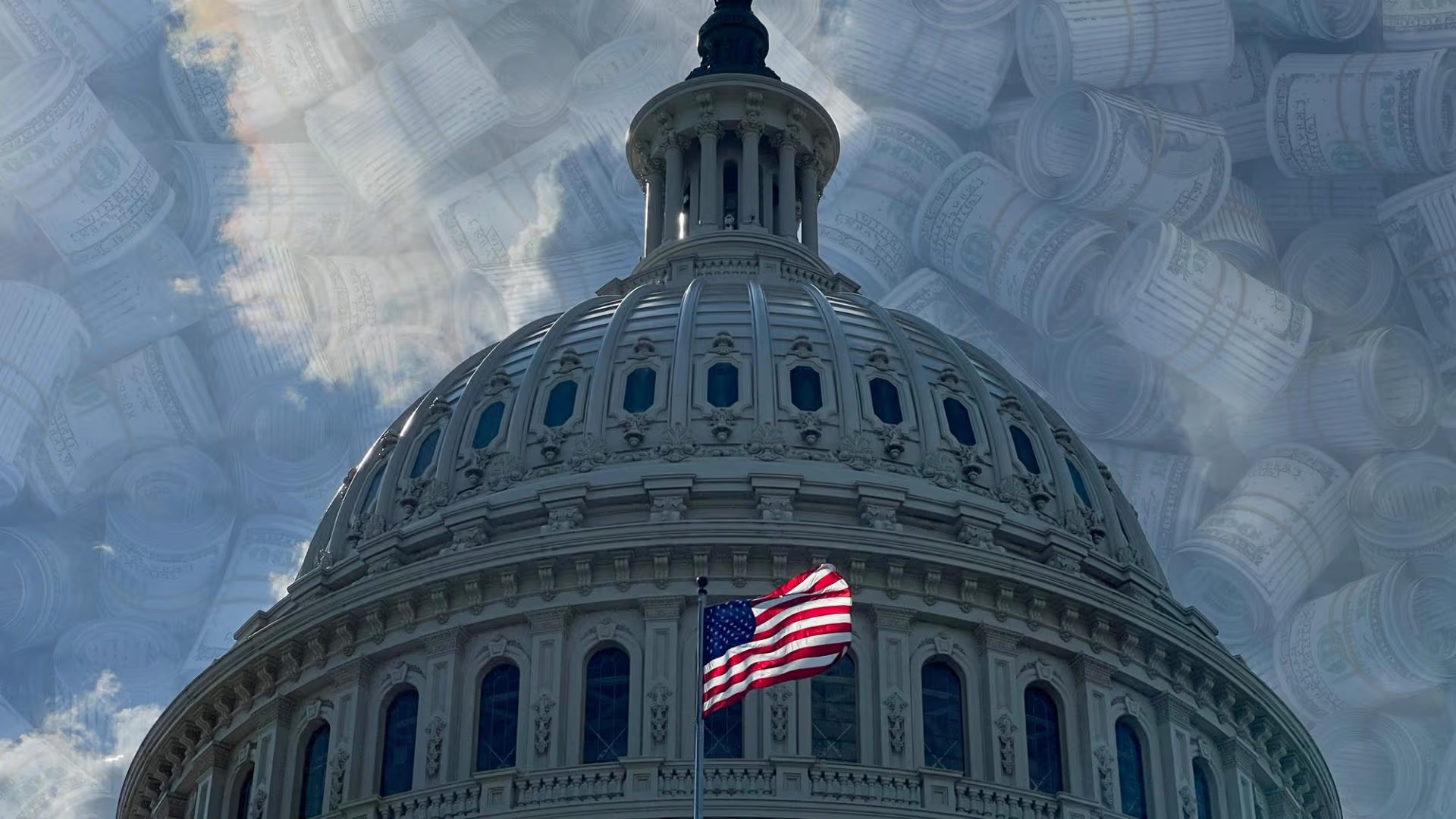 A political action committee in the cryptocurrency arena that previously committed to contributing $100 million has not yet made its presence known. (photo illustration by Jesse Hamilton/CoinDesk)
Related Posts
What to know:
- The Fellowship PAC was expected to play a significant role in the midterm U.S. congressional elections, but it has not yet delivered on its $100 million pledge.
- Initial reports linked Tether to the initiative as a potential supporter, and when inquired this week about their involvement, a spokesperson stated, “Tether International has no affiliation” with Fellowship.
- Despite Fellowship’s announcement in September, the most recent disclosures from the Federal Election Commission indicate that no funds have been allocated to the campaign.
The cryptocurrency sector showed in the last U.S. elections that an expenditure of $100 million on congressional races could sway policy decisions for the industry, so when a new cryptocurrency political action committee anonymously vowed to contribute that amount for 2026, it hinted at a new (yet unidentified) influence in the politics of digital assets.
However, the Fellowship PAC has not materialized.
A press release from September garnered significant attention last year as a major advancement in the industry’s substantial campaign expenditures compared to the more established super PAC, Fairshake. It was reported that Tether, a leading stablecoin provider with its USDT and recent efforts in the U.S. through a separate affiliate and the USAT token, would be among its supporters, although company representatives have refrained from confirming any association.
“In contrast to previous political endeavors, the Fellowship PAC’s objective is characterized by transparency and trust, ensuring that political action directly benefits the broader ecosystem instead of specific or individual interests,” stated the PAC’s original September release, implying it would take a different direction from Fairshake. The announcement did not disclose any officers, donors, or key personnel, nor did the PAC’s website.
Fellowship’s announcement highlighted President Donald Trump for establishing a regulatory framework “that positions America to become the global crypto capital.”
When questioned about Tether’s involvement, which launched its U.S. division around the same time as Fellowship’s announcement, company spokesperson Alex Welch indicated this week that Tether’s global entity has no influence over the PAC but did not comment on whether the U.S. operations had any role in Fellowship.
“Tether International has no affiliation or oversight of Fellowship, so any inquiries should be directed to the Fellowship website and associated email,” Welch stated via email.
Repeated efforts to reach Fellowship went unanswered, despite its establishment of a website and an account on social media platform X, where its latest activity involved reposting a comment from Tether CEO Paolo Ardoino earlier this month. It also registered as a super PAC with the Federal Election Commission, listing its treasurer as Mitchell Nobel, who manages digital-assets strategy at Cantor Fitzgerald, where Trump’s Secretary of Commerce Howard Lutnick serves as CEO. That firm has also managed Tether’s assets in recent years.
What Fellowship did not accomplish, according to FEC records, was secure any funding for its operations. Current filings indicate that it has no available funds.
Under U.S. election law, a PAC cannot receive funding from a non-U.S. entity. Concerns about foreign money influencing U.S. politics have existed for a long time and have attracted renewed scrutiny during the Trump administration, including claims that Trump-supporting PACs might have inappropriate connections to foreign donors. If Tether had engaged politically, it could have faced additional scrutiny, even if limited to its U.S. operations, since such a subsidiary would need to demonstrate that its funds were sourced domestically and that its political activities were not directed by foreign nationals.
Meanwhile, Fairshake, the industry’s leading super PAC, has reported having $193 million and has begun targeting initial campaigns to support pro-crypto candidates in Congress. During the 2024 election cycle, Fairshake—primarily backed by Coinbase, a16z, and Ripple—supported over 50 candidates from both major parties currently serving in the Senate and the House of Representatives.
With some of the earliest 2026 primaries approaching, any new participants in political spending may arrive late to the process. It remains uncertain whether the midterm congressional elections will witness Fellowship’s “$100 million commitment to support pro-innovation, pro-crypto candidates who will protect America’s position as the global leader in digital assets and entrepreneurship.”
