Disclaimer: Information found on CryptoreNews is those of writers quoted. It does not represent the opinions of CryptoreNews on whether to sell, buy or hold any investments. You are advised to conduct your own research before making any investment decisions. Use provided information at your own risk.
CryptoreNews covers fintech, blockchain and Bitcoin bringing you the latest crypto news and analyses on the future of money.


The ceasefire between the US and Iran led to a decline in oil prices, European stocks experienced their most significant single-day increase in over four years, and the cryptocurrency market also benefited from this wave of relief.
Amid this relief, traders quickly shifted their focus to privacy-related assets, resulting in Zcash rising approximately 59.6% over the course of a week and Dash increasing by about 47.3% during the same period.
As of the latest update, CoinGecko’s privacy coin category saw a 10.2% increase within 24 hours, while the overall privacy sector averaged gains of 21.5%, significantly surpassing Bitcoin’s performance.
The movement within the category is not uniform, revealing insights beyond the overall statistics.
Two forces unevenly applied
Two separate factors contributed to this outperformance, with the first being quite clear: as risk appetite sharply rebounds, traders tend to gravitate towards smaller, more volatile assets that offer greater potential for gains in a rising market.
The second factor was more selective, favoring assets with a clear narrative beyond the general macro relief.
Monero provides the most compelling evidence against the simplistic interpretation that “geopolitics drove a desire for privacy.” During the same week in which Zcash appreciated by 46.6% against Bitcoin and Dash increased by approximately 40.4%, the XMR/BTC pair declined by about 2.3%.
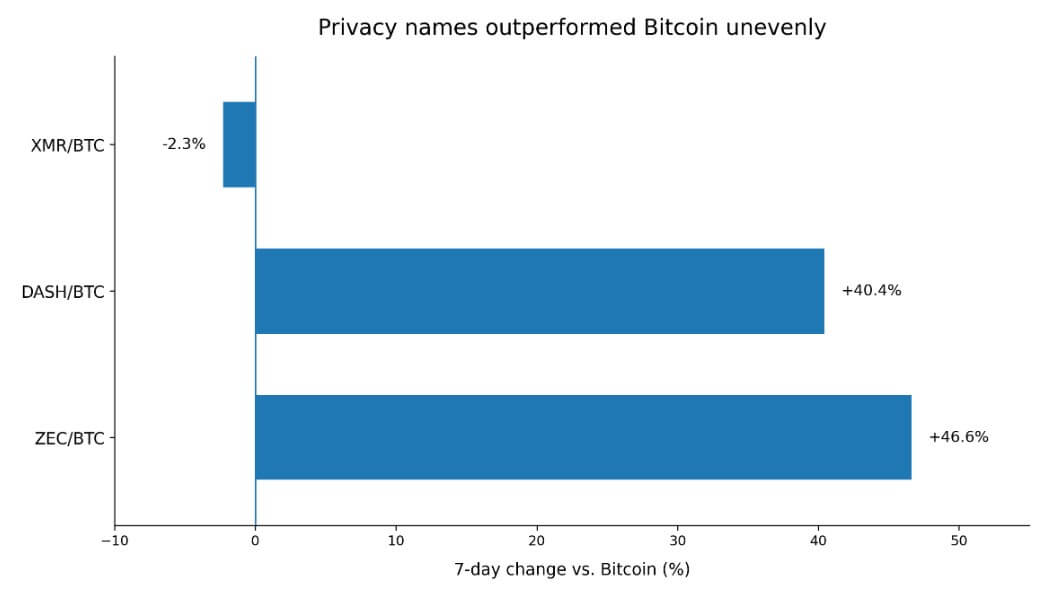 A horizontal bar chart illustrates ZEC/BTC gaining 46.6% and DASH/BTC gaining 40.4% against Bitcoin over a week, while XMR/BTC experienced a loss of 2.3%.
Considering the technical intricacies and market capitalization, a uniform ideological push for financial anonymity would have included Monero in this upward movement.
The uneven dynamics suggest that traders are selecting assets based on their potential for price surges and the clarity of their narratives, treating privacy as a trading cluster.
For Zcash, that secondary narrative was established well before the ceasefire.
On April 2, Grayscale submitted an amended S-3/A detailing a pathway to list the Grayscale Zcash Trust on NYSE Arca under the ticker ZCSH. This definitive signal of institutional access keeps options open for regulated capital.
In March, Foundry announced plans to launch an institutional-grade Zcash mining pool in April 2026, explicitly positioning Zcash as an asset that has progressed beyond retail-only infrastructure.
The Zcash Open Development Lab revealed it raised over $25 million from Paradigm, a16z crypto, Coinbase Ventures, and Winklevoss Capital, along with more than 400% growth in shielded pools and over $600 million in ZEC swaps since October 2025.
In January, the Zcash Foundation noted that the SEC had completed its review without recommending any enforcement action.
Each of these catalysts emerged prior to this week’s rally, making the ceasefire a macro entry point into a thesis that was already gaining institutional traction.
Dash as a high-beta proxy
Dash entered the week with genuine narrative momentum.
AEON Pay processed 994,000 transactions and $29 million in transaction volume across more than 50 million offline merchants, while Dash announced the introduction of shielded transaction capabilities for its Evolution platform utilizing Zcash’s Orchard technology, and March saw an integration with NEAR Intents for swap access.
Related Posts
However, Dash’s rally is based on weaker fundamental support compared to Zcash, as no single catalyst during the same timeframe had the same impactful force as Zcash’s institutional developments.
Dash’s compliance framing complicates any straightforward categorization, as the project has maintained since 2020 that its transactions are inherently transparent and that it functions as a payments cryptocurrency with optional privacy.
Currently, CoinGecko’s privacy coin category includes Monero and Zcash, with Dash excluded. Nevertheless, once Zcash began to rise, traders sought the nearest asset with any connection to the privacy cluster, and Dash was familiar, liquid enough for substantial trades, and small enough to respond quickly.
CoinGlass data indicates heightened derivatives activity in Dash, with 24-hour futures volume around $669 million against a market cap of approximately $561 million, turnover at about 119% of market cap, and open interest at roughly 15.15% of market cap.
| Metric | Zcash | Dash |
|---|---|---|
| 7-day price change | +59.6% | +47.3% |
| BTC-relative performance | +46.6% | +40.4% |
| In CoinGecko privacy category? | Yes | No |
| Clear institutional catalyst this week’s rally could lean on? | Yes | Not as clearly |
| Grayscale vehicle / conversion path | Yes — amended S-3/A describes path to NYSE Arca listing under ZCSH | No equivalent cited |
| Institutional mining pool plan | Yes — Foundry announced planned institutional-grade pool | No equivalent cited |
| Ecosystem funding / usage growth catalyst | Yes — ZODL disclosed $25M+ raise, 400%+ shielded-pool growth, $600M+ in swaps | More mixed — AEON / NEAR / Orchard-related progress, but no single catalyst of similar weight |
| Compliance / regulatory support point | Yes — Zcash Foundation said SEC concluded review without recommending enforcement action | Mixed — Dash has long stressed it is a payments crypto with optional privacy |
| 24h futures volume | Noted as elevated | ~$669M |
| Market cap | Implied by ratio discussion | ~$561M |
| 24h futures volume / market cap | ~63.45% | ~119% |
| Open interest / market cap | ~12.61% | ~15.15% |
| Best characterization of move | Institutional-access + privacy narrative | High-beta sympathy / squeeze trade |
Zcash also exhibited elevated metrics, with futures volume around 63.45% of market cap and open interest around 12.61%. Both sets of ratios align with narrative-driven, squeeze-amplified movements, while Dash’s figures appeared more stretched, indicating a setup where spillover momentum could exceed expectations.
The Grayscale vehicle introduces a structural element that distinguishes Zcash from other assets in the privacy sector.
The S-3/A filing indicated that the trust has historically traded at discounts as steep as 55% and premiums as high as 240%, but was at just a 0.3% premium to NAV as of March 31.
Traders are factoring in the potential for Zcash to become more accessible to regulated capital, representing a future-access wager, given that the trust had almost no arbitrage gap as of the filing date.
This potential aligns with a broader 2026 context that was already developing prior to this week. Grayscale’s fourth-quarter 2025 report identified privacy as the leading crypto theme of that quarter.
Coinbase’s January 2026 market note highlighted privacy tokens as among the top performers of 2025 and suggested that the narrative could remain significant through 2026, with regulation noted as the primary risk.
What could extend or end the trade
In a bullish scenario, oil prices remain below recent highs, equities maintain a risk-on stance, and at least one of Zcash’s institutional catalysts solidifies.
In such a scenario, Zcash retains much of its relative outperformance since the institutional access narrative is independent of the ceasefire, and Dash could overshoot again due to its thin market structure, which amplifies any continued inflows.
Conversely, in a bearish scenario, the ceasefire may prove unstable, leading to a rebound in oil prices and a reversal of macro relief. Given that Zcash and Dash are both smaller and more sensitive to trader positioning than Bitcoin, they typically experience greater retracements.
Dash would likely be the first to decline, considering its thinner liquidity and lack of a robust institutional narrative to mitigate the exit. Zcash would fare better if its institutional access narrative remains credible, although the extent of this depends on whether Foundry and Grayscale adhere to their proposed timelines.
The Grayscale filing outlines a conversion path pending regulatory approval, while Foundry’s pool is set for a planned launch in April 2026, awaiting confirmation. If either narrative fails to materialize, the institutionalization thesis could lose its near-term foundation.
| Scenario | Trigger | Oil / macro backdrop | Bitcoin | Zcash | Dash |
|---|---|---|---|---|---|
| Bull case | Ceasefire holds, equities stay risk-on, at least one Zcash catalyst firms up | Oil stays off recent highs | Holds gains or grinds higher | Keeps most relative outperformance; institutional-access thesis stays intact | Can overshoot again because thin market structure amplifies inflows |
| Base case | Relief rally cools but does not fully reverse | Oil stabilizes, macro stops improving fast | Consolidates | Holds up better than Dash because the second narrative remains | Gives back more of the move as momentum fades |
| Bear case | Ceasefire proves fragile; macro relief reverses | Oil rebounds, risk appetite weakens | Retraces | Retraces, but could hold somewhat better if institutional story remains credible | Likely falls faster because liquidity is thinner and narrative is less durable |
| Event-risk case | Grayscale path stalls, Foundry launch disappoints, or regulation/delistings hit privacy names | Macro secondary to idiosyncratic risk | Less affected relative to privacy names | Loses key near-term institutionalization support | Most vulnerable because it lacks a comparably strong institutional anchor |
| Key thing to watch | Which narrative gets validated first | Oil direction and ceasefire durability | Whether BTC leadership broadens or narrows | Confirmation on Grayscale / Foundry / institutional uptake | Whether derivatives-led momentum can persist without fresh fundamentals |
Coinbase’s January note highlighted regulatory actions and exchange delistings as asymmetric risks for privacy tokens with narrower liquidity bases than Bitcoin, a category that both Zcash and Dash belong to.
This week, Zcash and Dash outperformed Bitcoin due to a macro relief rally that boosted risk appetite across various asset classes, combined with a concentrated institutional narrative that provided traders with an additional reason to favor one specific privacy coin over others.
The post Zcash beats Bitcoin by 46% as privacy coins decouple during Iran War appeared first on CryptoSlate.
