Disclaimer: Information found on CryptoreNews is those of writers quoted. It does not represent the opinions of CryptoreNews on whether to sell, buy or hold any investments. You are advised to conduct your own research before making any investment decisions. Use provided information at your own risk.
CryptoreNews covers fintech, blockchain and Bitcoin bringing you the latest crypto news and analyses on the future of money.

XRP’s utility may gain from worldwide pressures, yet why is its price behaving like a high-risk asset?

XRP faces an identity crisis as oil prices, inflation concerns, and dollar strength impact the market simultaneously
XRP has entered a challenging phase of its cycle. Throughout much of the year, the asset maintained a clearer institutional narrative compared to many large-cap altcoins.
CryptoSlate has already observed a shift of institutional interest towards Ripple-associated products, the resilience of ETFs linked to Ripple’s growing presence, and the increasing tension between XRPL adoption and the capture of token value. The situation has now become more constrained.
A sudden overnight increase in oil prices, stronger dollar conditions, and renewed inflation worries have subjected XRP to a macro test that feels more immediate than the themes that supported it during the first quarter.
This transition occurred rapidly. Following President Donald Trump’s recent comments regarding Iran, AP reported that oil prices surged by over 6%, while a separate market summary from Business Insider indicated Brent crude nearing $108.
Brent crude rose to approximately $108, the U.S. Dollar Index increased to around 100, and Bitcoin dipped toward $66,666.
XRP’s price remained around $1.35 to $1.36, according to CryptoSlate data, although the weekly movement still exhibited noticeable pressure. The 24-hour trading volume is approximately $1.32 billion.
Why this matters: The fundamental argument for XRP relies on stress within the global financial system. If rising costs, tighter liquidity, and cross-border friction are on the rise, the token should be moving closer to its use-case value. Instead, it continues to behave like a high-beta asset, prompting a practical question for investors: when will utility begin to influence price?
The connection to XRP is more profound than general crypto weakness. Bitcoin typically absorbs the initial impact of geopolitical and liquidity shocks. XRP is more closely aligned with discussions around payment, liquidity, and settlement.
Ripple has dedicated months to developing that framework. The company’s acquisition of GTreasury and the subsequent launch of Ripple Treasury have expanded its influence in corporate cash management, while earlier reports on Ripple’s trust-bank aspirations and broader licensing initiatives provided XRP holders with a tangible reason to view the asset through a financial-infrastructure perspective.
This perspective now operates in both directions. When oil prices rise, freight and energy input costs increase, and inflation expectations become more rigid, the argument for faster, cheaper money movement becomes more urgent.
This same macro shock also strengthens the dollar, tightens financial conditions, and typically pushes risk assets into a more challenging environment. XRP now finds itself at the crossroads of these two forces.
The tension is direct as it impacts household budgets, portfolio reductions, and the costs associated with moving capital across borders.
Oil and the dollar have transformed XRP’s payments narrative into a real-time stress test
XRP’s use-case narrative has consistently emphasized efficiency. Cross-border transfers, on-demand liquidity, and enterprise settlement create a clearer economic argument when payment systems are under pressure.
This argument becomes more comprehensible during a week when the world suddenly has to account for higher energy costs, a stronger dollar, and the potential for another inflation surge. The macro landscape depicted on the chart is straightforward.
Brent crude increased, the DXY rose, and Bitcoin declined. XRP followed the downward pressure throughout the week, even though its long-term narrative should, in theory, gain relevance as global money flows become more costly and fragile.
This contradiction lies at the heart of the situation. XRP experienced a rally for much of this cycle based on the belief that Ripple’s regulated growth, enterprise positioning, and capital-market engagement were establishing a more stable foundation for the token.
CryptoSlate has reported on this process through articles covering institutional DeFi ambitions, integration with legacy finance, and recent softening of ETF flows. These themes remain significant.
However, they now confront a more challenging question. If a stronger dollar and rising oil prices create greater friction across the global economy, why has XRP acted like a pressured altcoin rather than a market leader?
Part of the explanation lies in the liquidity hierarchy. Bitcoin continues to command the initial response during macro stress, as it possesses the deepest liquidity, the broadest institutional recognition, and the most pronounced reflexive movement during periods of geopolitical uncertainty.
XRP operates within a narrower scope. It requires investors to believe that utility can translate into token demand within a timeframe that the market can evaluate.
This challenge has repeatedly manifested in the disparity between Ripple’s business success and XRPL activity, as well as XRP’s heightened beta during widespread crypto downturns. The current situation forces this same issue into a macro context.
Related Posts
Ripple can expand into custody, treasury management, and regulated financial software, yet XRP continues to trade within a market structure that reacts swiftly to dollar strength and diminishing crypto risk appetite.
Bitcoin has spent the last several sessions drifting back toward the mid-$66,000s, a noticeable decline from the higher levels traders had defended earlier in the week.
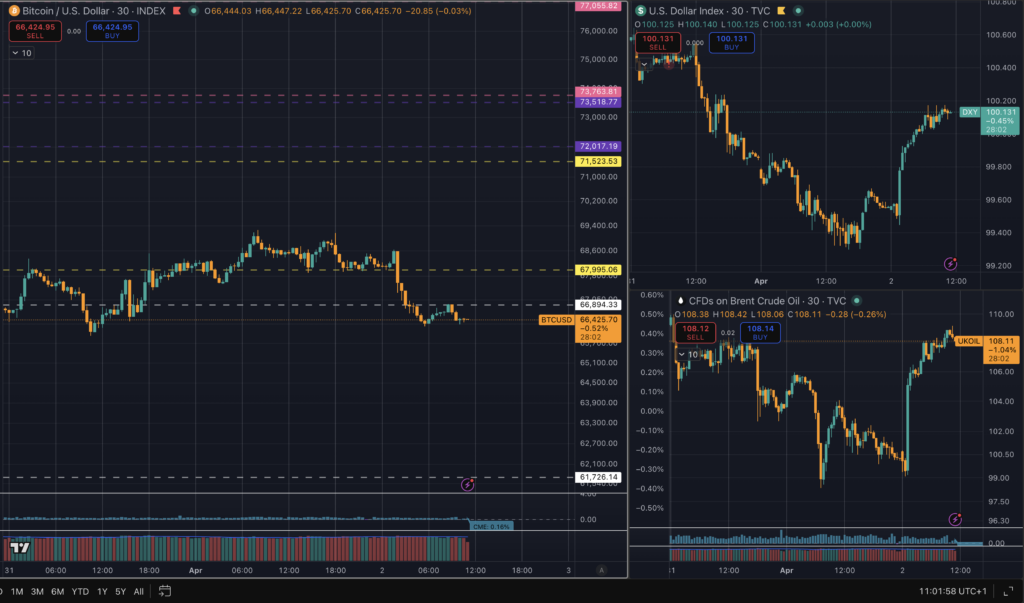 TradingView screenshot showing Bitcoin, U.S. Dollar Index, and crude oil charts with intraday price swings and rebound moves.
The dollar index regained the 100 mark, a psychological threshold that typically contributes to tighter global liquidity conditions. Brent then surged back above $108. XRP remained around the mid-$1.30s.
This series of movements conveys a clear economic message. Payment friction may be increasing in the real world, but capital is still prioritizing safety over efficiency.
For XRP, this situation results in an identity crisis. Its strongest fundamental narrative suggests that a fractured, costly, and slow-moving global financial system should enhance the value of its use case.
Current market behavior indicates that investors still categorize it as part of the higher-beta segment of crypto exposure.
The upcoming macro calendar will challenge XRP’s weakest aspects
The upcoming week further intensifies the issue, as the macro calendar presents three direct tests. The Bureau of Labor Statistics employment report is set to be released on Friday, April 3.
The Federal Reserve’s April schedule indicates that the minutes from the March 17-18 FOMC meeting will be available on Wednesday, April 8. The BLS release calendar then places March CPI on Friday, April 10.
These releases coincide with the new oil shock. They will determine whether markets perceive the recent rise in energy prices as a temporary disruption or the onset of another inflation phase that maintains tighter policy for an extended period.
XRP’s reaction to this sequence could define the next stage of its cycle. A stronger payrolls report would reinforce the notion that labor conditions remain robust enough to keep the Federal Reserve cautious.
Hawkish signals in the minutes would introduce an additional layer of restraint. A higher CPI reading next Friday would confirm that the oil price increase has occurred within an already sensitive inflation context.
This combination typically supports the dollar and pressures speculative assets. XRP would then enter a phase where every aspect of its identity is tested simultaneously.
The company behind XRP has spent months broadening its institutional reach. The token itself must still demonstrate that investors are willing to value it as a beneficiary of payment-system stress.
There is a more pronounced retail connection within this setup. Many individuals understand inflation in terms of grocery prices, gasoline, travel, and borrowing costs.
Far fewer consider the implications of a stronger dollar and rising energy costs on cross-border settlements, corporate treasury decisions, and the flow of liquidity through financial systems. Ripple’s enterprise initiatives, as reflected in its treasury platform strategy, bring XRP closer to that discussion, regardless of whether the token captures all the value today.
This gap between corporate utility and token pricing is where the emotional trigger resides. Market participants can observe oil prices rising and Bitcoin declining.
They can see the dollar gaining strength. The more challenging question then arises: if the world is becoming more expensive and fragmented, why is the most recognized payments token still struggling to perform like a payment asset?
The answer in the coming week may hinge on acceptance levels in price and narrative. If oil prices decrease, the DXY softens, and payrolls or CPI alleviate some pressure, XRP may have the opportunity to reclaim its enterprise-infrastructure narrative, especially with Ripple’s broader presence still providing investors with a structural reason to remain engaged.
<pConversely, if oil remains high, the dollar strengthens, and inflation concerns intensify, XRP may continue to trade as macro beta first and payments infrastructure second. This outcome would exacerbate the contradiction between Ripple’s strategic advancements and the token’s market role.
It would also leave holders confronting a more uncomfortable realization. XRP has been marketed for years as a bridge asset for an imperfect global financial system.
A week characterized by rising oil prices, a stronger dollar, and tighter conditions presents a live test of whether the market genuinely believes that the bridge warrants a premium.
The post XRP’s use case should benefit from global stress, so why is price acting like a risk asset? appeared first on CryptoSlate.
