Disclaimer: Information found on CryptoreNews is those of writers quoted. It does not represent the opinions of CryptoreNews on whether to sell, buy or hold any investments. You are advised to conduct your own research before making any investment decisions. Use provided information at your own risk.
CryptoreNews covers fintech, blockchain and Bitcoin bringing you the latest crypto news and analyses on the future of money.


XRP reached an intraday high of $1.60 on September 22, accompanied by reported trading volume of approximately $7.4 billion. While the price movement was significant, the latest public data regarding regulated futures reveals divergent positioning shifts across different trading venues.
A Commodity Futures Trading Commission (CFTC) snapshot from September 15 indicated that leveraged funds reduced their net short positions in CME futures by the equivalent of 46.3 million XRP within a single week. A net short position occurs when reported short contracts exceed reported long contracts.
Across three separately reported Coinbase Derivatives products, adjusted for each contract’s specific unit size, the same category of trader reduced its combined net short position by only 2.452 million XRP, maintaining a total short exposure of approximately 141.6 million XRP.
This discrepancy suggests a concentrated reset in positioning. However, the timeline prevents a definitive causal conclusion: these positions were observed on September 15 and the data was released on September 18, prior to the price snapshot recorded on September 22.
CME Positioning Shift Dwarfed Coinbase Activity
The standard CME futures contract represents 50,000 XRP per contract. On September 15, leveraged funds held 1,585 long contracts and 2,304 short contracts, resulting in a net short position of 719 contracts, equivalent to 35.95 million XRP.
A week earlier, their reported position consisted of 1,280 long contracts against 2,925 short contracts, representing a net short of 1,645 contracts, or the equivalent of 82.25 million XRP. The change between reports reduced the net short position by 926 contracts, equaling 46.3 million XRP.
This shift resulted from both an increase in long positions and a decrease in short positions. Leveraged-fund longs increased by 305 contracts, while shorts decreased by 621 contracts. Although short reductions drove most of the improvement, new long exposure also contributed to the change.
Open interest declined by 509 contracts over the same week, equivalent to 25.45 million XRP. This decline is consistent with traders closing out positions even as the category added new long exposure.
Coinbase reported a much smaller change after converting its three reported products into XRP-equivalent amounts. The standard Coinbase futures contract represents 10,000 XRP per contract. The products labeled “NANO XRP” and “NANO XRP PERP STYLE” in the CFTC table each represent 500 XRP per contract.
| Reported Market | Sept. 8 Leveraged-Fund Net Short XRP | Sept. 15 Leveraged-Fund Net Short XRP | Weekly Change |
|---|---|---|---|
| CME (50,000 XRP per contract) | 82.25 million | 35.95 million | 46.30 million XRP less short |
| Coinbase Standard (10,000 XRP per contract) | 132.17 million | 128.52 million | 3.65 million XRP less short |
| Coinbase Nano (500 XRP per contract) | 0.9945 million | 0.9025 million | 0.092 million XRP less short |
| Coinbase Nano Perpetual-Style (500 XRP per contract) | 10.902 million | 12.192 million | 1.290 million XRP more short |
| Coinbase Three-Product Total | 144.0665 million | 141.6145 million | 2.452 million XRP less short |
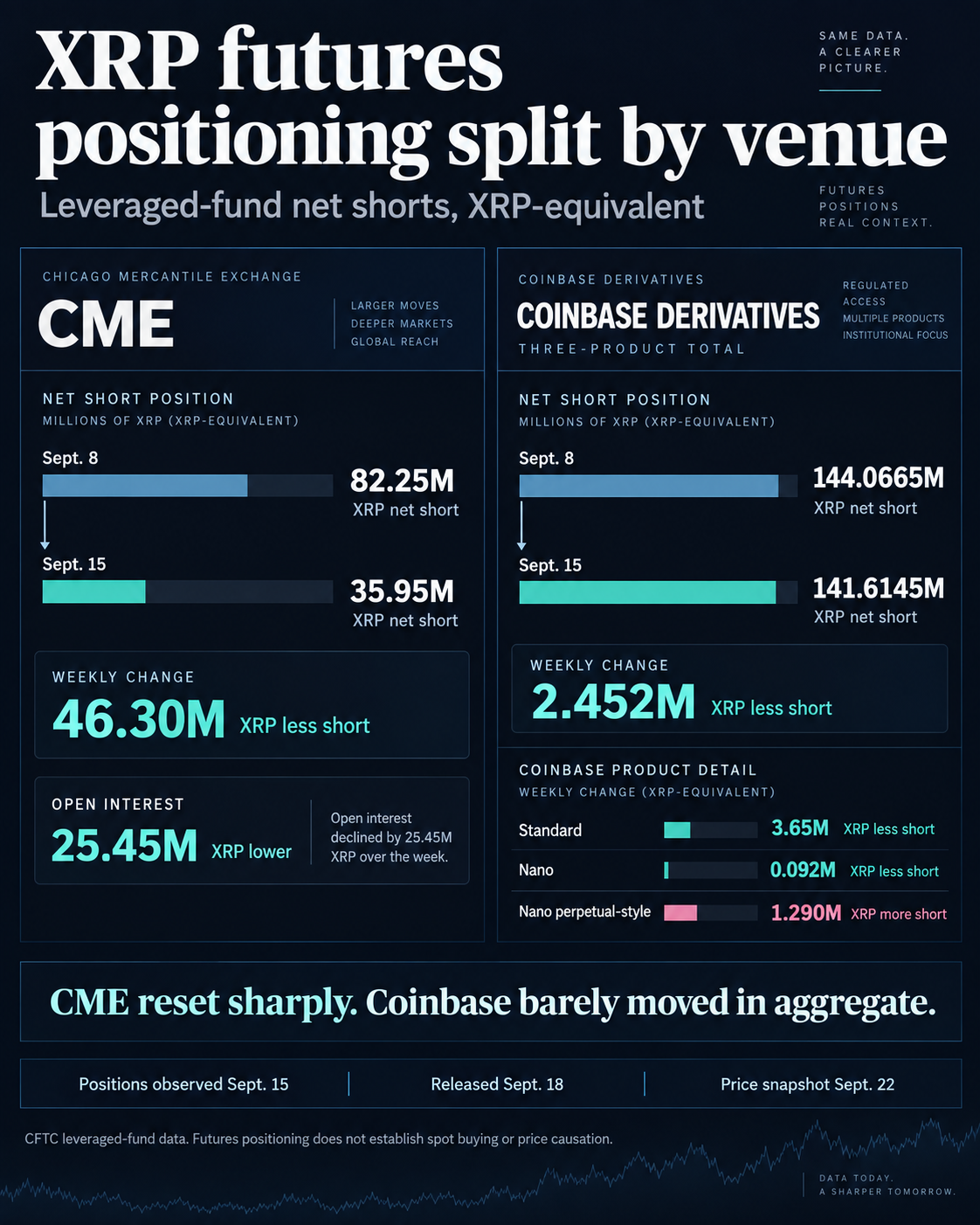
Leveraged funds reduced CME XRP-equivalent net shorts by 46.3 million in one week, while Coinbase derivatives positioning decreased by only 2.452 million.
The standard contract accounted for the majority of Coinbase’s modest improvement, while the nano contract contributed an additional reduction of 92,000 XRP. Conversely, the perpetual-style contract moved in the opposite direction: leveraged funds increased their net short position by 1.29 million XRP.
This increase offset part of the reduction seen in the other two products. The resulting aggregate Coinbase position remained nearly four times larger than the CME net short on September 15 and had moved only a fraction of the distance over the week.
Related Posts
The Coinbase perpetual-style product is structurally distinct from the unexpiring swaps commonly found on offshore exchanges. It is a regulated, five-year cash-settled future that utilizes funding adjustments. Its positioning may reflect a different mix of participants and strategies, which is why analyzing the separate product rows is significant.
Related Reading
Bitwise 14% Yield Gap in XRP Futures Shows How Institutions Are Quietly Extracting Cash from Traders
CME experienced a far larger shift than Coinbase overall, and Coinbase’s products moved in opposing directions. The combined evidence offers weak support for a market-wide directional turn.
What XRP Positioning Data Can and Cannot Show
The CFTC’s leveraged-funds category includes traders whose predominant self-reported business activity fits that classification. The report also contains a separate field for mechanical spreading positions, but neither feature definitively establishes the motive behind every long or short position.
A short position can express a bearish view, hedge spot exposure, offset another derivative, or form one side of a basis trade. Reducing a short position can reflect a bullish change, a hedge adjustment, a relative-value unwind, or a broader reduction in risk. Public aggregates do not identify individual firms or the specific economic purpose of each contract.
These limitations are crucial because the headline CME move combines rising longs, falling shorts, and lower total open interest. The supported conclusion is that leveraged-fund positioning on CME became significantly less short. Labeling the entire change as fresh directional buying, or attributing it as the cause of XRP’s later price gain, would exceed the available evidence.
The comparison is also limited to the four contract families included in the dated CFTC query, as CME lists Micro XRP as a distinct product. Under CFTC rules, a market is included in Commitments of Traders reports only when at least 20 traders hold positions at or above reporting levels.
A missing row leaves activity in another product unknown, and the reporting threshold is only one possible explanation for a specific absence.
The reporting lag now provides the next test. CFTC reports generally reflect positions as of Tuesday and are typically released on Friday at 3:30 p.m. Eastern time. The agency’s tentative 2026 schedule lists September 25 for the report that normally covers the week ending September 22.
That upcoming snapshot can show whether the cross-venue split persisted during the rally, while price causation remains outside the scope of what weekly positioning data can resolve.
A broader directional shift would gain support if Coinbase’s combined net short also fell materially, particularly alongside expanding open interest. If Coinbase remains heavily short while CME stays much less short, the data would continue to favor a venue-specific reset.
For now, three observations can stand together without being forced into a single causal story: XRP rallied, CME leveraged funds had already reduced a large net short position, and comparable Coinbase positioning had barely changed in aggregate.
The divergence is the signal, while the reason behind it remains outside what weekly category data can establish.
The post XRP Volume Surges to $7.4B as CME Short Positioning Shifts Outpace Coinbase appeared first on CryptoSlate.
