Disclaimer: Information found on CryptoreNews is those of writers quoted. It does not represent the opinions of CryptoreNews on whether to sell, buy or hold any investments. You are advised to conduct your own research before making any investment decisions. Use provided information at your own risk.
CryptoreNews covers fintech, blockchain and Bitcoin bringing you the latest crypto news and analyses on the future of money.

Why a majority of Grayscale investors could still see gains if GBTC declines an additional 20% to $27

Data from trading firm Webull indicates that approximately 70% of Grayscale GBTC holders are likely still in profit. The average purchase price of shares was $27.82, which is about 20% lower than the current price at the time of reporting.
The Webull information reflects the status of the trust just prior to its transition to a spot Bitcoin ETF, revealing that 70% of investors had acquisition costs ranging from $18.84 to $27.24.
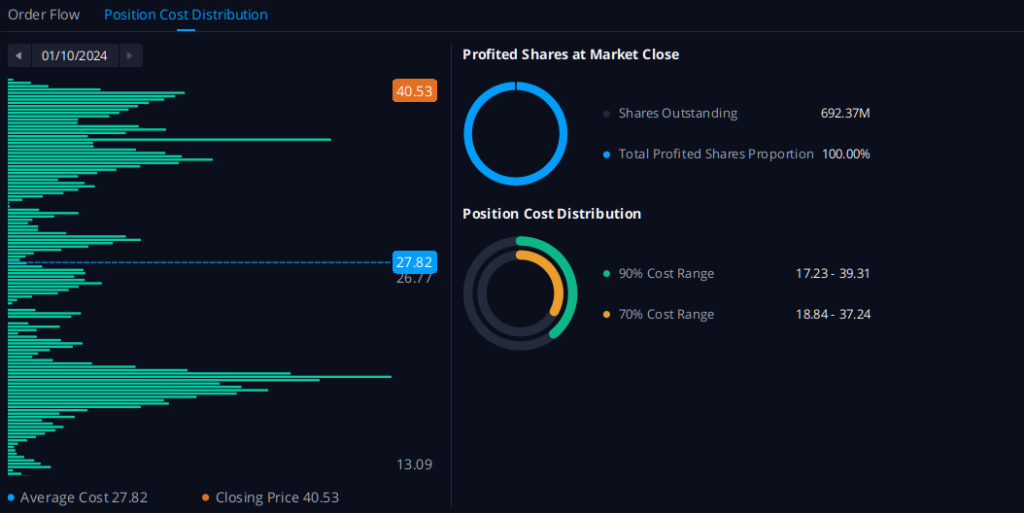 Grayscale holders in profit
Regarding distributions, the primary concentration of shareholders seems to be situated between $33 and $40. With the price at $34.9 at the time of reporting, it will be noteworthy to observe if the lower end of this range serves as a support level for the price amidst ongoing outflows.
The secondary concentration is significantly lower, falling between $18 and $21. This segment will continue to be profitable until the GBTC price decreases by another 39%.
If the price were to decline to this threshold and its assets under management experienced a similar reduction, an additional 230,000 BTC would enter the OTC market, valued at approximately $8.9 billion at the time of reporting.
This decline would leave Grayscale with around 350,000 BTC, which, at a 1.5% management fee, would still yield about $200 million in revenue if Bitcoin maintained a price of around $39,000. This highlights the minimal pressure on Grayscale to reduce fees, along with the seemingly boundless opportunity for Grayscale investors to realize profits. With limited inflows into the ETF, the proportion of investors in profit remains quite high.
Consequently, it can be argued that Grayscale’s influence on Bitcoin’s price through profit-taking could be as significant as a nearly 40% decline. For those bearish on the market, a 40% drop in Bitcoin’s price at this moment would bring it down to May 2023 lows of approximately $23,000.
Potentially 100% of Grayscale investors in profit at conversion.
Since its conversion, the ETF has experienced substantial outflows totaling around $3.5 billion. Its assets under management have decreased to $22.1 billion (552,681 BTC) from a year-to-date peak of $29 billion (623,390 BTC) on January 10. In dollar terms, its all-time high for AUM was actually further back, coinciding with the peak of the 2021 bull market at an impressive $44 billion (651k BTC).
Notably, even at the market’s peak, worries regarding the trust’s composition led to it trading at a 15% discount to its net asset value (NAV), indicating a price peak of about $58,000 instead of the spot price of $69,000. This discount continued to widen until early 2023, reaching a low of -47%.
Related Posts
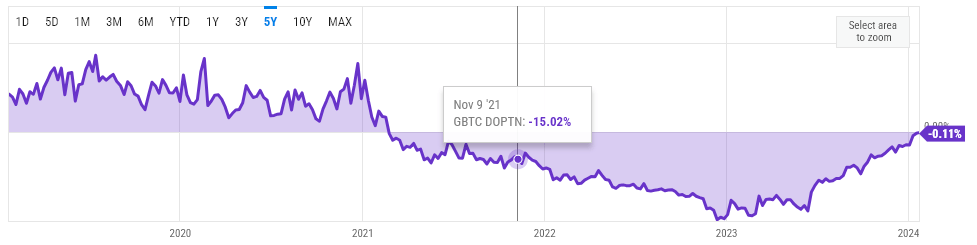 GBTC discount/premium chart
Through the application and eventual success of its transition to a spot Bitcoin ETF, the discount has nearly vanished to just -0.11% as of January 23.
Interestingly, the position cost distribution chart from Webull indicates that all investors who acquired shares at around $40.53 exited the trust prior to its conversion. In comparison to the historical NAV price chart below, GBTC predominantly traded above $40.53 for roughly 12 months between May 2021 and January 2022. However, Webull data suggest that when the trust closed on January 10, its final day before becoming an ETF, 100% of shares were profitable.
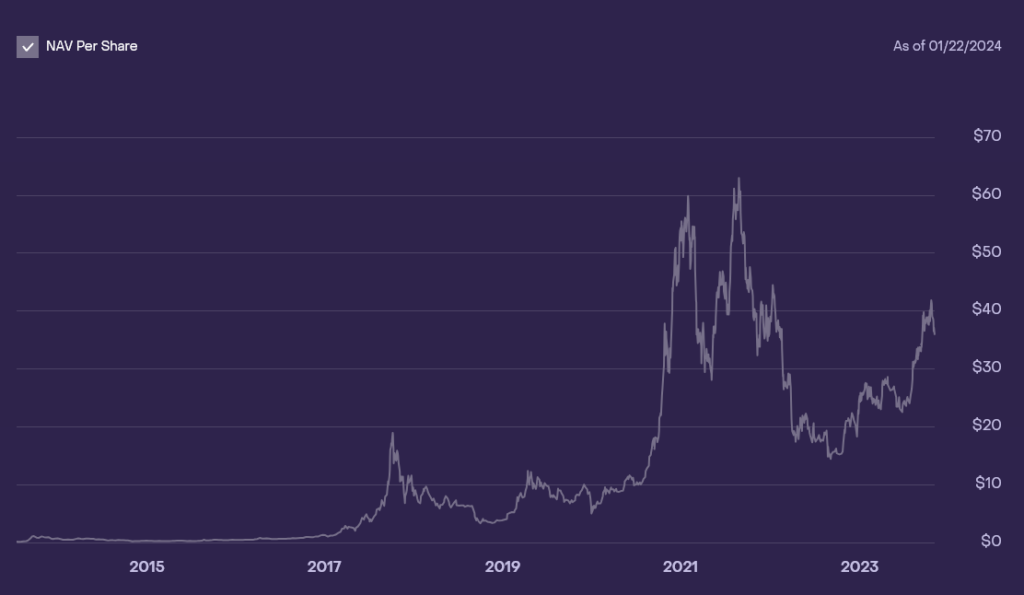 GBTC NAV over time
The TradingView chart below corroborates this assertion, as it concluded at its highest price in 17 months. What is even more surprising is the number of investors who had already exited the fund after entering at higher prices throughout 2021.
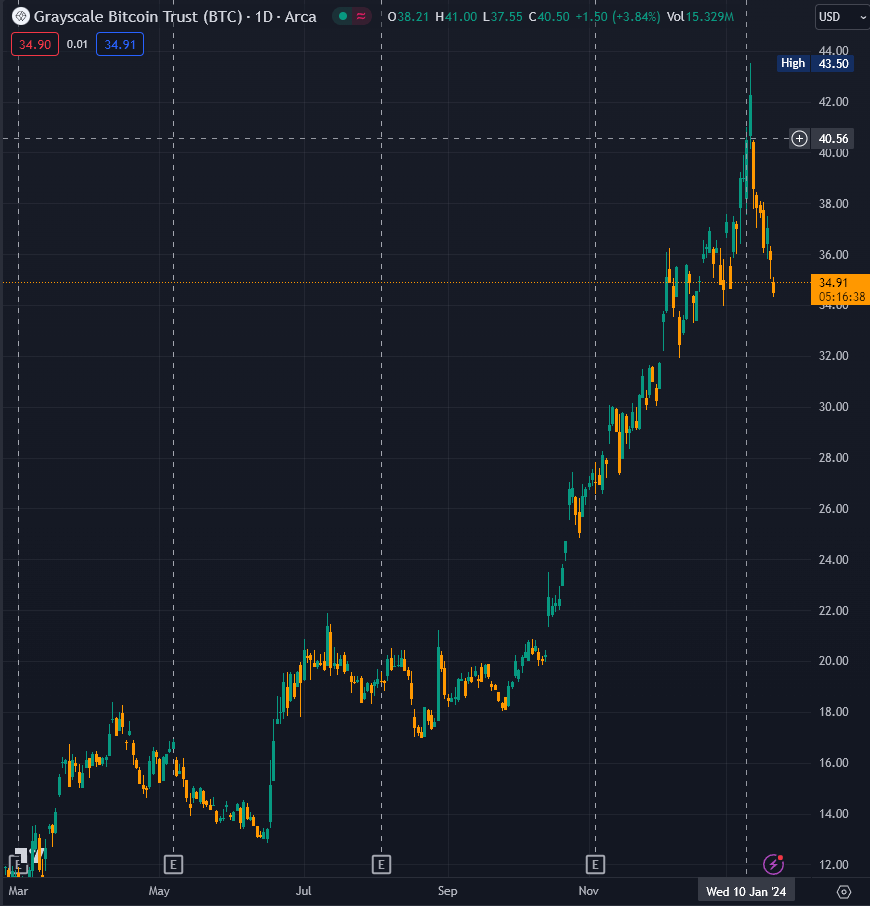 GBTC TradingView chart
Following the disclosure that a significant portion of the outflows from GBTC stemmed from FTX liquidations, many within the Bitcoin community were encouraged by the possibility of ETF outflows decelerating. However, an additional 17,000 BTC was transferred to Coinbase Prime on January 23, with net outflows of approximately 15,000 BTC, valued at around $600 million.
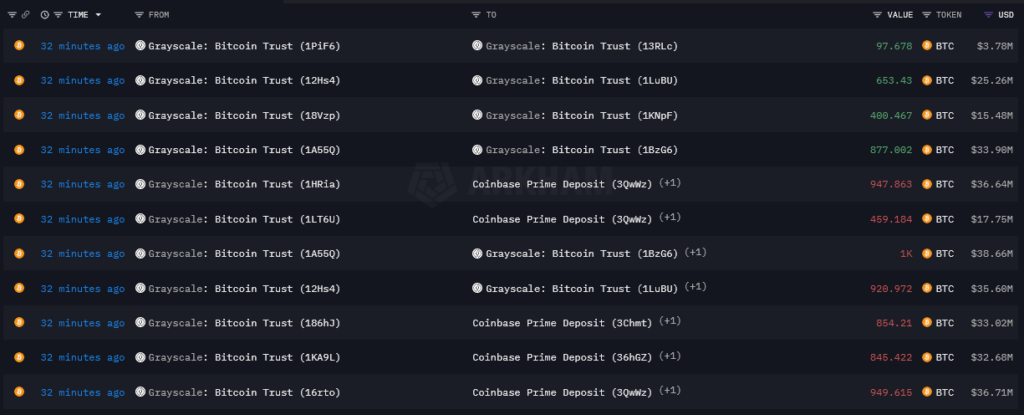 grayscale outflows (source: Arkham Intelligence)
The substantial number of investors in profitable positions places the ETF in a delicate situation regarding further outflows. Nevertheless, the effect this will have on the spot Bitcoin price will only become apparent over time. Transactions between the ETF issuers and their trading counterpart, Coinbase, occur over the counter (OTC), thus having a limited direct impact on the underlying Bitcoin price.
However, this holds true only as long as there are buyers willing to purchase Bitcoin. If OTC liquidity diminishes, the price impact could be significant. Nonetheless, given the institutional appetite for Bitcoin, it is unlikely that investors like Michael Saylor would pass up the opportunity to acquire Bitcoin at a lower price.
Bloomberg analysts, including James Seyffart, estimated that only about 33% of GBTC outflows have been redirected into other ETFs. However, if the FTX liquidations have concluded, it will be intriguing to observe whether flows eventually stabilize and the majority simply transition to lower-fee funds such as Fidelity and BlackRock, which are currently leading the Newborn Nine.
The post Why most Grayscale investors may remain in profit if GBTC falls further 20% to $27 appeared first on CryptoSlate.
