Disclaimer: Information found on CryptoreNews is those of writers quoted. It does not represent the opinions of CryptoreNews on whether to sell, buy or hold any investments. You are advised to conduct your own research before making any investment decisions. Use provided information at your own risk.
CryptoreNews covers fintech, blockchain and Bitcoin bringing you the latest crypto news and analyses on the future of money.


Bitcoin futures have become a crucial component of the cryptocurrency ecosystem. Futures are a financial tool that enables investors to purchase or sell Bitcoin at a predetermined price on a specified future date. These contracts provide traders with a means to mitigate price fluctuations, making them an essential resource for managing risk.
Perpetual futures are distinguished as a unique and significant instrument within the futures landscape. Unlike conventional futures that have a defined expiration date, perpetual futures do not expire. This feature allows traders to maintain positions indefinitely, as long as they cover periodic funding fees.
Observing the status of Bitcoin futures, particularly perpetual futures, provides insight into the overall health and sentiment of the cryptocurrency market.
One particularly revealing metric is the comparison between the annualized perpetual funding rates and their 3-month rolling basis. Historically, when the annualized funding rate increased above the 3-month rolling basis, it almost invariably indicated an approaching price decline. In contrast, a price uptrend typically followed when the annualized funding rate fell below the 3-month rolling basis or turned negative.
This trend can be linked to the demand for leverage in perpetual futures, which closely aligns with spot market price indices. Elevated demand for leverage can result in an oversupply of sell-side contracts, leading traders to arbitrage down the high funding rates.
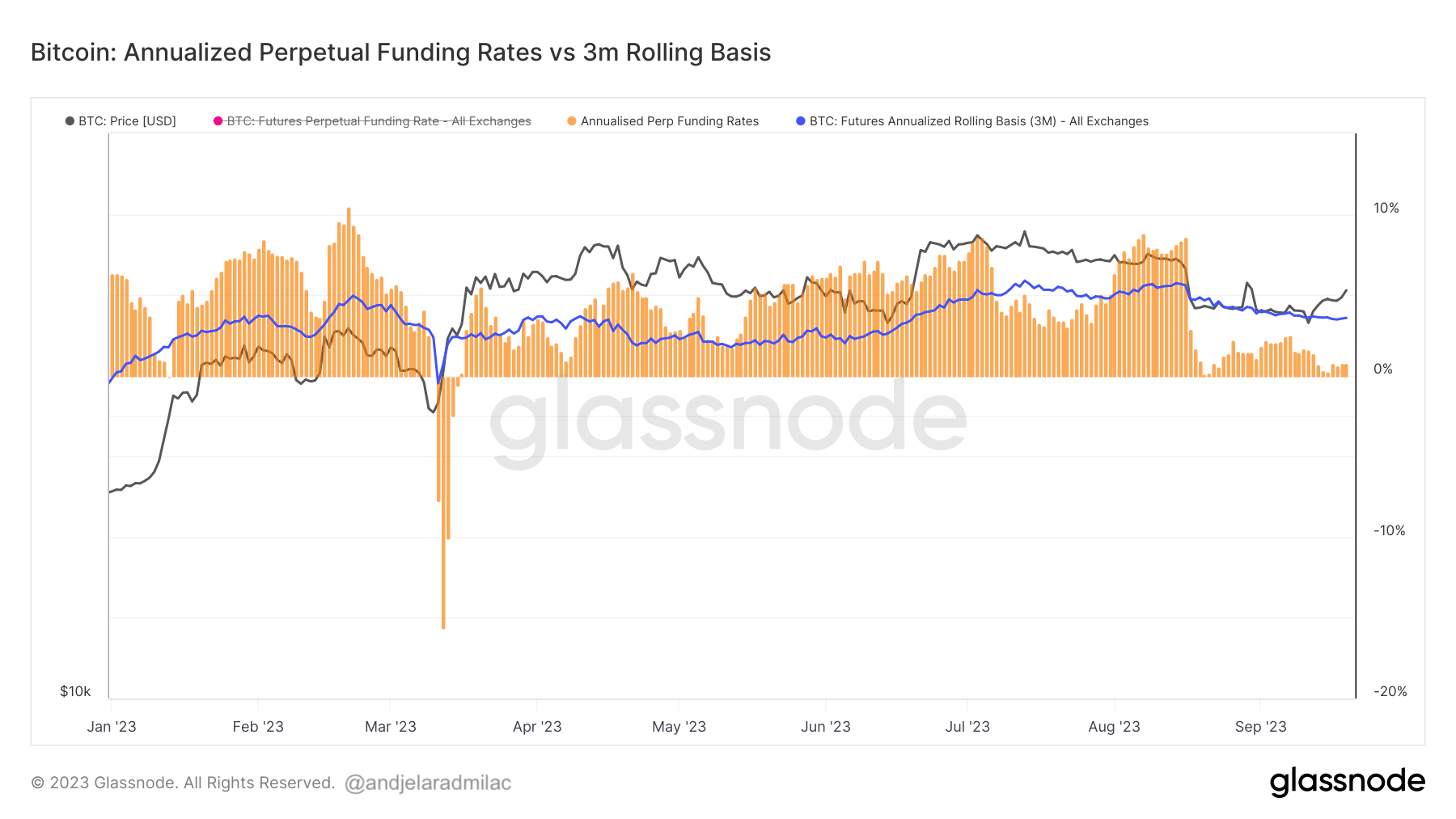 Graph comparing the annualized perpetual futures funding rate to its 3-month rolling basis in 2023. Note how the annualized rate trends above the 3-month rolling basis during price uptrends (Source: Glassnode)
A recent example occurred on Aug. 17, when the annualized perpetual funding rate fell below the 3-month rolling basis. This change coincided with a notable decline in Bitcoin’s price, which dropped from $29,200 on Aug. 15 to $26,000 on Aug. 18.
As of Sep. 19, the annualized perpetual funding rate remains below the 3-month rolling basis, recorded at 0.782%, while the 3-month rolling basis is at 3.574%. This indicates that the market is currently undergoing a de-risking phase, often seen following a downward price movement or during bearish trends.
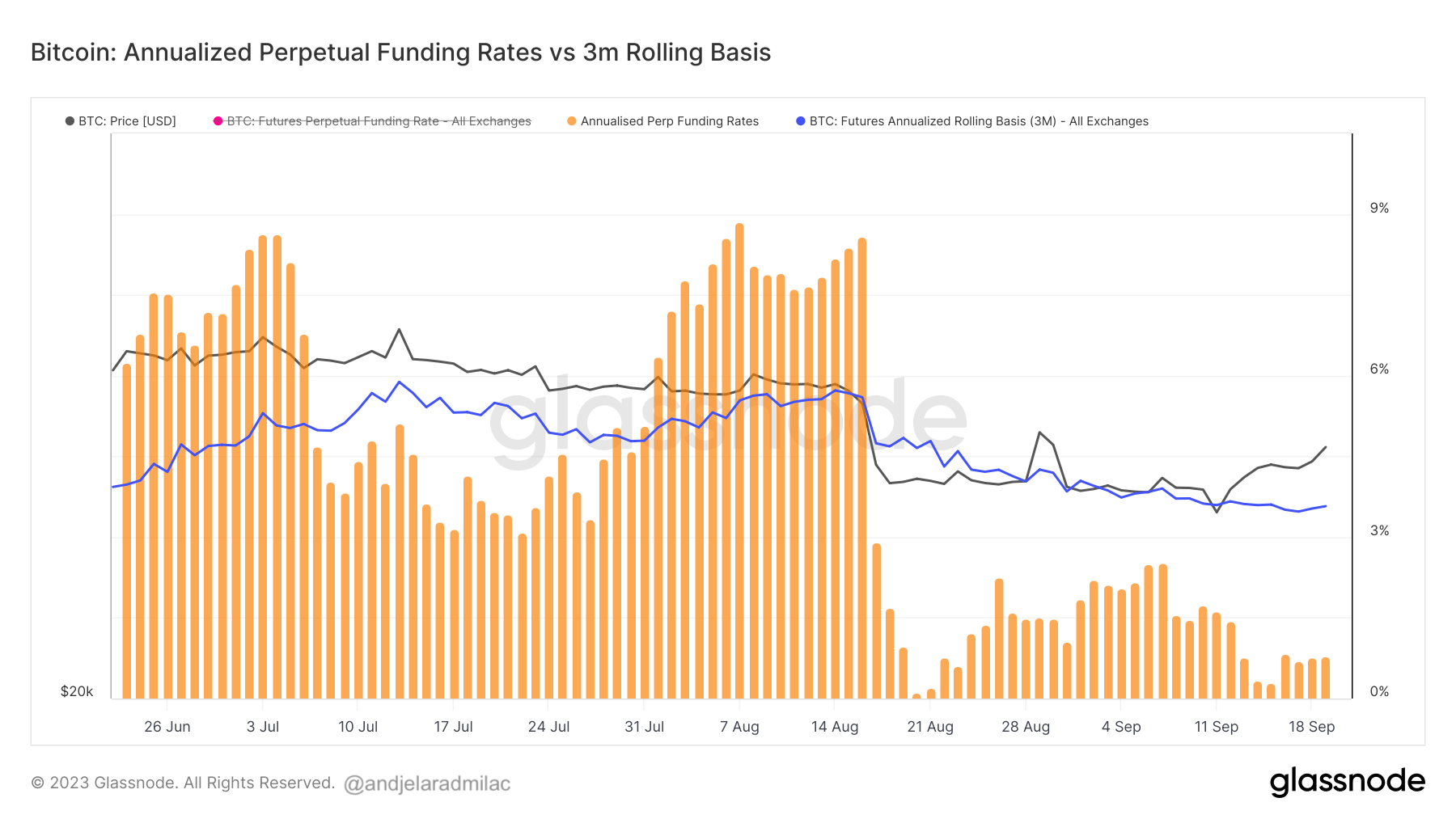 Graph comparing the annualized perpetual futures funding rate to its 3-month rolling basis from June 22 to Sep. 20, 2023 (Source: Glassnode)
Related Posts
Another important metric is the futures open interest leverage ratio. This ratio, derived by dividing the market open contract value by the asset’s market capitalization, illustrates the level of leverage in the market relative to its size.
High values suggest a significant open interest compared to the market size, increasing the risk of short/long squeezes or liquidation events. Conversely, low values indicate a more stable market environment with a diminished risk of forced buying or selling.
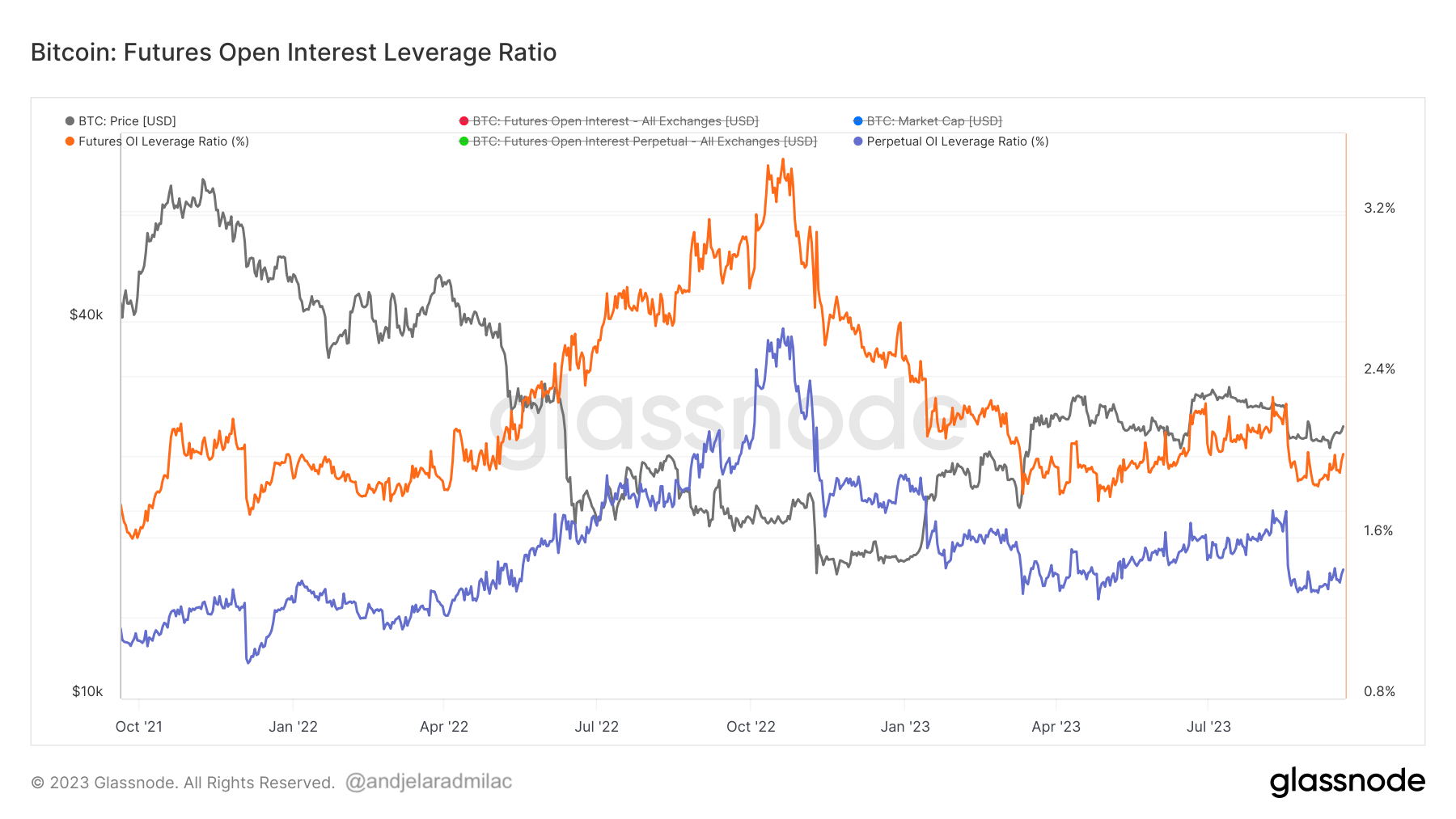 Graph showing the open interest leverage ratio for perpetual futures (blue) and futures (orange) from Sep. 20, 2021, to Sep. 20, 2023 (Source: Glassnode)
On Aug. 17, a notable drop in this ratio was recorded, indicating a significant deleveraging event in the market. By Sep. 19, the futures open interest leverage ratio was at 2%, with the perpetual open interest leverage ratio at 1.439%. These figures represented an increase from 1.9% and 1.3% since Sep. 18, correlating with Bitcoin’s price rise above $27,000.
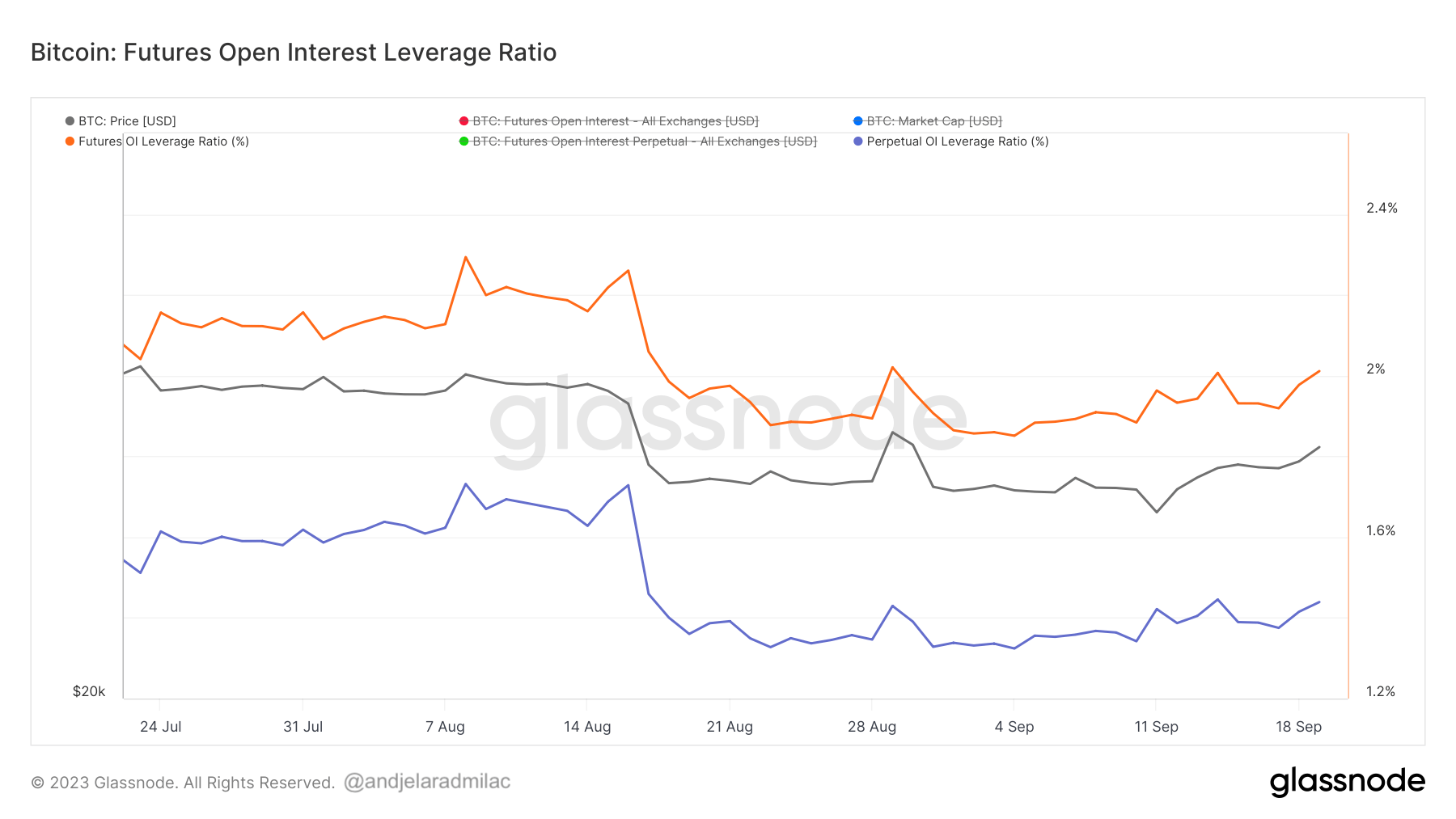 Graph showing the open interest leverage ratio for perpetual futures (blue) and futures (orange) from July 23 to Sep. 20, 2023 (Source: Glassnode)
As indicated by the annualized funding rate and its 3-month rolling basis, the current de-risking environment may reflect caution among traders, possibly in anticipation of further price movements or external market influences. The recent rise in the futures open interest leverage ratio suggests renewed confidence among traders, particularly following the sharp decline in the ratio noted on Aug. 17.
However, an increasing leverage ratio can present risks. While it may signify robust market engagement, it can also elevate the potential for short/long squeezes and heighten the chances of liquidation cascades.
These metrics illustrate a market that is proceeding with caution. Traders are balancing their optimism with prudence, preparing for the volatility they expect to encounter.
The post What perpetual futures tell us about the current Bitcoin market appeared first on CryptoSlate.
