Disclaimer: Information found on CryptoreNews is those of writers quoted. It does not represent the opinions of CryptoreNews on whether to sell, buy or hold any investments. You are advised to conduct your own research before making any investment decisions. Use provided information at your own risk.
CryptoreNews covers fintech, blockchain and Bitcoin bringing you the latest crypto news and analyses on the future of money.


Standard Chartered has maintained its forecast for Bitcoin to reach $100,000 by December 31, despite the cryptocurrency briefly dropping below $60,000 last week for the first time since October 2024.
Geoffrey Kendrick, the bank’s global head of digital assets research, described the selloff as “painful” but argued that the bulk of the selling pressure may have passed. He added that investors might later view this price zone as the buying opportunity they had been waiting for.
With Bitcoin trading around $63,400, reaching $100,000 by the end of the year would require roughly a 57.8% upside over approximately 206 days. This equates to a compounded daily gain of about 0.22%, or 7% per month.
Bitcoin has matched that pace before, but the market has repriced the probability of it happening again.
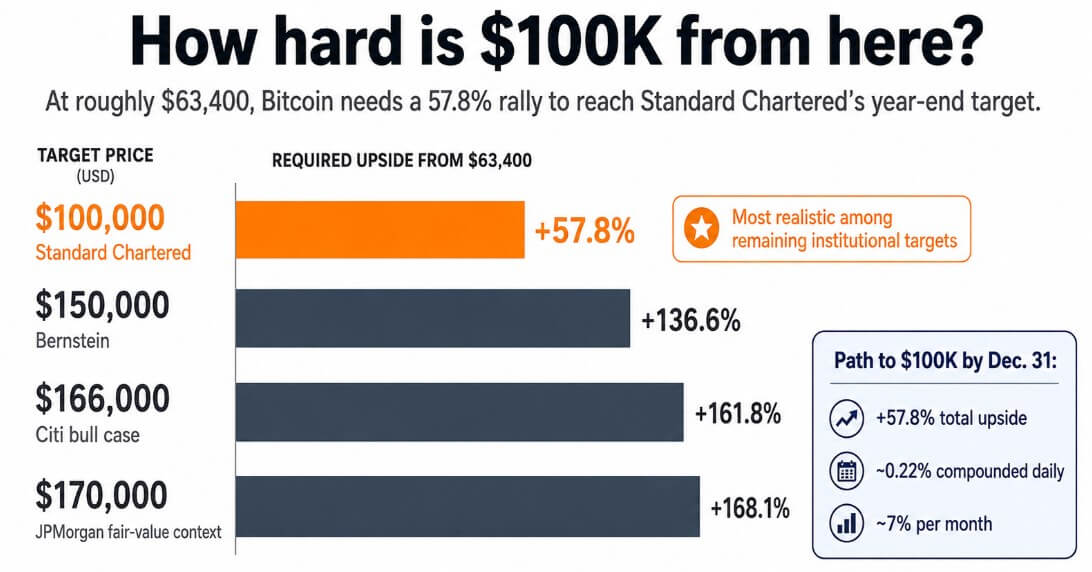
Standard Chartered’s $100,000 year-end Bitcoin target requires a 57.8% upside from $63,400, representing the smallest required gain among four major institutional price targets.
What’s driving the damage
The selloff that pushed Bitcoin toward $60,000 was driven by record ETF outflows, Strategy’s first Bitcoin sale since 2022, and forced liquidations totaling $1.8 billion in a single session.
This combination drove the Crypto Fear and Greed Index to 12, leaving Bitcoin more than 51% below its October 2025 all-time high. US-traded spot ETFs shed roughly $4.4 billion across 13 consecutive outflow sessions, while institutional money rotated into AI stocks.
Strategy’s sale of 32 BTC hit the market as a psychological shock, triggering a selloff disproportionate to the size of the sale. Kendrick acknowledged the timing was unfortunate but cited the company’s history of buying back more than it sold after each prior sale.
Strategy disclosed a new purchase between June 1 and June 7, which Kendrick cited as evidence that the aggressive buying pattern he predicted had already begun.
The bank had cut its year-end target twice before this reaffirmation, reducing it from $300,000 in December to $150,000 in January, and then to $100,000 in February. The June 4 post-crash hold marks its first confirmation since the drawdown accelerated.
Four conditions
The path to $100,000 requires four conditions to align, starting with ETF outflows no longer setting the marginal price. After a record 13-session outflow streak, flows turned slightly positive by early June, giving bulls a concrete reversal trigger to monitor.
Strategy must remain a buyer, a move supported by the June purchase, and regulatory progress on the CLARITY Act must re-enter the institutional calculus.
The fourth condition is that Bitcoin must reclaim its key trend levels: the 30-day moving average near $75,685 and the 200-day moving average near $78,840. These represent the technical threshold separating a crash recovery from a renewed uptrend.
| Condition | Current signal | Bullish confirmation |
|---|---|---|
| ETF flows stabilize | Spot Bitcoin ETFs just exited a 13-session outflow streak totaling roughly $4.4B | Multiple weeks of net inflows |
| Strategy remains a buyer | Strategy sold 32 BTC, then disclosed a new June 1-7 purchase | Continued purchases without further symbolic sales |
| Regulatory momentum returns | CLARITY Act progress is still uncertain | Senate floor scheduling or clearer market-structure path |
| Bitcoin reclaims trend levels | BTC remains below the 30-day MA near $75,685 and 200-day MA near $78,840 | Sustained move above $75K-$79K |
Grayscale has argued that the four-year cycle thesis will prove wrong in this era of institutional capital, with steadier inflows replacing the old boom-bust rhythm. This view would support a faster recovery than historical patterns imply.
Fidelity’s analysts are split, with some supporting the supercycle thesis and others, such as macro director Jurrien Timmer, arguing that the traditional cycle pattern stays intact.
Related Posts
Bernstein set a $150,000 year-end target as recently as March 24 and called the current drawdown the “weakest bear case in Bitcoin’s history.” It sits on the more aggressive end of the still-bullish spectrum, though the firm has not freshly reaffirmed that call since the crash.
Citi’s base case sits above $100,000 even after a March target reduction, and its bull case runs to approximately $166,000. However, reaching either number from $63,400 requires 76.7% and 162% upside, respectively, making Standard Chartered’s $100,000 target the most defensible of the remaining institutional targets.
A cycle bottom that comes too late
Cycle analysts tracking the 2024 halving rhythm place the historical bottom window at approximately day 900 after the halving.
With the current cycle at day 775, there are roughly 125 days before that window opens, pointing to an October bottom. Prior cycles suggest a low in the $40,000s.
Under that timing, a hypothetical bottom at $50,000 in October would require approximately 0.76% compounded daily through December 31 to reach $100,000. This is over three times the daily pace implied by Standard Chartered’s current target from today’s price.
Prediction market traders on Kalshi assign a 66% probability that Bitcoin will drop below $55,000 this year and a 50% probability of sub-$50,000 prices.
A separate Kalshi market puts the probability of Bitcoin dropping under $50,000 this year at 52%, a level last seen in August 2024. Those odds reflect that capital rotating into AI stocks, semiconductor ETFs, and high-profile IPOs may be a lasting reallocation, with no obvious catalyst to pull it back into Bitcoin on a short timeline.
A sustained break below the $60,000 floor over multiple sessions, producing lower lows and lower highs, would shift traders’ focus toward the $50,000 area and the 200-week moving average at $61,778, which Bitcoin touched last week for the first time since 2023.
The global regulatory backdrop sharpens that risk, as EU MiCA enforcement begins July 1. After that date, crypto-asset service providers without a license must stop serving EU clients, removing a layer of regulatory optionality that had provided some institutional cover for holding the asset through uncertainty.

Where the probability stack sits
JPMorgan’s fair-value model, built on a volatility-adjusted gold comparison, points toward $170,000, though that estimate predates the crash and functions as long-term context rather than a near-term price call.
Galaxy Digital’s Alex Thorn reportedly trimmed his 2026 Bitcoin legislative passage estimate from 75% to 60% due to Senate calendar risk.
The resulting probability stack includes Standard Chartered at $100,000, Bernstein’s standing $150,000 target, Citi’s reduced but still above-$100,000 base case, and Kalshi’s markets pricing only a 21% chance that Bitcoin crosses $100,000 before January 2027.
| Source / market | Signal | Interpretation |
|---|---|---|
| Standard Chartered | $100K by Dec. 31 | Fresh post-crash reaffirmation |
| Citi base case | Above $100K | Reduced but still bullish |
| Bernstein | $150K | Standing target, not freshly reaffirmed after crash |
| JPMorgan model | $170K | Older fair-value context |
| Kalshi: BTC crosses $100K before Jan. 2027 | 21% | Market prices $100K as possible, not probable |
| Kalshi: BTC below $55K this year | 66% | Traders still price downside risk |
| Kalshi: BTC below $50K this year | 50%-52% | Drawdown risk remains central |
That disconnect between analyst targets and market-priced outcomes is the most accurate summary of where things stand.
The $100,000 call has shifted from a bull market assumption to a stress test of whether ETF demand, Strategy buying, regulatory momentum, and macro relief can overpower a damaged tape before the calendar runs out.
Standard Chartered’s Geoffrey Kendrick is the only major institutional voice to have explicitly reaffirmed $100,000 after Bitcoin’s crash below $60,000. The next decisive test sits at whether the asset can reclaim $75,000 before the four-year cycle’s projected bottom window opens in October.
The post Wall Street Maintains $100,000 Bitcoin Target as Market Sentiment Weakens appeared first on CryptoSlate.
