Disclaimer: Information found on CryptoreNews is those of writers quoted. It does not represent the opinions of CryptoreNews on whether to sell, buy or hold any investments. You are advised to conduct your own research before making any investment decisions. Use provided information at your own risk.
CryptoreNews covers fintech, blockchain and Bitcoin bringing you the latest crypto news and analyses on the future of money.


Crypto users spent years establishing USDC as the default dollar for institutional DeFi trading, lending, and settlement, but Open Standard’s new Open USD stablecoin is testing whether the dollars users hold can generate returns.
Open Standard states that businesses will be able to mint and redeem Open USD at no cost, with unlimited volume, and that reserve earnings will flow to partner businesses after a management fee is deducted.
The initiative already boasts over 140 businesses, including Visa, Mastercard, and Coinbase. Open Standard designs the project around scale, default earnings, and a governance board composed of partner businesses.
This structure marks a significant shift in the stablecoin wars, which have evolved from a trust battle between Tether and Circle, to a compliance contest where regulations like GENIUS and MiCA favored regulated issuers, and then to a distribution fight as payment networks and exchanges competed for placement on apps and rails.
Open USD pushes this competition into a new phase, focused on incentives: determining who gets paid to hold, route, and lend the next digital dollar.
DeFi commentator Ignas noted that crypto-native users built USDC’s liquidity, volume, and user habits, while the economic upside primarily benefited Circle, Coinbase, and their distribution partners.
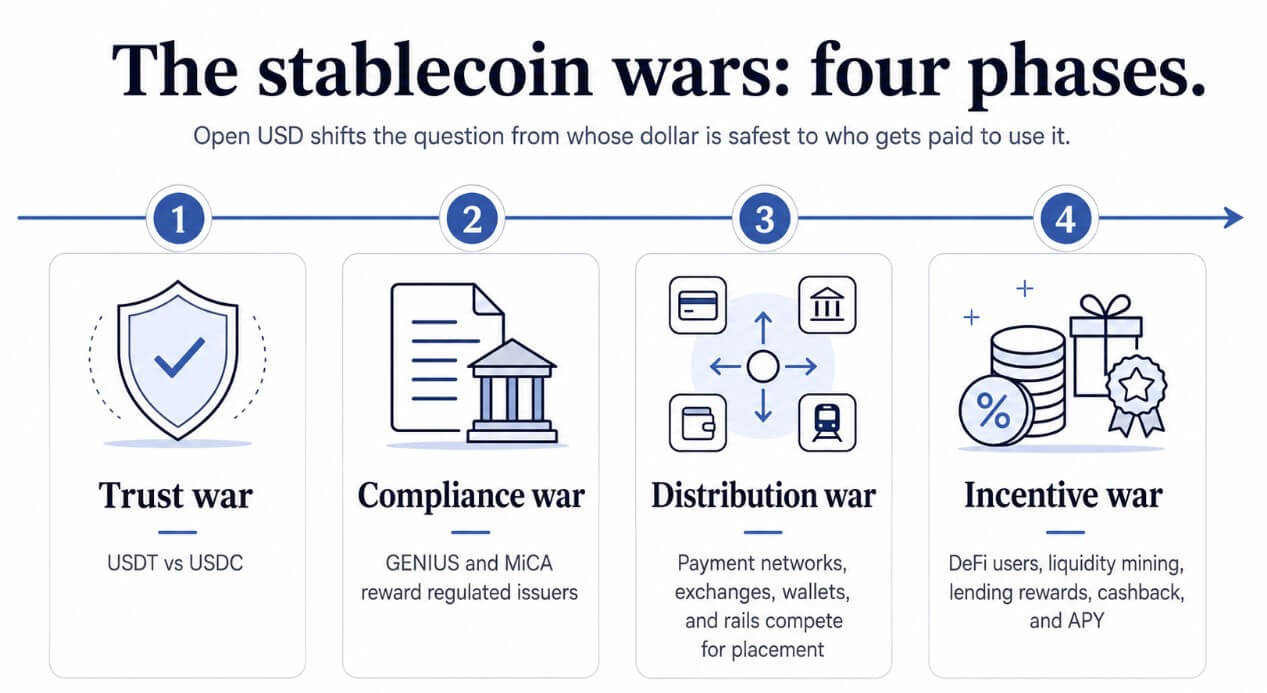
A diagram titled “The stablecoin wars: four phases” outlines the escalation from trust (USDT vs USDC) through compliance, distribution, and finally an incentive war over DeFi rewards.
Where the money could go
Plasma serves as a key test to see if this behavior finds a new home, as the network already markets itself around stablecoin spending, saving, sending, and earning through Plasma One, a product offering instant transfers, global spending, cashback, and balance-based earnings.
Open USD is scheduled to launch with native support on Plasma and Tempo later this year. If this materializes, reserve economics designed for institutions could reach DeFi users directly through chain-level rewards.
A partner collecting reserve-share income could convert it into liquidity mining on a decentralized exchange, boosted lending rates on Open USD collateral, wallet cashback, or routed rebates via a bridge.
| Incentive route | Who could fund it | What users see | DeFi impact |
|---|---|---|---|
| DEX liquidity mining | Chains, protocols, or Open USD partners | Rewards for supplying Open USD liquidity | Builds trading depth and tighter stablecoin swaps |
| Lending-market boosts | Lending protocols or ecosystem funds | Higher APY for supplying Open USD collateral | Makes Open USD useful in DeFi leverage loops |
| Wallet cashback | Wallets, payment apps, or card partners | Rewards for spending, holding, or routing Open USD | Turns stablecoin adoption into consumer habit |
| Bridge/routing rebates | Bridges, chains, or aggregators | Lower fees or rebates for moving Open USD | Pulls settlement volume across preferred rails |
| Exchange campaigns | CEX partners | Fee discounts, earn products, or trading rewards | Helps Open USD compete with USDC and USDT liquidity |
Each of these routes places the incentive in a partner’s hands, keeping Open USD within the regulatory lines drawn around stablecoin interest.
The GENIUS Act prohibits stablecoin issuers from paying interest directly to holders, leaving open the question of how much affiliates and third parties can offer interest.
Coinbase already pays rewards on USDC balances, and PayPal pays them on PYUSD, a structure banks have criticized as a workaround that withdraws deposits from the regulated banking system.
Related Posts
Open USD’s partner list, which already includes wallets, exchanges, and DeFi protocols such as Aave, Morpho, MetaMask, and Trust Wallet, sits within this same gray zone.
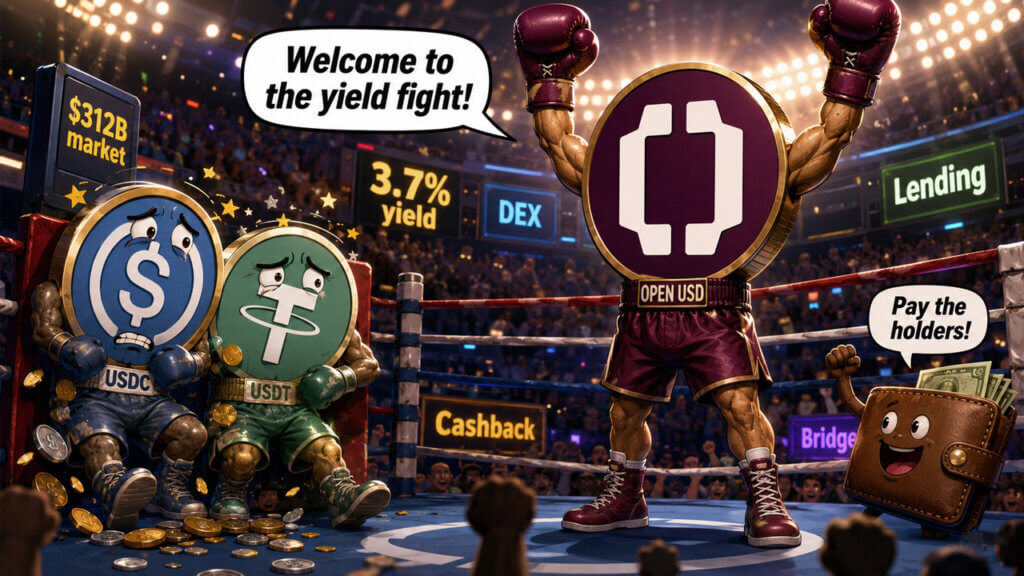
How big the prize is, and how it breaks
The market Open USD is entering is large enough to make this gray zone worth fighting over.
DeFiLlama reports the total stablecoin supply at nearly $312 billion, with USDT at approximately $184.6 billion and USDC at around $73.9 billion. Citi has raised its 2030 stablecoin forecast to $1.9 trillion in its base case and $4 trillion in its bull case, citing faster growth and a wave of new issuer announcements.
At a 3.7% yield, roughly where short-term Treasury bills trade currently, every $1 billion of Open USD in circulation would generate about $37 million a year in gross reserve income before fees and costs.
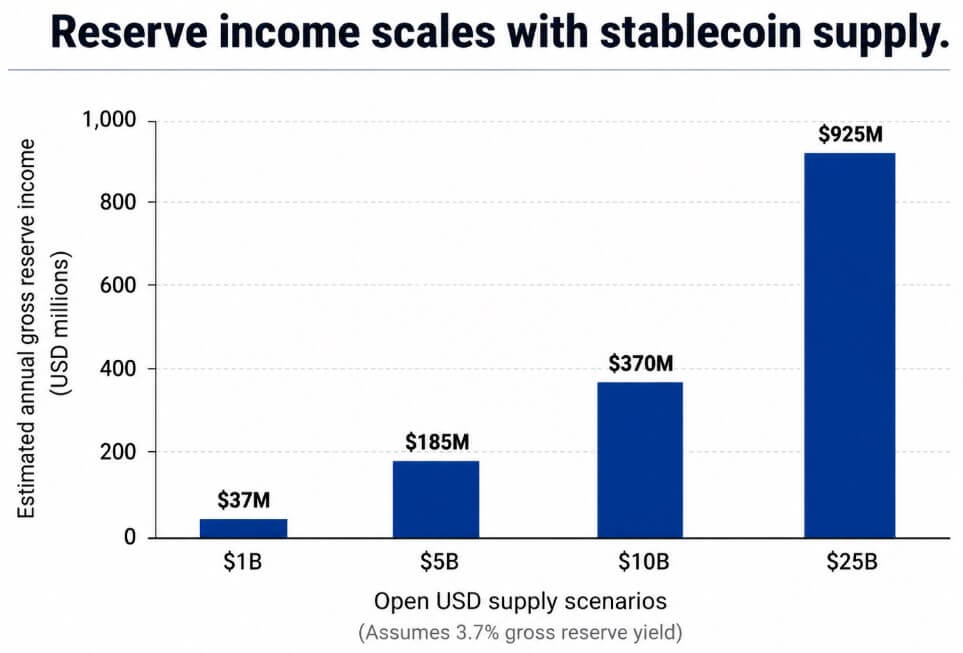
A bar chart shows estimated annual gross reserve income for Open USD scaling from $37 million at $1 billion supply to $925 million at $25 billion, assuming a 3.7% yield.
Circle’s first-quarter 2026 results show the pool is already in motion: $653 million in reserve income against $407 million in distribution, transaction, and other costs, a figure Circle attributes to higher payments to partners.
Circle’s 2025 annual filing also disclosed that it shares reserve-related income directly with Coinbase to maintain USDC liquidity and widespread usage, the same playbook Open USD is now applying to a much larger partner list from the start.
Markets reacted immediately, and Circle shares fell as much as 17% intraday on the day of the announcement, touching a low near $63 as investors priced in a direct hit to the reserve income that funds Circle’s business.
The favorable path sees Plasma, Tempo, wallets, and DeFi protocols turning their share of reserve income into liquidity campaigns almost immediately. Open USD pools appear on Plasma-native exchanges, lending markets accept the token as collateral, and wallets layer cashback on top of chain-level rewards.
Early liquidity concentrates, so even a modest pass-through rate compounds into a meaningful subsidy, the kind of yield that pulls deposits away from USDC and USDT pools while Open USD remains marketed strictly as a payments token.
The less favorable path leaves reserve income wherever it lands. Payment firms and exchanges treat their share as margin; DeFi incentives remain occasional and temporary; and Open USD circulates mostly within enterprise settlement rails.
Users stick with USDC or USDT, which already possess the liquidity depth and collateral support a stablecoin needs to be useful at scale, an advantage Open USD has yet to match.
The fight now spans reserve economics among issuers, distribution among payment firms, and settlement volume among chains, but crypto’s most reliable users care less about who wins than about who pays them the most to hold the next digital dollar.
The post Visa, Mastercard and Coinbase Back Open USD as Stablecoin Incentive War Heats Up appeared first on CryptoSlate.
