Disclaimer: Information found on CryptoreNews is those of writers quoted. It does not represent the opinions of CryptoreNews on whether to sell, buy or hold any investments. You are advised to conduct your own research before making any investment decisions. Use provided information at your own risk.
CryptoreNews covers fintech, blockchain and Bitcoin bringing you the latest crypto news and analyses on the future of money.


The following is a guest contribution by Rajagopal Menon, the Vice President of WazirX.
As the bull market approaches, new models emerge to forecast Bitcoin’s price. During the last bull market in 2021, the Stock-to-Flow (S2F) model gained significant attention. Developed by Plan B, this model evaluated asset scarcity by comparing existing stock to annual production. When applied to Bitcoin, the S2F model highlighted its potential as ‘digital gold’ and offered long-term price predictions based on scarcity. However, the S2F model lost prominence during the crypto winter of 2022.
Nevertheless, in the current bull market, a new model has emerged – the Power Law Model, which claims to predict Bitcoin’s price with notable accuracy.
Understanding Power Laws
In a universe that often appears chaotic and random, researchers have identified underlying patterns and relationships known as power laws. These laws offer a framework for comprehending how various phenomena interact, revealing consistent mathematical patterns that govern different aspects of our world.
Power Laws in Everyday Life
Power laws represent intriguing mathematical relationships that manifest in a wide array of phenomena, providing insights into the fundamental simplicity of complex systems. They illustrate how two quantities relate, with a change in one leading to a proportional change in the other. This relationship spans various scales, from the microscopic to the cosmic, impacting biology, society, technology, and natural events.
The Size Limits of Animals
Galileo’s square-cube law serves as a classic illustration of a power law in nature, explaining how an animal’s size influences its strength. As animals increase in size, their volume and weight grow at a much faster rate than their strength. This law establishes natural limits, clarifying why larger animals possess thicker bones and why the largest species are typically found in aquatic environments where buoyancy counteracts weight.
Metabolic Rates
Research by Max Kleber on metabolic rates further illustrates the relevance of power laws. It shows that an organism’s metabolic rate scales to the ¾ power of its mass, suggesting that larger animals exhibit greater energy efficiency. This principle has significant implications for understanding the lifecycles, growth rates, and sustainability of various species.
Natural Phenomena and Human Activities
Power laws govern a variety of phenomena, from the distribution of earthquake magnitudes to the frequency of words in a language. They elucidate why we observe a limited number of significant events alongside a multitude of smaller occurrences. For instance, Zipf’s law describes word frequency in languages, emphasizing the disproportionate prevalence of common words compared to rarer ones.
Beyond Natural Phenomena
Power laws also extend into human endeavors such as economics, finance, and technology. They clarify wealth distribution, where a small number of individuals hold a substantial portion of wealth. In the realm of technology, power laws illustrate how content interacts online, with a few highly popular nodes and many less popular ones creating a long tail distribution.
Related Posts
Bitcoin’s Power Law
Astrophysicist Giovanni Santasi identified this connection, stating that 15 years of data indicate Bitcoin adheres to a power law principle. Santostasi first introduced the power law model in the r/Bitcoin subreddit in 2018, but it gained renewed attention in January after finance YouTuber Andrei Jeikh discussed it with his 2.3 million subscribers in a video.
Giovanni’s theory posits that Bitcoin’s price is not as random as it appears. While there is an element of randomness, over the long term, Bitcoin’s price aligns with a specific mathematical model. It is not merely a mathematical equation that someone drew a line through; rather, it follows a power law akin to those observed throughout the universe.
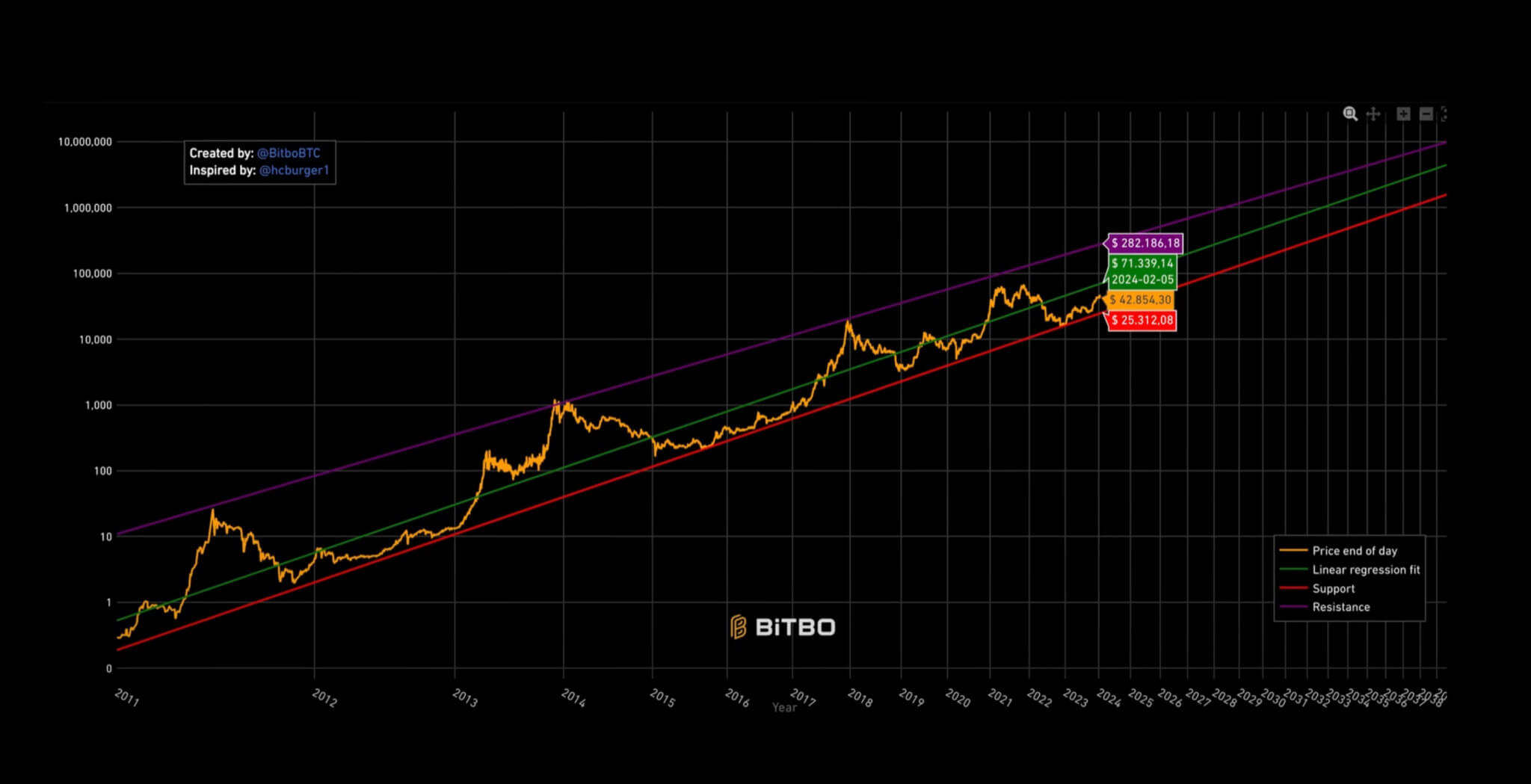
The yellow line indicates the current price, while the red line denotes the support line, the level Bitcoin typically does not fall below. The green line represents the linear regression line, akin to the fair value price that Bitcoin is expected to revert to, and the purple line signifies the resistance line that Bitcoin generally reaches before a decline.
Predicting Bitcoin’s Future
Santostasi’s Power Law Model accurately charts Bitcoin’s price trajectory. It features a graph that displays Bitcoin’s current price, a support line indicating the level Bitcoin usually does not drop below, a linear regression line representing a fair value price, and a resistance line denoting the level Bitcoin typically attains before a downturn.
This model highlights the notably linear growth of Bitcoin, particularly when outliers are excluded. Despite occasional variations, Bitcoin’s overall trajectory follows a recognizable pattern reminiscent of other phenomena governed by power laws.
Implications for Investors
The Power Law Model provides compelling insights into Bitcoin’s potential future peaks. Santostasi’s analysis suggests that Bitcoin could reach a peak of $210,000 in January 2026, followed by a decline to approximately $60,000. He further predicts that Bitcoin will attain a value of $1 million by July 2033. While mathematical models offer valuable insights, they are not infallible and may overlook unforeseen events that could significantly affect prices.
The phrase “All models are broken but some are useful” implies that while models may not be flawless, they can still yield valuable insights. Models, such as the power law model or the stock-to-flow model for predicting Bitcoin’s price, have their shortcomings and limitations. For instance, Julio Marino from Crypto Quant highlighted issues with the power law model, including underestimating errors and creating a misleading impression of accuracy.
Interestingly, both the power law and stock-to-flow models have encountered similar criticisms. Despite their imperfections, they have historically produced nearly identical predictions for Bitcoin’s price. However, over time, their forecasts may diverge.
This raises the question: if these models are accurate, why continue with traditional investment strategies like the 60/40 portfolio? Some contend that new models explaining Bitcoin’s behavior could yield superior returns.
While some may dismiss these models as worthless, others, including the author, believe they still possess value. Scarcity, driven by Bitcoin’s fixed supply, contributes to its price appreciation. Additionally, factors such as M2 growth also affect Bitcoin’s price.
Although models can provide useful insights, they cannot foresee the future. Even with their flaws, Bitcoin’s trajectory appears to be upward. Thus, while it is crucial to consider these models, it is equally important to acknowledge their limitations.
The post Using Power Laws to predict when the Bitcoin price will hit $1 million appeared first on CryptoSlate.
