Disclaimer: Information found on CryptoreNews is those of writers quoted. It does not represent the opinions of CryptoreNews on whether to sell, buy or hold any investments. You are advised to conduct your own research before making any investment decisions. Use provided information at your own risk.
CryptoreNews covers fintech, blockchain and Bitcoin bringing you the latest crypto news and analyses on the future of money.

US Bitcoin National Defense Strategy advocates for ‘Mutually Assured Preservation’ – Lowery

US Space Force Major and author of “Softwar,” Jason Lowery, urges the United States to reevaluate Bitcoin’s function through a proposed US Bitcoin National Defense policy. He argues that Bitcoin serves as a strategic asset for national defense by utilizing physical power to safeguard cyberspace, highlighting its importance beyond just a financial instrument.
In 2021, Lowery presented the diagram below to illustrate how Bitcoin could supplant the existing system, which he describes as “the chain of custody for [land, gold, oil, and equities] is written in blood.” He further remarked,
“Not having to waste human life to defend monetized wealth is worth every watt.”
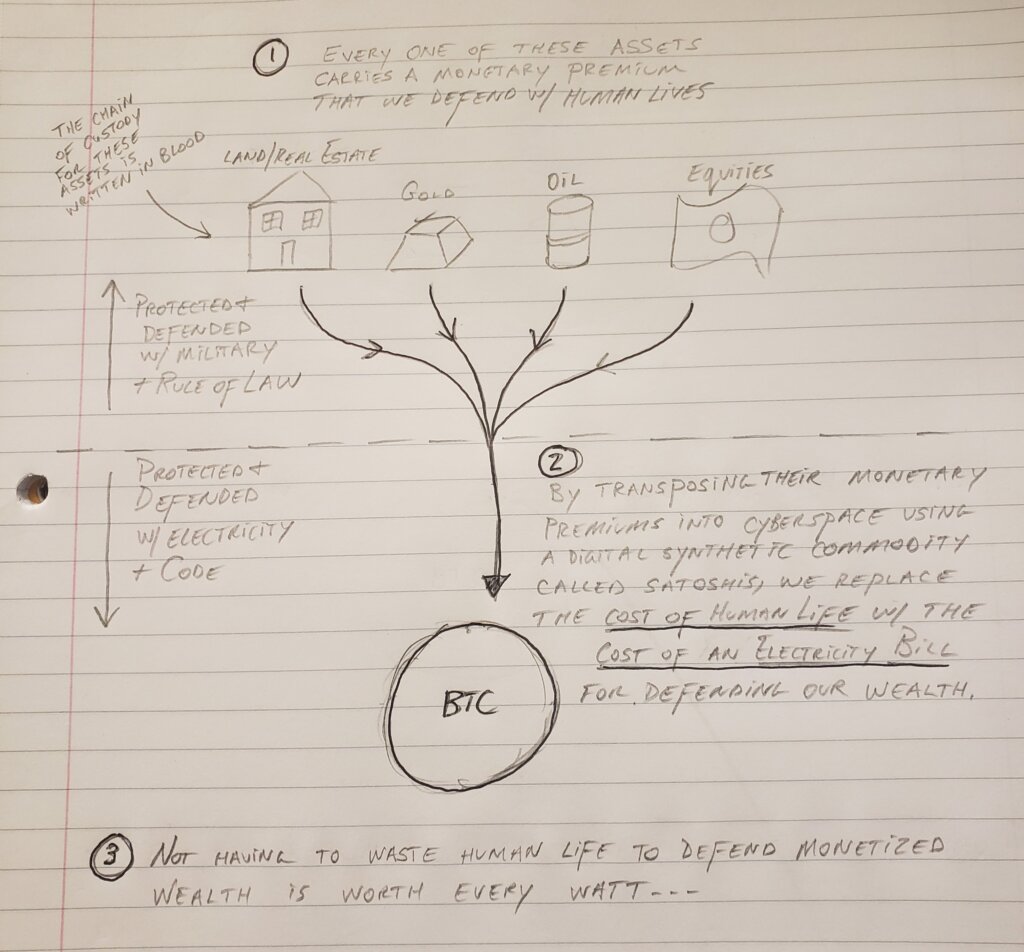 Bitcoin reduces the cost of human life (Source: Jason Lowery)
He posits that Bitcoin’s Proof-of-Work mechanism facilitates cyber sovereignty by physically securing information and digital assets in a trustless, peer-to-peer fashion. This method is analogous to how nations protect land, sea, air, and space domains. He views this characteristic of Bitcoin as a groundbreaking development in computer theory that is presently undervalued.
Lowery criticizes the Department of Defense for its lack of initiative, deeming it unacceptable that the agency is not sufficiently proactive in investigating the cybersecurity advantages of reusable Proof-of-Work networks like Bitcoin. He insists that the United States should take the lead and actively finance related research in this domain.
Related Posts
He also emphasizes the necessity for policymakers to receive clearer guidance on differentiating Bitcoin from other blockchain technologies. According to Lowery, grasping these essential distinctions is vital for crafting effective strategies.
Regarding the nation’s strategic reserves, Lowery contends that any proposed Bitcoin holdings are inadequate. He suggests that once the idea of “Bitcoin equals bitpower” is acknowledged, it becomes clear that possessing only a million units does not fulfill the country’s requirements.
To ensure access to Bitcoin, Lowery advocates for the establishment of a strong hashing industry, termed a “U.S. Hash Force.” He observes that while this initiative does not need to be government-driven, governmental support could facilitate its growth. Drawing a comparison to how the US Space Force aids commercial launch companies to guarantee access to orbit, he proposes that similar backing could ensure access to the Bitcoin ledger.
In his thesis, Lowery portrays Bitcoin as the most physically potent and efficient power projection tool ever discovered by humanity. He describes it as a non-kinetic defense system that could lead to a peaceful power equilibrium referred to as “Mutually Assured Preservation.”
 Bitcoin power projection (Source: Jason Lowery, Softwar)
Lowery seeks to redirect the dialogue and inspire actionable measures from policymakers and defense organizations by redefining Bitcoin as a strategic asset essential to national security.
The post US Bitcoin National Defense Policy promotes ‘Mutually Assured Preservation’ – Lowery appeared first on CryptoSlate.
