Disclaimer: Information found on CryptoreNews is those of writers quoted. It does not represent the opinions of CryptoreNews on whether to sell, buy or hold any investments. You are advised to conduct your own research before making any investment decisions. Use provided information at your own risk.
CryptoreNews covers fintech, blockchain and Bitcoin bringing you the latest crypto news and analyses on the future of money.

Toncoin (TON) surged from approximately $1.32 on May 1 to an intraday high of $2.90 by May 7, driving its market capitalization to roughly $7.8 billion.
The price movement was triggered by Pavel Durov’s announcement that Telegram would replace the TON Foundation as the network’s primary driving force and become its largest validator within two to three weeks.
Concurrently, the ton.org domain was updated to indicate it is “controlled by MTONGA.” Traders interpreted this combination as confirmation that TON had effectively become Telegram’s native chain, meaning its value would be determined by the same company that serves its one billion users.
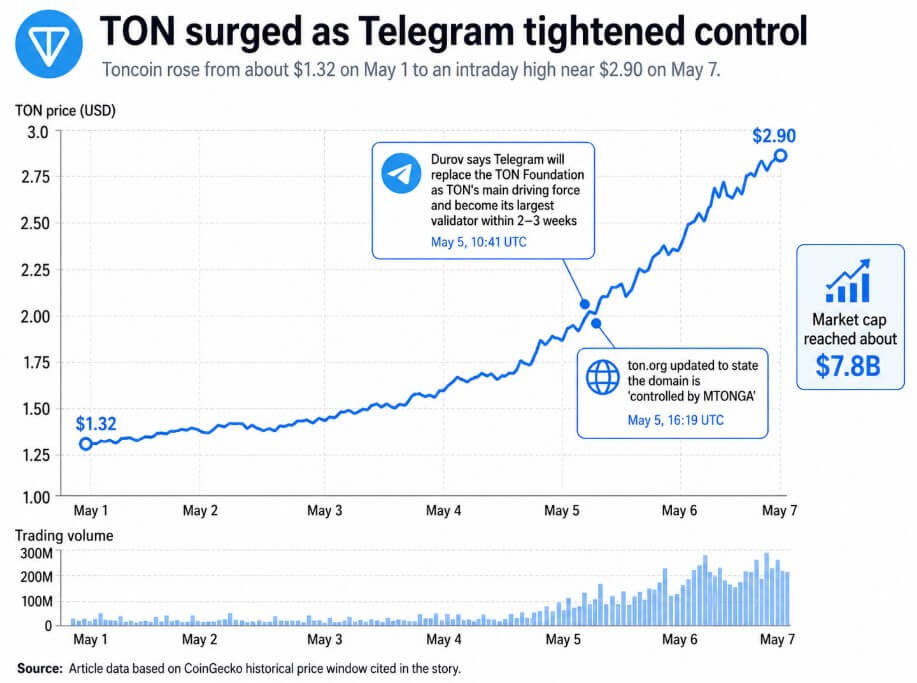
Toncoin climbed from $1.32 on May 1 to an intraday high of $2.90 on May 7 following Durov’s announcement that Telegram would assume governance of TON.
In January 2025, Telegram and TON formalized exclusivity agreements that extended far beyond branding.
TON became the exclusive blockchain infrastructure for Telegram Mini Apps, TON Connect became the mandatory wallet-connection standard for blockchain-enabled mini apps, and Toncoin became the sole cryptocurrency accepted for Telegram Stars, Premium subscriptions, Ads, Gateway services, and specific developer and channel-owner payouts.
These terms granted TON a structural claim on every financial transaction processed through Telegram’s platform. The announcement in early May added a governance layer on top of this commercial position.
The practical implications of the January deal only became visible once Telegram began building the product stack to leverage it.
TON Pay launched in February 2026, institutional stablecoin access was introduced via SCRYPT in April, embedded wallet infrastructure arrived through Dynamic and Fireblocks in late March, and sub-second finality went live on the mainnet in April. This reduced confirmation times from approximately ten seconds to about one second, with blocks arriving every 400 milliseconds.
These releases assembled an in-app payments architecture fast enough to feel invisible within a chat window.
Distribution, data, and broader context
TON’s payments thesis suggests that consumer crypto adoption succeeds by embedding within surfaces where users already spend their time. This argument transforms into a product roadmap when Telegram’s 1 billion-plus active users constitute that surface.
Durov’s announcement provided traders with a specific trigger, but the trade was essentially a bet that Telegram could convert its user base into a payment network, with TON serving as the settlement layer.
Data from DefiLlama showed $152.9 million in decentralized exchange volume for the seven days ending May 7, a 1,054% week-over-week increase, and $12.4 million in perpetuals volume over the same period, up 3,200%. App fees reached $1.48 million in a single day.
These figures highlight the distance TON still has to cover. Solana recorded $6.37 million in app fees on a comparable day and holds $15.4 billion in stablecoins, compared with TON’s $752.5 million.
TRON, built on dollar-denominated stablecoin transfer volume, holds $89.6 billion in assets. TON’s payment-rail footprint lags significantly behind the chains it would need to displace for the Telegram thesis to pay out at scale.
Related Posts
A more honest peer comparison is Sui, which shows $567.2 million in stablecoins, $120,600 in daily app fees, and a market capitalization exceeding $4 billion.
The gap between TON’s current on-chain scale and its Telegram-narrative valuation reflects the market’s pricing of Telegram’s ability to close that gap. If Mini App payments and TON Pay generate real adoption, that premium may hold.
| Chain | Stablecoins / assets | App fees (daily) | DEX volume (7d) | Market cap | Core narrative |
|---|---|---|---|---|---|
| TON | $752.5 million | $1.48 million | $152.9 million | ~$7.8 billion | Telegram distribution bet |
| Solana | $15.4 billion | $6.37 million | — | — | High-scale consumer/app chain |
| TRON | $89.6 billion | — | — | — | Stablecoin transfer rail |
| Sui | $567.2 million | $120,600 | — | $4.03 billion | Closest scale peer |
The centralization problem at the center of the bull case
The uncomfortable dimension of Durov’s announcement is that the feature traders are buying runs structurally opposite to what most blockchain projects sell as their core value.
Durov framed Telegram’s validator role as a net positive, arguing that a credible anchor would attract more participants and lock more TON into staking at approximately 20% APR.
The case for decentralization-through-concentration relies on Telegram executing on its commitments without extracting monopoly rents from the network it now leads.
The Financial Times reported earlier this year that Telegram’s revenue was already tied to Toncoin-linked exclusivity agreements, and that a writedown in Toncoin’s value contributed to a net loss.
This entanglement means Telegram’s balance sheet and TON’s price move are linked, creating the same corporate dependency that makes the bull case intuitive. It also positions Telegram as a self-interested steward. Telegram has direct economic reasons to deepen TON’s value, making it a financially invested principal with skin in every price move.
Three near-term risks could undermine this acceptance before the bull case proves itself.
DefiLlama flags a May 24 unlock of approximately 36.58 million TON, worth roughly $93.65 million at current prices, or 1.36% of the float. For a rally built on an announcement, this supply overhang arrives at a vulnerable moment.
Durov’s legal exposure adds another layer of uncertainty. He received a Russian criminal summons naming him as a suspect, and earlier reporting documented an ongoing French inquiry.
A founder whose personal freedom is contested cannot provide the stable governance anchor that Telegram’s central validator role requires.
The 2-to-3-week timeline Durov cited for the validator transition also means the market bought an announced intention, one that only settles once on-chain stake data confirm the move. Sell-the-news dynamics could punish any delay.
| Risk | What happens | Why it matters | Timing |
|---|---|---|---|
| May 24 token unlock | ~36.58 million TON enters circulation, worth about $93.65 million, or 1.36% of float | Creates supply overhang into a rally driven by announcement momentum | Near-term |
| Validator transition execution risk | Market bought Durov’s announced intention before on-chain stake data confirms the move | Delay or weaker-than-expected follow-through could trigger sell-the-news pressure | Next 2–3 weeks |
| Durov legal exposure | Russian criminal summons and earlier French inquiry keep governance tied to founder risk | Weakens the idea of Telegram as a stable central anchor for TON | Ongoing |
| Centralization discount | Market may decide Telegram control deserves a discount rather than a premium | Re-rates TON toward current fundamentals instead of Telegram-linked future upside | Medium-term |
The bear case rests on the market’s conclusion that Telegram control warrants a centralization discount and prices TON based on current fundamentals.
At that point, TON’s stablecoin base, app fees, and validator structure place it in mid-tier territory, priced for a future that has yet to materialize.
The post TON price doubles after Telegram made a move critics say cuts against crypto’s core promise appeared first on CryptoSlate.
