Disclaimer: Information found on CryptoreNews is those of writers quoted. It does not represent the opinions of CryptoreNews on whether to sell, buy or hold any investments. You are advised to conduct your own research before making any investment decisions. Use provided information at your own risk.
CryptoreNews covers fintech, blockchain and Bitcoin bringing you the latest crypto news and analyses on the future of money.

Stop fearing the Bitcoin quantum risk – Reasons Google cannot take your BTC, and malicious entities are years away from posing a threat.

The current landscape of quantum computing and its potential impact on Bitcoin
Quantum computing has made significant strides in the last 18 months, yet the domain is still evolving from unreliable hardware to initial fault tolerance.
The primary transition is from focusing on the number of physical qubits to emphasizing logical qubits, gate fidelity, operational time, and error correction. This transition is crucial for Bitcoin, as risk assessments are influenced more by logical qubits and fault-tolerant operations than by overall hardware counts.
 Related Reading
Google reduces quantum cracking estimates by 20X, initiating a $600 billion countdown for Bitcoin and Ethereum
Google employed zero-knowledge proofs to validate quantum attack estimates without revealing the underlying attack circuits.
Mar 31, 2026 · Oluwapelumi Adejumo
What is the current status of advancements in quantum computing?
Progress is evident across three areas: below-threshold error correction, small-scale logical-qubit demonstrations, and more complex circuits with reduced noise.
In late 2024, Google’s Willow chip showcased below-threshold error correction, where error rates decreased as the encoded system expanded. IBM claims its current systems can execute certain circuits with over 5,000 two-qubit gates and has released a roadmap aiming for a 200-logical-qubit fault-tolerant system by 2029.
Quantinuum has reported 48 error-corrected logical qubits and 64 error-detected logical qubits from 98 physical qubits, along with 50 error-detected logical qubits on Helios performing at better-than-break-even levels. Microsoft and Atom Computing have reported 24 entangled logical qubits and computations with 28 logical qubits on neutral-atom hardware.
The industry still lacks a large-scale fault-tolerant machine, which is one reason for the existence of DARPA’s Quantum Benchmarking Initiative.
This initiative aims for a quantum computer whose computational value surpasses its cost by 2033, and the agency is still assessing competing architectures rather than certifying that any team has achieved this milestone.
What capabilities do quantum computers possess today?
Current systems can credibly perform four tasks. They can tackle benchmark problems that exceed classical brute-force methods, including Google’s random circuit sampling and recent advancements in Quantum Echoes.
They can conduct limited, specialized simulations in physics and chemistry, often in hybrid workflows with classical high-performance computing. They can also demonstrate logical qubits and fault-tolerant subroutines on a small scale. Additionally, they serve as testbeds for error correction, decoding, and control systems.
However, what they cannot achieve today is critical for Bitcoin.
No public system possesses the necessary logical-qubit count, fault-tolerant gate budget, or sustained runtime required for cryptographically significant attacks on secp256k1. Google’s Willow comprises 105 physical qubits.
The leading public demonstrations of logical qubits remain in the tens, not the thousands. A recent estimate from Google researchers and co-authors suggests that a Bitcoin-relevant attack would require between 1,200 to 1,450 logical qubits and tens of millions of Toffoli gates, highlighting a substantial gap between current machines and a cryptographically relevant system.
Related Reading
Google reduces quantum cracking estimates by 20X, initiating a $600 billion countdown for Bitcoin and Ethereum
Google employed zero-knowledge proofs to validate quantum attack estimates without revealing the underlying attack circuits.
Mar 31, 2026 · Oluwapelumi Adejumo
What is necessary to develop quantum computers capable of cracking Bitcoin?
The essential threshold is a cryptographically relevant quantum computer that can execute Shor’s algorithm against the elliptic-curve discrete logarithm problem on secp256k1.
According to a March 2026 paper from Google, fewer than 1,200 logical qubits and 90 million Toffoli gates, or fewer than 1,450 logical qubits and 70 million Toffoli gates, could theoretically resolve ECDLP-256.
Assuming superconducting conditions with 10-3 physical error rates and planar connectivity, the authors estimate that such an attack could be performed in minutes with fewer than 500,000 physical qubits.
This establishes the engineering challenge. The path ahead is not merely a straightforward increase from around 100 physical qubits to 500,000. The more complex issue is creating a large number of stable logical qubits, maintaining tens of millions of fault-tolerant operations, achieving rapid cycle times, and integrating all of this with real-time decoding, cryogenics or photonic interconnects, classical control, and manufacturable modules.
The same paper posits that fast-clock systems, such as superconducting and photonic platforms, are more pertinent to on-spend attacks than slower-clock systems, like ion traps and neutral atoms, since runtime can be critical within a mempool window.
For Bitcoin, “crack on some level” does not imply compromising the network in a single action. The initial risk involves recovering private keys from exposed public keys or targeting spends while public keys are visible.
In its research disclosure regarding cryptocurrency vulnerabilities, Google indicates that blockchains relying on ECDLP-256 require a post-quantum migration strategy and highlights near-term mitigations, such as avoiding exposed or reused vulnerable wallet addresses.
 Related Reading
Algorand surged 50% after Google highlights quantum risk for Bitcoin and Ethereum
Algorand’s ALGO increased from $0.08 to $0.12 as traders reacted to Google emphasizing a genuine post-quantum rollout.
Apr 5, 2026 · Oluwapelumi Adejumo
Is Google’s recent prediction for 2029 genuinely plausible?
This inquiry requires clarification. In Google’s terminology, 2029 is a target for post-quantum migration, not a definitive timeline for a Bitcoin-cracking machine.
On March 25, 2026, Google announced it was establishing a timeline for the post-quantum cryptography migration to 2029, citing advancements in hardware, error correction, and resource estimates.
In a research post dated March 31, 2026, the company stated that future quantum computers may breach elliptic-curve cryptography utilized in cryptocurrencies with fewer qubits and gates than previously anticipated. These claims are related but not identical.
As a migration deadline, 2029 appears ambitious yet justifiable. However, as a firm prediction for Bitcoin-breaking capability, the public evidence remains limited.
Google has significantly lowered the attack estimate, and IBM has a public roadmap for 2029 targeting 200 logical qubits and 100 million gates. Nevertheless, IBM’s 2029 goal still falls short of Google’s latest logical-qubit estimate for attacking secp256k1.
DARPA’s utility-scale benchmark horizon extends to 2033, which serves as a more conservative reference point. Based on current evidence, 2029 is more suitable as a preparedness date than as a definitive date for Q-Day.
Related Posts
 Related Reading
As quantum ‘Q-Day’ approaches in 2029, Ethereum faces a new challenge regarding coins left in old wallets
The Ethereum Foundation’s post-quantum roadmap contends that the real threat lies in a prolonged struggle over how to transition user wallets.
Mar 26, 2026 · Gino Matos
What financial investment is needed to reach that stage?
No one has released a definitive public budget for a quantum computer capable of cracking Bitcoin. The most substantial public indicators come from capital raises, government funding, and facility developments. PsiQuantum secured $1 billion in 2025 for utility-scale fault-tolerant systems and additionally obtained an A$940 million public package in Australia for its Brisbane project.
Quantinuum raised approximately $300 million in early 2024 and later announced another financing round in 2025. Illinois also put together a $500 million quantum park initiative and a reported $200 million tax incentive package linked to the Chicago site associated with PsiQuantum.
The reasonable conclusion is that a first-generation cryptographically relevant system would cost in the low single-digit billions of dollars, potentially more once all campus, specialized fabrication, packaging, cryogenics, classical computing, networking, control electronics, and multi-year staffing expenses are accounted for.
Public and private funding are already converging at this scale, marking it as an infrastructure-scale development.
What milestones should be monitored moving forward?
The first milestone is the transition from tens to hundreds of high-fidelity logical qubits that remain stable long enough to execute significant programs.
Following that, the next threshold is whether those logical qubits can support millions to tens of millions of fault-tolerant gates with real-time decoding and manufacturable scaling. IBM’s public roadmap outlines this progression directly with Starling at 200 logical qubits and 100 million gates by 2029, followed by Blue Jay at 2,000 logical qubits and 1 billion gates by 2033.
The second milestone is architectural validation. The Google attack-resource paper indicates that fast-clock architectures are the systems most pertinent to on-spend crypto attacks. This places greater importance on advancements in superconducting and photonic systems when evaluating near-term Bitcoin risks.
The third milestone is independent verification. DARPA’s QBI and US2QC programs are significant because they compel companies to transform roadmaps into verifiable engineering plans. Microsoft and PsiQuantum have already progressed into the final validation and co-design phase of US2QC, while IBM, Quantinuum, Atom, IonQ, QuEra, Xanadu, and others remain in Stage B of QBI.
If one of those programs concludes that a design is feasible as intended, it will carry more weight than a standard corporate roadmap.
The fourth milestone is the cryptographic response. NIST finalized its first three post-quantum cryptography standards in August 2024 and advises organizations to begin migrating now, with vulnerable algorithms on a path to deprecation and removal by 2035. For Bitcoin and the broader crypto ecosystem, a credible migration strategy significantly alters the risk profile.
Who is most likely to develop a quantum computer first?
The answer hinges on the definition of “first.” If the benchmark is the first public fault-tolerant system with substantial logical-qubit scale, IBM and Quantinuum currently present the strongest public case.
IBM has the clearest long-term public roadmap for hundreds, then thousands, of logical qubits. Quantinuum possesses some of the most robust public data on trapped-ion logical qubits and break-even performance.
If the benchmark is the first independently validated path to utility scale, Microsoft and PsiQuantum stand out, as DARPA has already advanced them into the final validation and co-design phase of US2QC. This does not conclude the competition, but it does suggest that a serious government review process considers those paths mature enough for more in-depth system-level examination.
If the benchmark is the first system plausibly relevant to Bitcoin, fast-clock platforms warrant the closest scrutiny. Based on current public evidence, which leans more towards superconducting or photonic stacks than trapped-ion or neutral-atom systems for the earliest on-spend attack capability.
This keeps Google, IBM, PsiQuantum, and potentially Microsoft’s topological approach in the highest-attention category, while still allowing for the possibility of a surprise from another DARPA-supported architecture.
What would be necessary for a malicious actor to utilize such a machine after a leading lab confirms the capability?
The barrier would remain exceedingly high. Any malicious entity would require access to a facility-scale system, specialized supply chains, advanced control electronics, packaging, cryogenics, or extensive photonic infrastructure, error-correction software, compilers, and a team proficient in quantum hardware, error correction, systems engineering, and cryptography.
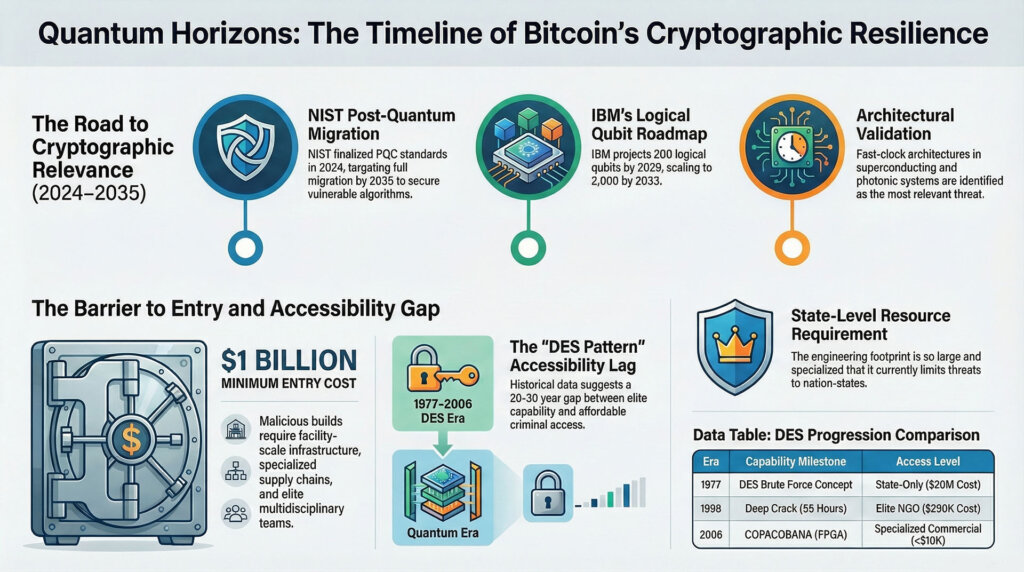 Timeline infographic illustrating Bitcoin’s cryptographic resilience against quantum computing, including NIST post-quantum standards, IBM’s roadmap, accessibility barriers, and projected milestones from 2024 to 2035
The anticipated cost profile likely remains in the billion-dollar range, and the engineering footprint would be challenging to hide. This elevates the first credible threat to a state, a state-sponsored program, or the misuse of an existing top-tier lab capability rather than an independent criminal operation.
There is also an additional layer of complexity. Even after a leading lab demonstrates theoretical capability, translating that into reliable illicit use would necessitate stable runtime, sufficient machine availability, targeting intelligence, and a method to operationalize results before defenders complete migration.
In its responsible disclosure, Google withheld attack specifics and utilized zero-knowledge methods to validate claims without publishing an operational guide. This raises the barrier to reckless replication.
The most relevant historical comparison for “computing breakthrough at research level to bad actor capability” is DES.
In 1977, Whitfield Diffie and Martin Hellman suggested that a machine capable of brute-forcing DES in about a day would cost approximately $20 million, which positioned that capability within state control.
By 1998, the Electronic Frontier Foundation constructed Deep Crack for under $250,000 and cracked DES in 56 hours.
By 2006, the FPGA-based COPACOBANA machine reduced that cost below $10,000, demonstrating that a capability once considered at national-lab scale had transitioned into the realm of commercially available specialized hardware.
The pattern is more significant than the specific cipher. Cryptanalytic capability often first appears as an elite-budget possibility, then as a public demonstration, and only later as something that can be assembled at a much lower cost from accessible components.
For Bitcoin, the pertinent question is not solely when a leading lab can showcase a cryptographically relevant quantum attack, but also how long it takes for that capability to descend the cost curve into something smaller actors could realistically access and operate.
Thus, even if Google were to develop a quantum machine capable of cracking Bitcoin in 2029, following the DES timeline, malicious actors may not gain access for another 30+ years.
Conclusion
Bitcoin is not currently facing a quantum threat. The concern has transitioned from the realm of science fiction to that of planning.
Google’s updated estimate reduces the required resources sufficiently to refine the central question: whether Bitcoin and the broader cryptographic framework can migrate before fast-clock fault-tolerant systems reach the threshold for cryptographically relevant attacks.
Even if a leading lab achieves that threshold sooner than anticipated, the limiting factor for malicious actors is likely to be access, as the first cryptographically relevant systems would still be facility-scale machines with billion-dollar economics rather than tools that can be quietly purchased, rented, or assembled at a criminal scale.
Indeed, a migration plan for Bitcoin is necessary. It is advisable to begin sooner rather than later. However, your wallet is not at immediate risk of being compromised, nor is BTC likely to be stolen by a quantum computer in the near future. Probably not even within our lifetime, to be frank.
Once a quantum computer capable of cracking Bitcoin exists in a leading lab, if the migration is not complete, the price will likely plummet due to sentiment, but there will still be decades before on-chain data is genuinely at risk.
The post Stop worrying about the Bitcoin quantum threat – Why Google can’t steal your BTC, and bad actors are decades behind appeared first on CryptoSlate.
