Disclaimer: Information found on CryptoreNews is those of writers quoted. It does not represent the opinions of CryptoreNews on whether to sell, buy or hold any investments. You are advised to conduct your own research before making any investment decisions. Use provided information at your own risk.
CryptoreNews covers fintech, blockchain and Bitcoin bringing you the latest crypto news and analyses on the future of money.

S&P Introduces Ratings-Style Scrutiny to $10 Billion Crypto Vault Market Following $6 Million Base Incident

S&P Global is introducing ratings-style risk assessments to crypto lending vaults as the rapidly expanding market faces new security challenges.
On October 4, the ratings firm launched its Vault Risk Assessment framework, establishing a standardized method for comparing the likelihood of investor impairment in lending vaults. According to S&P, deposits in these products reached approximately $10 billion in September, a significant increase from $1.5 billion two years prior.
The framework’s launch coincided with a warning from blockchain security firm CertiK regarding suspicious activity involving an unnamed vault on the Coinbase-backed Base network.
CertiK reported that a newly deployed proxy borrowed approximately 1,783 aBaswstETH, valued at roughly $6 million, from the vault. The tokens were subsequently redeemed through Aave for around 1,783 wstETH.
The incident did not directly exploit Aave. Instead, it highlighted a growing concern as vaults gain popularity: investors may be exposed to risks introduced by the contracts, permissions, and managers situated between their deposits and the underlying lending protocols.
This distinction is central to S&P’s new framework. Vaults pool investor assets and allocate them according to predefined strategies, with decisions either automated via smart contracts or overseen by human managers known as curators. Investors receive tokens representing claims on the pooled assets and associated returns.
$55 million Aave stablecoin pool sees just $4.4 million available for withdrawals
Vault growth brings new layers of risk
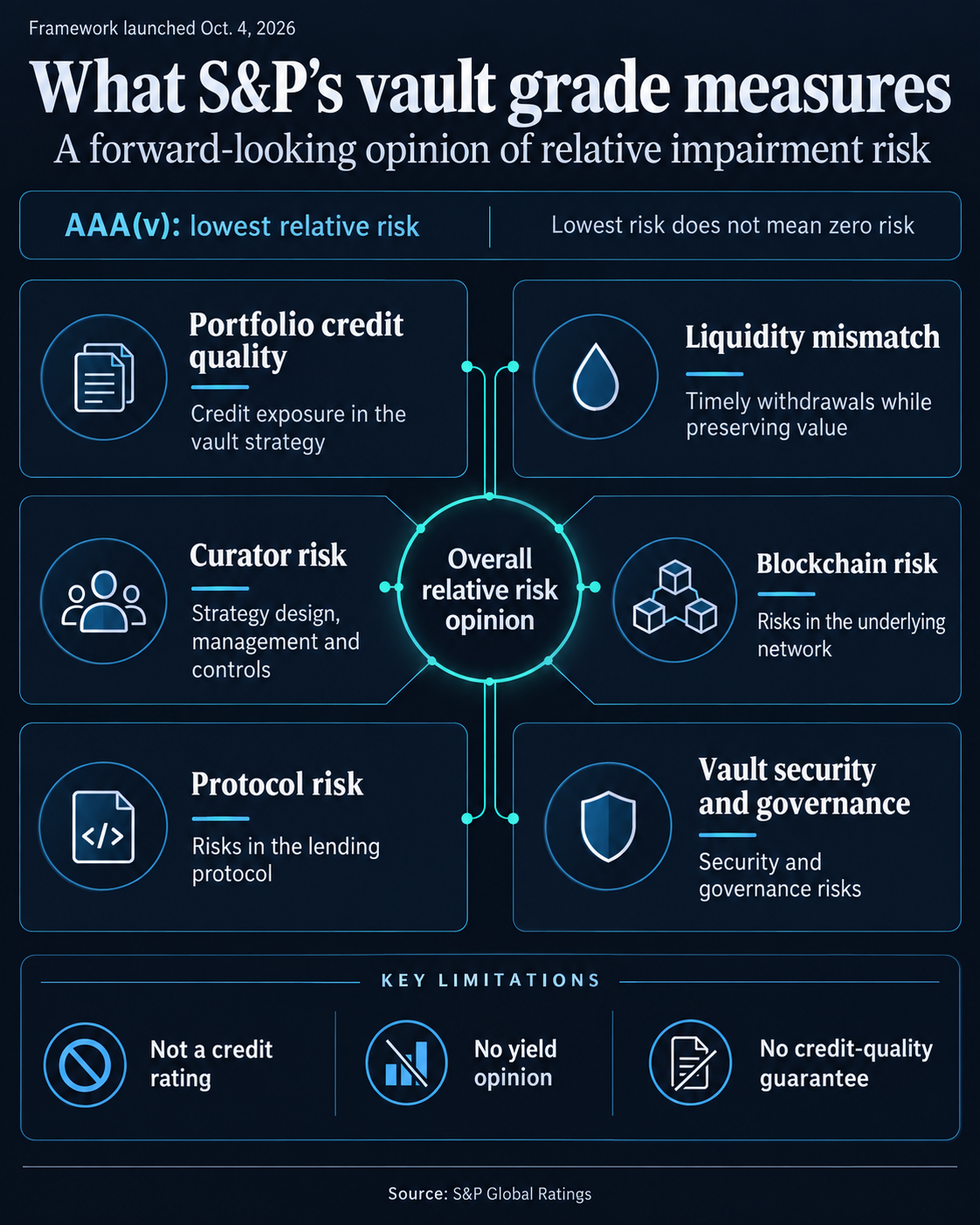
S&P’s framework evaluates six key areas: portfolio credit quality, liquidity mismatch, curator risk, blockchain risk, protocol risk, and vault security and governance.
Related Posts
The assessment aims to move beyond the point-in-time transparency offered by blockchain transactions, examining how a vault might perform as market conditions change.
This approach becomes increasingly important as vaults begin to resemble on-chain versions of managed investment products. S&P noted that these structures can replicate functions associated with money-market funds, private credit, private equity, and hedge funds, while allowing pooled capital to operate directly on blockchains.
This added flexibility introduces additional points of failure. A depositor may have exposure to a large lending protocol, but losses can still arise from a curator’s allocation decisions, insufficient withdrawal liquidity, changes to smart-contract permissions, or vulnerabilities within the vault itself.
S&P’s grades utilize a “(v)” suffix, with AAA(v) representing the lowest relative risk category. These are not credit ratings; they do not assess expected yields nor guarantee capital recovery. Instead, the agency describes them as forward-looking opinions on the relative risk of impairment.
Assessments can also be revised as eligible assets, their risk profiles, smart-contract features, or liquidity conditions evolve. This allows S&P to reassess vaults whose structures become riskier, even if their historical on-chain record remains clean.
The next phase will involve S&P publishing assessments for individual vaults, which the firm stated will follow in future announcements.
These grades could provide institutional allocators with a common benchmark for comparing strategies in a market that has expanded nearly sevenfold over two years.
They may also raise the stakes for vault managers, as investors might demand higher returns from lower-rated products or direct deposits toward structures with stronger assessments.
