Disclaimer: Information found on CryptoreNews is those of writers quoted. It does not represent the opinions of CryptoreNews on whether to sell, buy or hold any investments. You are advised to conduct your own research before making any investment decisions. Use provided information at your own risk.
CryptoreNews covers fintech, blockchain and Bitcoin bringing you the latest crypto news and analyses on the future of money.

Significant Bitcoin decline raises concerns of “multi-billion dollar manipulation” as on-chain analysis reveals market maker selling activity.

Bitcoin’s activity over the last 24 hours appeared tailored for cryptocurrency traders, as BTC exceeded the $90,000 mark in the early hours of Dec. 29, only to relinquish those gains in under 12 hours.
Traders such as TedPillows shared clown emojis alongside charts depicting repeated peaks and valleys, while CryptoSeth referred to it as “fraud commodity” behavior, highlighting the same sawtooth pattern occurring 30 times.
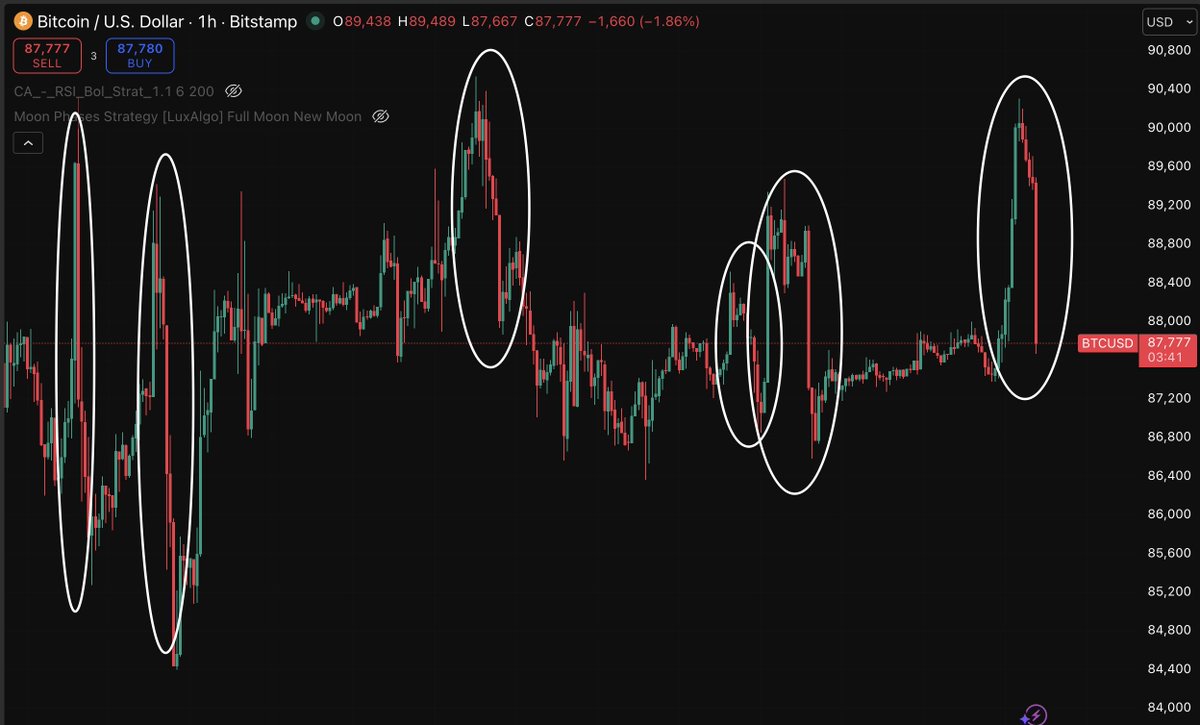 Bitcoin V-shaped crashes (Source: TedPillows)
Moreover, Wimar X directly accused Binance and Wintermute, asserting “multi-billion dollar manipulation” evident on-chain. However, the on-chain transfers involving Wintermute, as illustrated in his screenshot, amounted to less than $30 million.
Nonetheless, the issue isn’t whether the allegations lack merit, but whether the data can differentiate between opportunistic stop-hunting and a structurally fragile, overleveraged market that reacts similarly each time someone applies pressure.
The microstructure tells the story
Binance’s cumulative volume delta, which represents buy-aggressor volume minus sell-aggressor volume accumulated over time, reveals a clear pattern: a sharp intraday spike fueled by aggressive buying, with CVD rising as market orders lift offers, followed by an equally sharp reversal driven by aggressive selling, causing CVD to plummet as traders hit bids.
The price concludes approximately where it began, with net CVD remaining nearly flat throughout the entire period.
This exemplifies a “push through the book, harvest stops and late momentum, then fade it back” sequence. It is not indicative of a slow trend-building conviction, but rather a rapid up-and-down movement that leaves the market relatively unchanged, yet would be profitable for anyone who engaged in both legs.
The tape does not reveal who initiated the movement or if it was coordinated, but it indicates that the move was propelled by aggressive directional flow, rather than passive order matching. These are signs of market manipulation.
 Bitcoin’s price and Binance cumulative volume delta over 24 hours on Dec. 29, illustrating that aggressive buying fueled the rally before aggressive selling reversed it.
This is not an isolated occurrence. The same V-shaped spikes and retracements have been observed across Bitstamp and Bybit throughout December. Different platforms, similar patterns, repeated over time.
This indicates that the environment itself is conducive to the behavior traders are alleging: a structurally fragile, overleveraged market where participants continue to target obvious stop zones because it remains effective.
Related Posts
 Bitcoin perpetual futures on Bybit displaying recurring V-shaped price spikes throughout December, with 11 distinct instances within one month. Image: thedefivillain/X
It does not confirm that the same trader is responsible each time. The market is easily influenced by anyone with sufficient size and speed to shift prices in a thin order book, then adjust inventory and collateral across platforms before the reversal occurs.
Someone is stop-hunting
The tape closely resembles a classic stop-hunt, as liquidity is sparse during the holiday season. CoinGecko data indicates that Binance consistently remains below $10 billion, while other major exchanges have recently struggled to reach $1 billion in volume.
Additionally, Coinglass data reveals that open interest fluctuated by 0.08%, -0.67%, and 0.03% in the past 1 hour, 4 hours, and 24 hours, respectively.
Liquidations over these timeframes totaled tens of millions of dollars, divided between longs and shorts, rather than the significant one-sided wipeouts that typically accompany a heavily crowded trade being triggered.
 Bitcoin liquidations over one-hour, four-hour, and 24-hour windows, indicating roughly balanced long and short positions totaling under $160 million each.
Prices at other exchanges generally mirrored Binance rather than diverging, suggesting that the movement was not confined to a single order book. The on-chain snapshots reveal custody reshuffling, not the specifics of the trades or the profit-and-loss trajectory of any individual wallet.
Professional trading desks were active, as on-chain data indicates over 87 BTC moving from Binance to a Wintermute deposit wallet, but the motivations behind these actions remain unclear.
In summary, the evidence aligns with a pattern of opportunistic profit-seeking in thin order books. Aggressive buying propels Bitcoin into a sharp intraday spike, aggressive selling retracts it, and cumulative flow ultimately remains relatively flat.
Repeated inverted V-shaped movements across Bitstamp, Bybit, and Binance, along with a surge of cross-venue flows from Binance to market-maker and exchange addresses, all suggest a market that is easily influenced by well-capitalized traders seeking short-term profit.
The evidence implies opportunistic manipulation of the tape. The behavior traders describe is plausible and supported by the observed pattern, but the data does not pinpoint a specific orchestrator or demonstrate intent beyond a reasonable doubt.
What the data does reveal is that the environment is structurally susceptible to the kind of stop-hunting traders are alleging, and that the tape appears to have been exploited.
The post Violent Bitcoin crash cries “multi-billion dollar manipulation” as on-chain data catches market maker dumping appeared first on CryptoSlate.
