Disclaimer: Information found on CryptoreNews is those of writers quoted. It does not represent the opinions of CryptoreNews on whether to sell, buy or hold any investments. You are advised to conduct your own research before making any investment decisions. Use provided information at your own risk.
CryptoreNews covers fintech, blockchain and Bitcoin bringing you the latest crypto news and analyses on the future of money.


Worldcoin announced earlier this year that the WLD unlock rate would decrease by 43% on July 24, adhering to existing schedules.
Additionally, the project stated that 4.9 billion WLD, representing 49% of the token’s 10 billion total supply, was already unlocked as of April 10, with 3.3 billion WLD in circulation. This context suggests that the upcoming July reduction is less of a fresh supply shock and more of a market test to determine whether slower new emissions can sustain demand when nearly half the supply is already unlocked.
WLD now faces a test to see if slower emissions can coincide with durable demand given the significant amount of supply already unlocked.
Data from CryptoSlate’s WLD market page showed the token trading near $0.38 on July 9, with a market capitalization of approximately $1.34 billion and a 24-hour trading volume of about $192 million.
At this level, the market is assessing whether World ID can evolve into a source of recurring token utility.
What changes on July 24
The scheduled reduction on July 24 lowers the daily rate at which WLD unlocks across both community-linked and insider-linked allocations. Unlocks will continue on a linear schedule without a cliff.
| Allocation | Before July 24 | After July 24 | Change |
|---|---|---|---|
| World Community tokens | 3.2 million WLD per day | 1.6 million WLD per day | Down 50% |
| TFH investor and team tokens | 1.9 million WLD per day | 1.3 million WLD per day | Down 32% |
| Aggregate unlock rate | Approx. 5.1 million WLD per day | Approx. 2.9 million WLD per day | Down 43% |
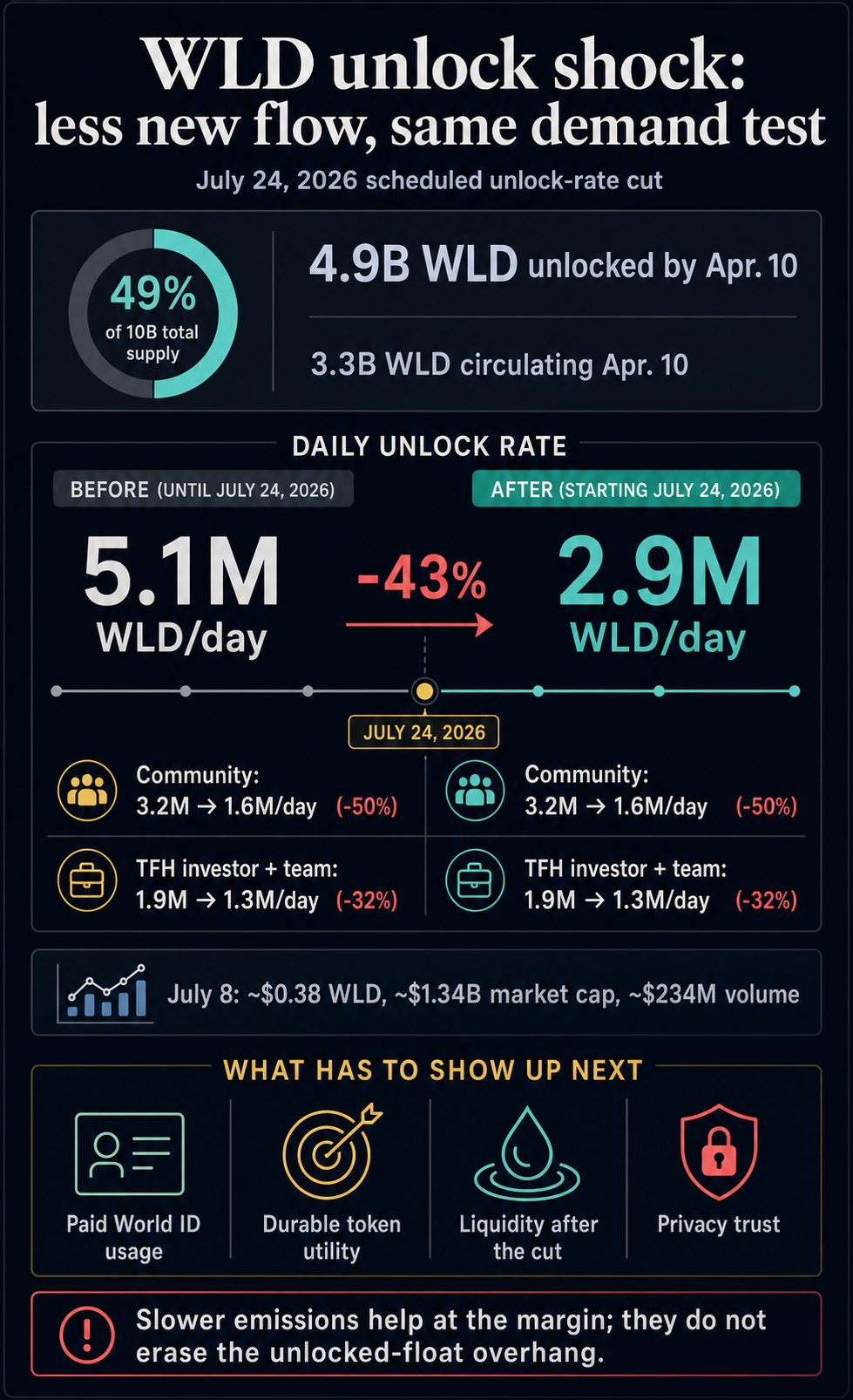
The reduction equates to approximately 2.2 million WLD per day, resulting in roughly 803 million fewer WLD entering unlock schedules over a full year.
For a token with a total supply of 10 billion, this change is significant enough to alter daily supply pressure.
Daily emissions determine how much fresh supply must be absorbed by buyers, market makers, and long-term holders. A lower future unlock rate leaves the already-unlocked supply in place.
Worldcoin’s figures from April 10 indicated that 4.9 billion WLD was unlocked before the July slowdown, highlighting the tension between a slower future drip and an already substantial unlocked base.
CryptoSlate’s market data showed approximately 3.52 billion WLD in circulation on July 8, compared to Worldcoin’s April 10 statement that 3.3 billion WLD was in circulation at that time.
A larger unlocked pool lies outside the most restrictive definition of circulating supply, reducing future pressure at the margin. This is why the July 24 supply cut requires proof of demand before it can be considered bullish.
The next step is to identify who buys WLD, why they hold it, and what recurring activity creates token demand once the flow slows, thereby shifting the long-term demand curve.
Currently, Worldcoin’s answer is still forming, with the protocol arguing that World ID can serve as infrastructure for solving the internet’s proof-of-human problem.

World’s WLD token trades at an all-time low despite introduction of new messaging feature
World Chat introduces secure, human-verified messaging amid regulatory scrutiny on data practices.
Mar 6, 2025 · Oluwapelumi Adejumo
Proof-of-human becoming paid infrastructure
Worldcoin’s strongest demand-side argument is that applications may eventually pay for proof-of-human infrastructure, routing value back through the protocol.
In an April 16 post regarding World ID’s revenue potential, Worldcoin stated that applications could pay World ID fees while end users remain free.
The project also noted that tokens are ultimately used to pay all fees, and that protocol fees could be allocated to network operations or token burns. This represents the critical bridge between identity adoption and WLD demand.
If platforms pay for World ID proofs, those payments settle through token-based mechanisms, and fees become recurring, the token could demonstrate demand beyond emissions, grants, and speculative positioning.
In an April 17 post introducing the new World ID, Worldcoin stated that World Network participants span 160 countries and that nearly 18 million people have verified their humanness at an Orb.
The same post framed World ID as proof-of-human infrastructure for consumer platforms, enterprise applications, and AI agents.

Related Posts
World Foundation secures $135M via token sales to expand biometric Orb-verified IDs globally
World Assets raised the $135 million through a strategic token sale to venture capital firms a16z and Bain Capital.
May 22, 2025 · Assad Jafri
Worldcoin stated in a separate April 17 post that Zoom and DocuSign are integrating proof-of-human use cases, with Outtake and a VanEck-linked beta also cited.
These integrations shift the narrative from crypto-native distribution toward proving that a real person is behind an action in a world of deepfakes, bots, and AI agents.
The evidence needed after July 24 includes fee volume, token-settled usage, recurring application demand, or clear disclosures that World ID activity is reducing WLD’s effective supply through burns or other mechanisms.
Lower emissions can improve the setup, and if proof-of-human adoption becomes economically visible, the market may treat WLD as a token with real utility.
Privacy scrutiny is still part of the demand test
Worldcoin’s identity pitch carries the constraint that the product depends on trust in biometric data handling.
Spain’s data protection authority (AEPD) ordered Tools for Humanity in March 2024 to stop collecting and processing personal data in Spain as part of Sam Altman’s Worldcoin project. The decision cited complaints including insufficient information, collection of minors’ data, and limits on withdrawing consent.
The authority also noted that biometric data receives special protection under the GDPR due to its sensitive nature.
In February 2026, the AEPD stated it had warned Tools for Humanity about the planned restart of World activity in Spain and that the company had communicated its intent to temporarily postpone the relaunch to review the issues raised.
The regulator said the intended processing appeared to involve biometric data for iris identification and facial authentication, requiring justification through a data-protection impact assessment.
Germany’s Bavarian State Office for Data Protection Supervision also concluded an investigation into Worldcoin’s biometric data processing in December 2024, issuing corrective measures.
The authority stated that the company would be required to provide a GDPR-compliant deletion procedure and that the results had to be followed throughout Europe when processing personal data.

German regulator orders Worldcoin to enhance privacy measures after biometric data probe
Worldcoin must delete unlawfully collected data within one month, says Bavarian regulator after concluding investigation.
Dec 20, 2024 · Assad Jafri
Regulatory friction affects the demand case because Worldcoin depends on platforms, users, and jurisdictions accepting proof-of-human infrastructure at scale.
Worldcoin has emphasized privacy architecture to address regulatory challenges, with April product posts describing zero-knowledge proofs, one-time-use nullifiers, and systems designed to avoid exposing or storing personal data.
The market question is whether these assurances, product changes, and enterprise integrations are sufficient to shift Worldcoin’s public narrative from biometric controversy to paid identity infrastructure.
Demand is the next test for Worldcoin
The July 24 change reduces the WLD daily unlock rate, clarifies that there is no cliff, provides traders with a hard date to watch, and makes the demand gap more visible.
If WLD strengthens after the cut, a more convincing signal would be a combination of stable liquidity, improved price action, and evidence that World ID usage is becoming fee-generating infrastructure.
If the token fades, the market will have effectively signaled that the already-unlocked supply base and uncertainty around real token demand still outweigh the benefits of slower emissions.
The July 24 reduction is significant, but it still requires demand confirmation.
Worldcoin’s harder test begins after the supply headline passes, when investors can judge whether proof-of-human adoption is turning into durable WLD demand or whether the token is still carrying the weight of an already-large unlocked float.
The post Sam Altman’s Worldcoin cuts WLD unlocks by 43% but 4.9B tokens still need to prove demand appeared first on CryptoSlate.
