Disclaimer: Information found on CryptoreNews is those of writers quoted. It does not represent the opinions of CryptoreNews on whether to sell, buy or hold any investments. You are advised to conduct your own research before making any investment decisions. Use provided information at your own risk.
CryptoreNews covers fintech, blockchain and Bitcoin bringing you the latest crypto news and analyses on the future of money.

Ray Dalio presents economic “war thesis” highlighting dollar depreciation in comparison to Bitcoin.

Ray Dalio’s April 9 TIME essay presents a geopolitical perspective with an underlying monetary argument.
Dalio clearly states that his indicators suggest a simultaneous collapse of the monetary system, certain domestic political structures, and the global geopolitical order.
The conflict in Iran serves as the immediate catalyst, but the deeper assertion is that investors anticipate a swift stabilization, thereby underestimating the extent of the ongoing transition.
In his July 2025 TIME essay titled “Defending the Value of Money,” Dalio contended that the disagreement between President Donald Trump and Fed Chair Jerome Powell fundamentally revolved around the value of currency.
When debt levels become excessively burdensome, the typical response is to lower real interest rates and devalue the currency.
In that same essay, he observed that the dollar had depreciated approximately 27% against gold and 45% against Bitcoin since the previous summer.
His January 2026 LinkedIn post asserted that the monetary, domestic political, and international geopolitical systems were all undergoing a single Big Cycle, with the current phase representing a transition before a breakdown.
Dalio’s April warning adds another layer to that argument.
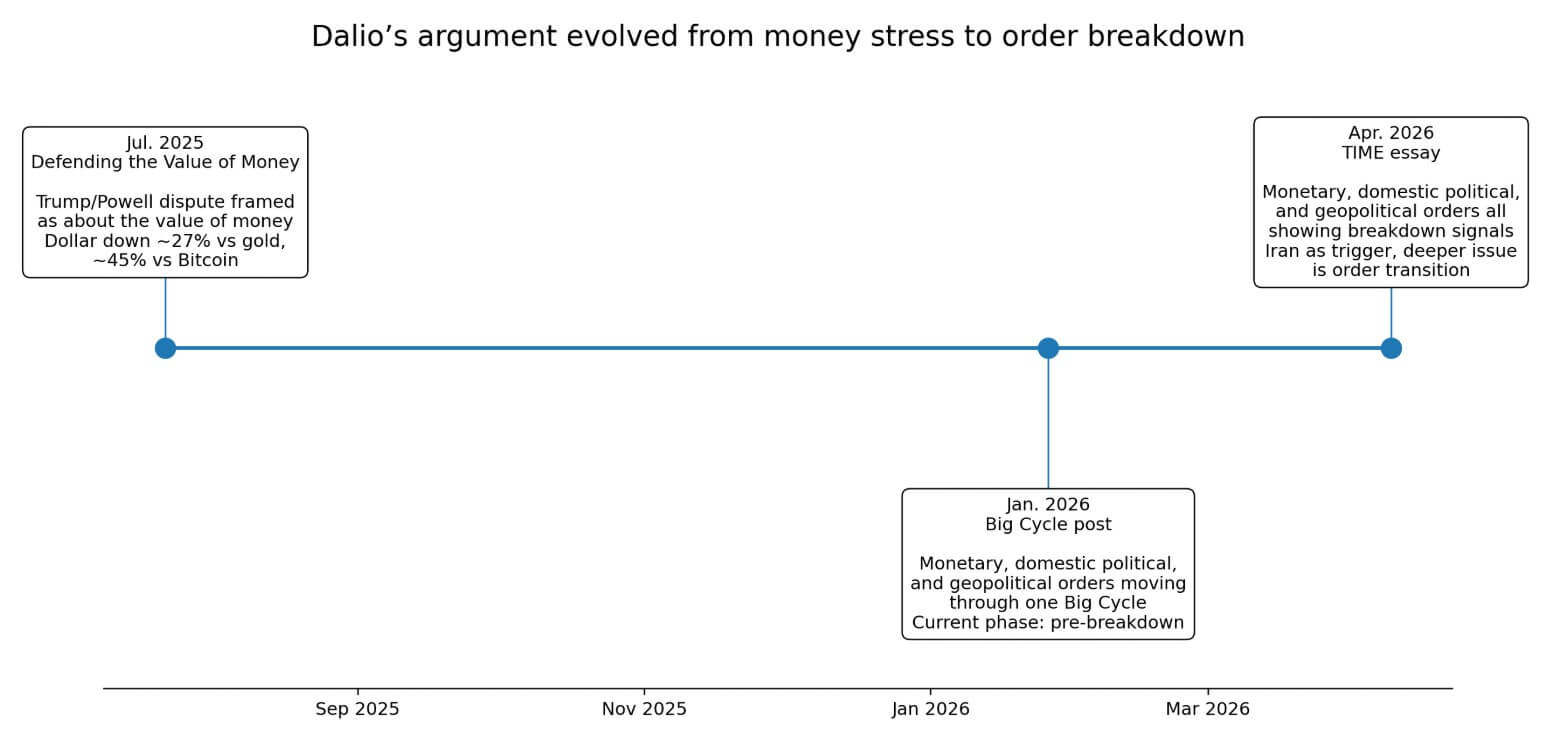 A timeline illustrates three of Dalio’s essays from July 2025 to April 2026, tracing his argument from dollar devaluation through the pre-breakdown phase of the Big Cycle to a complete collapse of monetary and geopolitical orders.
Implications of the breakdown for hard money
As the focus shifts from war-related shocks to a transition in the monetary order, investors should begin to evaluate which assets will maintain their value as debt instruments become less dependable and fiat systems appear increasingly politically vulnerable.
In a June 2025 LinkedIn essay titled “How Countries Go Broke,” Dalio outlined the rationale for maintaining a lower allocation in debt assets, a higher allocation in gold, and a modest position in Bitcoin.
In an October 2025 TIME essay named “Gold Is the Safest Money,” Dalio clarified the hierarchy, identifying gold as the monetary asset least susceptible to devaluation or confiscation.
Bitcoin’s role within this framework is based on its scarcity and independence, functioning outside any issuing authority, central bank, or state balance sheet.
In a scenario where Dalio believes fiat systems are increasingly pressured by debasement, these characteristics become more significant for investors seeking monetary exposure beyond the conventional system.
The dollar’s 45% decline against Bitcoin over approximately a year, as noted by Dalio, provides a solid foundation for the theoretical argument.
Bitcoin’s non-sovereign attributes present a forward-looking case for what it could evolve into as a monetary asset throughout a complete cycle. This prospective case contrasts with the reality of Bitcoin’s performance during periods of acute stress, highlighting the gap between aspiration and actual behavior, which reinforces the gold hierarchy.
Gold takes the initial lead
On April 7, as tensions with Iran escalated, gold prices increased while Bitcoin dropped nearly 2% alongside other risk assets.
This single trading session alone cannot substantiate a structural conclusion, but it aligns with a pattern observed during the current conflict period, where gold has surged due to safe-haven demand while Bitcoin has moved in tandem with equities and technology stocks.
In February, Bitcoin’s rebound above $70,000 coincided with a recovery in tech shares.
Dalio’s own statements articulate the distinction more clearly than any market analysis, as he refers to gold as the safest form of money, while describing Bitcoin as “a bit of Bitcoin.”
Gold provides reserve managers with depth, central bank credibility, and a 5,000-year history of monetary use. In contrast, Bitcoin has an emerging institutional base, regulatory uncertainties, and a price history that still resembles venture-stage risk.
Data from reserve managers further strengthens Dalio’s case for gold as the primary choice.
Related Posts
Reuters reported that nearly 70% of surveyed central banks now view geopolitics as the foremost global risk, up from 35% in 2024. Approximately 75% of these central banks hold gold, and nearly 40% are contemplating increasing their exposure.
As of March, China’s central bank has expanded its gold reserves for the seventeenth consecutive month. These trends illustrate an institutional monetary preference that Bitcoin has yet to match on a comparable scale.
| Attribute | Gold | Bitcoin |
|---|---|---|
| Dalio’s wording | “Safest money” | “A bit of Bitcoin” |
| Role in portfolio | Core hard-money allocation | Smaller satellite allocation |
| Behavior in acute stress | Rose as Iran tensions deepened | Fell close to 2% with risk assets |
| Institutional depth | Reserve-manager and central-bank asset | Growing institutional base, but shallower |
| Central bank demand | Yes | No meaningful central-bank participation |
| Historical monetary track record | ~5,000 years | Short modern history |
| Regulatory certainty | Higher | Lower |
| Volatility profile | Lower | Higher |
| Best fit in Dalio framework | First-round refuge | Forward-looking non-sovereign money bet |
The macro context behind the argument
The practical backdrop for Dalio’s thesis emerged during the same week as his essay.
IMF Managing Director Kristalina Georgieva indicated that the conflict would lead to higher prices and lower growth, even with a rapid resolution. World Bank President Ajay Banga stated that some level of slower growth and increased inflation would occur regardless of how quickly the war concludes.
UBS adjusted its anticipated Fed rate cuts to September and December, citing rising energy prices that would sustain inflation and modestly impact output.
This trio outlines a macro regime with specific implications for portfolios, as slower growth and persistent inflation compress returns on duration, while delayed Fed easing prolongs the pressure on leveraged balance sheets.
In such an environment, assets devoid of duration risk and credit risk hold a more advantageous structural position compared to a scenario of easing financial conditions and normalizing growth.
The World Gold Council reported that total gold demand in 2025 surpassed 5,000 tons for the first time, with ETF holdings increasing by 801 tons and investment demand rising by 84%. Gold prices surged 64% in 2025, and analysts predict potential for $6,000.
These statistics indicate that Dalio’s framework aligns with a re-monetization of gold that is already in progress within institutional markets.
Bitcoin has also benefited from some of these same dynamics, but with greater volatility, shallower institutional depth, and less central bank involvement.
Potential future developments
In the optimistic scenario for Bitcoin, markets transition from pricing a war shock to adjusting for a monetary order repricing.
Investors who have taken in the IMF’s growth warnings, the World Bank’s inflation forecasts, and UBS’s delayed-easing perspective are beginning to consider which assets should be included in a portfolio designed for chronic debasement.
Bitcoin’s fixed supply, its position outside sovereign balance sheets, and Dalio’s explicit categorization in the relevant portfolio segment all offer a credible entry point.
The documented decline of the dollar against both gold and Bitcoin supports the notion that this repricing has already commenced in price terms, even as institutional flows trend toward it.
In the pessimistic scenario, energy shocks and tighter financial conditions remain the prevailing market forces. Bitcoin continues to trade alongside technology equities and broader risk sentiment, while gold attracts the safe-haven allocation that a fragmented monetary world directs toward it.
| Scenario | Trigger | Gold | Bitcoin | Best interpretation |
|---|---|---|---|---|
| Bull case for Bitcoin | Markets shift from war shock to monetary repricing | Still strong | Gains relevance as non-sovereign money | Bitcoin starts acting more like hard money over time |
| Base case | Sticky inflation, slower growth, delayed Fed cuts | Remains preferred refuge | Participates, but with higher volatility | Gold leads, Bitcoin follows |
| Bear case | Energy shock and tighter conditions dominate | Captures safe-haven flows | Trades with tech and broader risk assets | Bitcoin remains equity-adjacent in stress |
| Long-run unresolved case | Monetary fragmentation deepens over years | Retains institutional primacy | Gradually earns larger portfolio role | Bitcoin matters, but not as first resort |
Investors seeking hard-money protection tend to favor the asset with a five-thousand-year history and direct central bank demand, relegating Bitcoin to a higher-beta satellite that may participate in the eventual repricing but lags in the initial rush to safety.
The evidence of Bitcoin’s correlation with technology and gold’s safe-haven performance during the current conflict period supports this as the more immediate trajectory.
Dalio’s own phrasing clarifies the distinction as effectively as possible, regarding gold as the safest form of money and Bitcoin as “a bit of Bitcoin.”
This hierarchy accurately positions Bitcoin within a framework designed for the disintegration of an old order, making it a fitting component in the portfolio for the future that Dalio envisions.
The post Ray Dalio issues economic “war thesis” showing dollar-debasement against Bitcoin appeared first on CryptoSlate.
