Disclaimer: Information found on CryptoreNews is those of writers quoted. It does not represent the opinions of CryptoreNews on whether to sell, buy or hold any investments. You are advised to conduct your own research before making any investment decisions. Use provided information at your own risk.
CryptoreNews covers fintech, blockchain and Bitcoin bringing you the latest crypto news and analyses on the future of money.


A trader can secure a better Solana (SOL) swap price, while a passive pool depositor remains exposed to traders exploiting stale quotes. A September 29 preprint quantifies this divergence.
For quiet-market SOL/USDC fills, propAMMs—pools managed by professional operators—recorded a reference-relative execution cost proxy of 0.26 basis points, compared to 2.59 for public automated market makers (AMMs).
The study covers the period from September 1, 2025, to August 31, 2026, with shorter samples for Base and Monad. It weights fills by notional value against Bybit’s size-weighted top-of-book USDT microprice, converted using its USDC/USDT midpoint. The authors are affiliated with ETH Zurich and Category Labs.
A swapper seeks more tokens for the same input, whereas a depositor supplies the inventory against which others trade and requires compensation for the risks that inventory entails. Low execution costs can attract traders without constituting a sufficient investment case for depositors.
Swap prices and depositor returns on Solana
Across its Solana sample, the paper reports two-second gross maker markouts of +0.37 basis points for propAMMs and −0.22 for public AMMs. A markout compares a fill with a later reference price, where a positive figure favors the maker.
Quiet-flow execution measures how much a trader sacrifices against a relatively stable reference. The proxy requires less than 1 basis point of reference movement from five seconds before to one second after a fill.
Maker markouts assess what happens to a trade’s value after the pool accepts it. Combining these measures could misinterpret evidence regarding pricing and adverse selection as a profitability claim that the data does not support.
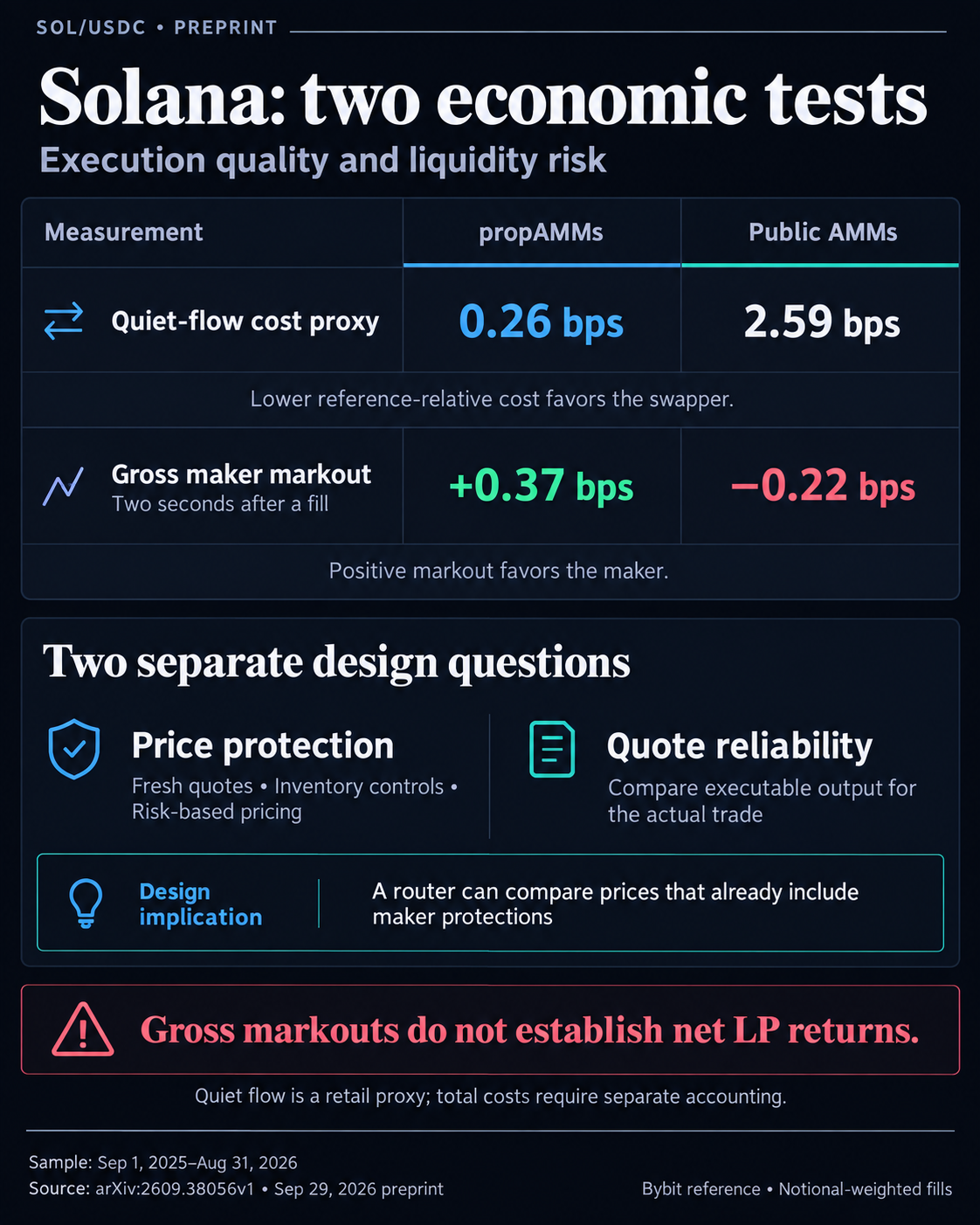
Lower swap costs do not guarantee reliable quotes or positive liquidity provider (LP) returns.
When an external market moves first, a pool offering an outdated price may sell too cheaply or buy too dearly. An arbitrageur restores price alignment, but the correction occurs through a trade against the liquidity already present in the pool.
Research on loss-versus-rebalancing treats this arbitrage cost as one component of LP economics. Returns also reflect asset exposure and fees earned; thus, an investment assessment requires a position, a holding period, and the income and costs attributable to it.
Trading fees must be allocated correctly, while inventory changes, hedging, operating expenses, and transaction costs also matter when applicable. The short time horizon leaves this accounting unresolved, and venue averages cannot establish that professional pools caused aggregate passive-LP losses.
Depositors require a return assessment that includes this broader balance sheet, while swappers can benefit from liquidity whose operators actively manage pricing risk.
Jump Crypto’s April account describes propAMMs, including its own BisonFi, adapting prices and available liquidity to inventory, quote freshness, and the quality of incoming flow. Jump is an interested operator, and implementations vary.
A maker holding excessive amounts of an asset may discourage trades that add more of it, while a stale price may justify withdrawing depth or widening fees. A routing path associated with adverse selection may receive different terms from flow the maker considers less risky.
Economically, these controls allow a maker to quote more tightly when it anticipates lower risk. Requiring every counterparty to receive identical terms would eliminate one method of distinguishing risk. The price ultimately received by an ordinary swapper still needs to be measured.
Related Posts
Jupiter’s AMM integration documentation shows that a dedicated signer identifies trades originating from its frontend, describing that flow as retail and non-toxic. However, identifying the origin differs from independently establishing that every trade is harmless to the maker.
Private market-making logic can operate behind public settlement. The ability to defend a price may help a firm offer cheaper liquidity, while access to that price depends on the actual route and counterparty.
Related Reading
Why 90% of your DeFi trades are quietly being routed back to Wall Street market makers
Quote reliability is a separate test
For Tessera on Base, execution averaged 1.08 basis points worse per trade and 0.56 basis points worse by volume than reconstructed previous-block-end quotes. Researchers describe the block-timed fee pattern as “spoofing.”
The researchers compare reconstructed pool output with execution, leaving individual screen quotes outside the measure. The observed pattern provides no direct evidence of operator intent. Better execution relative to a market reference and worse execution relative to an earlier quote can coexist.
In a March 20 report, routing provider 0x described Base prices deteriorating between quote selection and settlement through block timing and spread changes. Its operators were unnamed, so that report cannot identify Tessera as the subject. 0x also stated a policy of cutting off sources until execution issues are remedied.
If an advertised output attracts an order but a different output is delivered, competition on the advertised number can reward the wrong venue. The question becomes whether routers compare what a trader can receive under the conditions of that transaction.
Jump argued that routers selecting executable prices when transactions run can largely close the display-to-fill gap. The useful design implication is that a maker could retain inventory, freshness, and counterparty protections, provided the router compares outputs that already include them.
Jupiter’s current Swap API overview describes competition between routing engines and a mechanism that sidelines underperforming sources. Its integration guide also requires quote/execution parity tests against the same pool snapshot.
A parity check measures agreement on one snapshot, but persistence through later updates is a separate question. Competition between engines also leaves open whether each venue is reconsidered within an executing transaction.
Comparing executable output offers a design direction, but its effectiveness needs to be measured.
For a meaningful comparison, the executable output must reflect the same trade size, caller, current pool state, and applicable charges. Otherwise, a price available to one routing path can be mistaken for a price available to another.
Jupiter documents a platform swap fee on its Meta-Aggregator path and none on its Router path, while integrator fees and landing arrangements can differ. A protocol-level spread cannot stand in for the amount ultimately received after all applicable charges.
Next useful evidence would compare quoted and delivered output on matched transactions, explain which costs are included, and show how routing treats persistently underperforming sources.
For passive liquidity, a separate position-level return assessment is needed. Better routing can improve the swapper’s decision while leaving the depositor’s investment question open.
The post PropAMMs Reduce Solana Trading Costs, but Public Pool Returns Decline appeared first on CryptoSlate.
