Disclaimer: Information found on CryptoreNews is those of writers quoted. It does not represent the opinions of CryptoreNews on whether to sell, buy or hold any investments. You are advised to conduct your own research before making any investment decisions. Use provided information at your own risk.
CryptoreNews covers fintech, blockchain and Bitcoin bringing you the latest crypto news and analyses on the future of money.


The Ethereum network has experienced a decrease of 417,413 ETH in its supply since its shift to a Proof-of-Stake (PoS) consensus mechanism in September 2022, according to data from ultrasound.money. Over the 540 days following The Merge, 1,509,991 ETH has been burned while the network has generated 1,092,578 new ETH, leading to a net reduction.
At the time of reporting, the market value of the ETH removed from circulation is $1,653,797,635, reflecting an annual inflation rate of -0.23%.
 Ethereum issuance since The Merge (Source: ultrasound.money)
In comparison, Bitcoin’s supply has increased by 1.716% during the same timeframe. This underscores the differing monetary policies of the two leading cryptocurrencies, as Bitcoin adheres to a consistent issuance schedule. Meanwhile, the interplay between staking rewards and transaction fee burning now dictates changes in Ethereum’s supply.
A Proof-of-Work (PoW) simulation on the ultrasound.money dashboard indicates that Ethereum’s supply would have risen by over 5.5 million ETH during this period had the network not transitioned to PoS. According to the simulation, 7,031,556 ETH would have been issued with the same burn rate of 1.5 million ETH, resulting in a net increase of 5,521,564 ETH since The Merge. The value of the ETH issued in this simulation would total $21,865,393,440, indicating a theoretical inflation rate of 3.26%.
 Ethereum issuance PoW simulation since The Merge (Source: ultrasound.money)
This significant contrast illustrates the deflationary effect of Ethereum’s new consensus model compared to its previous mining-based framework. The shift to PoS has markedly curtailed new ETH issuance, as validators staking ETH now secure the network instead of PoW miners. This transition, along with the ongoing burn mechanism established in EIP-1559, has exerted downward pressure on Ethereum’s supply growth.
Related Posts
Current real-time data shows that Ethereum’s total circulating supply is 120,103,624 ETH. In contrast, the PoW simulation estimates that the supply would have reached 125,625,188 ETH if miners were still operating the network under the previous model.
The supply reduction since The Merge aligns with the Ethereum community’s objective of transforming ETH into a deflationary asset over time, diverging from Bitcoin’s fixed inflationary model. Advocates believe that the combination of staking rewards and fee burning will continue to counterbalance new issuance, potentially resulting in periods of net negative supply change.
In the last week, rising ETH network fees have contributed to an increase in deflationary behavior, with the rate reaching -1.435%. Furthermore, even under PoW, its inflation rate would have decreased to 1.911% due to the rise in network activity and its relationship with the burn mechanism.
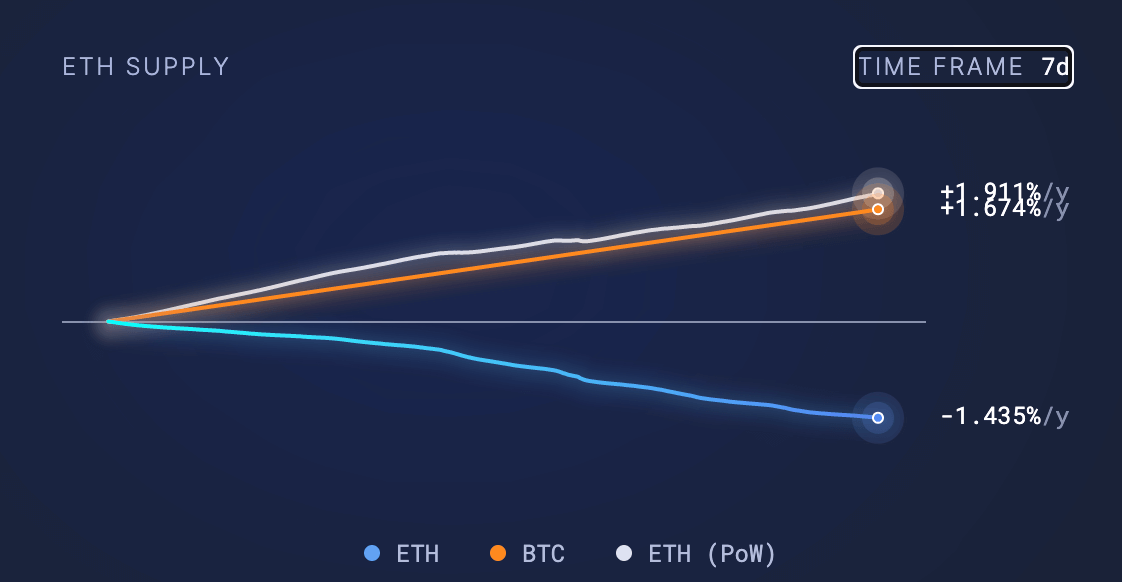 Ethereum 7-day inflation rate (Source: ultrasound.money)
However, some critics contend that the transition to PoS has centralized control of the network among major staking entities and exchanges. There are concerns that the concentration of staked ETH could jeopardize Ethereum’s decentralization and security assurances, in contrast to Bitcoin’s more distributed mining network.
As Ethereum progresses under its new PoS framework and Bitcoin continues with its established PoW model, observers will closely monitor how their respective supply dynamics and security trade-offs develop. With Bitcoin’s issuance set to halve due to the upcoming halving, its inflation rate will decrease to 0.8%, which is within 1% of Ethereum. However, Bitcoin has a capped supply and will ultimately reach an inflation rate of zero. Ethereum’s inflation rate is linked to network activity and the volume burned through transactions.
Nonetheless, the deflationary trend in ETH over the past 540 days provides an early insight into the potential future of the two largest cryptocurrencies ahead of the first Bitcoin halving since The Merge. The long-term viability and implications for both networks remain uncertain, with Bitcoin currently valued at a $1.3 trillion market cap and Ethereum following at $478 billion.
The post Proof of Stake cut $21 billion ETH from circulation as deflation falls to 1.4% appeared first on CryptoSlate.
