Disclaimer: Information found on CryptoreNews is those of writers quoted. It does not represent the opinions of CryptoreNews on whether to sell, buy or hold any investments. You are advised to conduct your own research before making any investment decisions. Use provided information at your own risk.
CryptoreNews covers fintech, blockchain and Bitcoin bringing you the latest crypto news and analyses on the future of money.


A significant transformation has occurred in Bitcoin’s derivatives market over the past five years. While the market has grown larger, institutions now play a much more prominent role, exchanges offer more sophisticated products, and traders have become far more adept at managing risk, one of the foundational products of this market has nearly vanished from the crypto-native venues where Bitcoin derivatives first gained traction.
Dated futures volume across offshore venues tracked by Glassnode is now approximately 97% below its 2021 levels. Meanwhile, options have expanded from roughly one-quarter of crypto-native Bitcoin derivatives open interest to nearly half, gaining share during four of the five market regimes Glassnode studied since 2019.
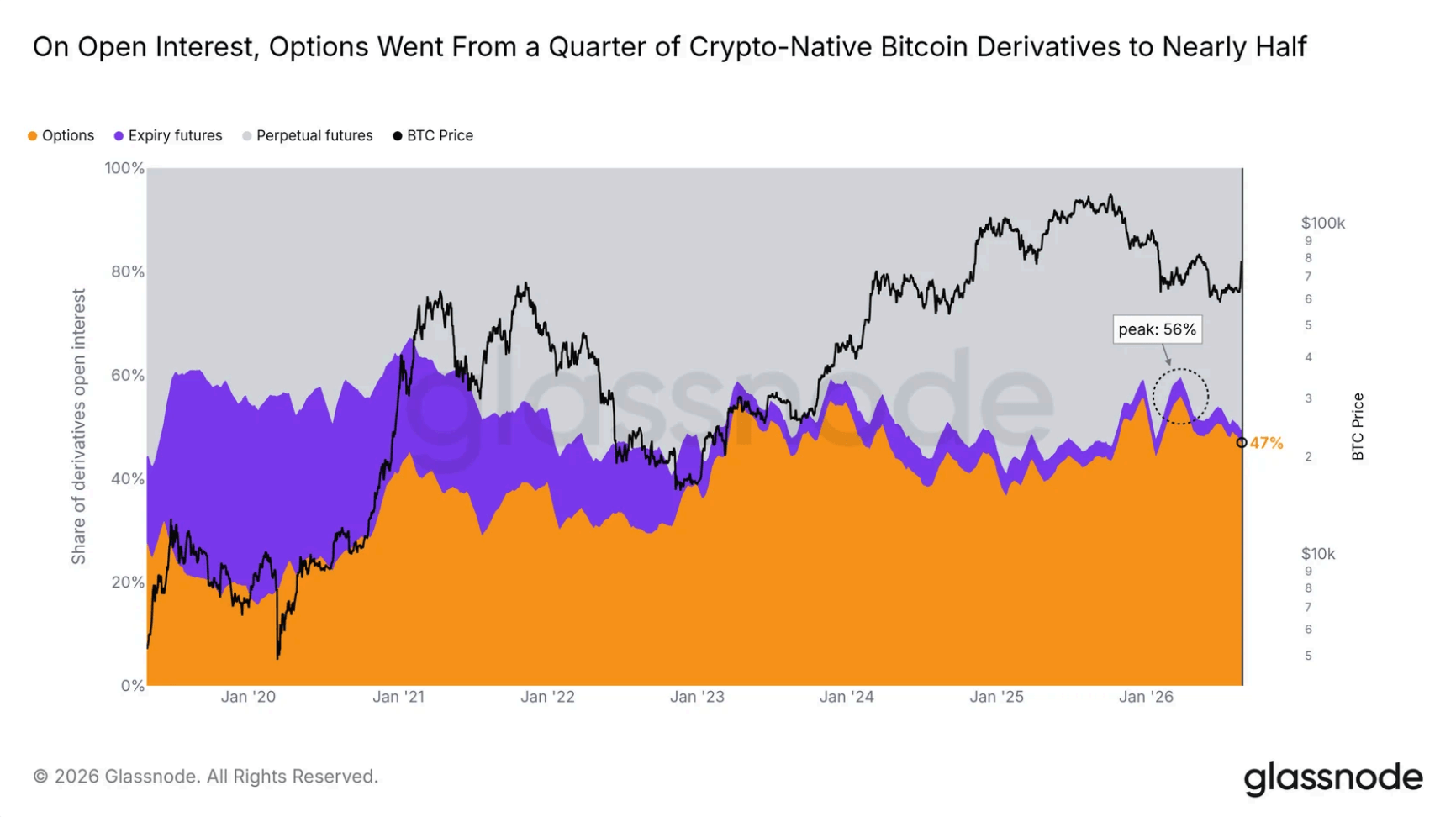
It might be tempting to describe this as options simply replacing futures, but that is not entirely accurate. The Bitcoin derivatives market has split the old futures landscape between two products better suited to different types of risk. Perpetuals have become the primary vehicle for leveraged directional bets without the complexity of expiry, while options have taken over more of the work related to hedging, volatility, downside protection, and trades structured around specific prices or dates.
This division has effectively squeezed dated futures from both sides.
CryptoSlate has monitored this evolution for years. A 2024 market report on how Bitcoin options impact the broader crypto market highlighted how large expiries were already reshaping open interest and influencing short-term trading. By March 2025, Bitcoin’s options-to-futures open interest ratio had surged from 57.8% to 69.6% in less than a week, while Ether’s ratio remained significantly lower, according to CryptoSlate’s analysis.
The ratio finally flipped in January 2026, when Bitcoin options open interest reached approximately $74.1 billion compared to roughly $65.22 billion in futures, marking the first time CryptoSlate recorded options carrying a larger position inventory. CryptoSlate’s January derivatives report captured this shift as it unfolded.
The new Glassnode data adds critical context that those snapshots lacked, showing the reordering across several market cycles and, more importantly, clarifying where the old futures activity migrated.
The futures market splits in two
Conventional futures are tied to a specific date. Buying a December Bitcoin future means the contract will eventually expire, requiring the trader to settle, close, or roll the position into another maturity.
This structure remains highly effective in traditional markets built around standardized monthly and quarterly contracts. However, crypto markets trade 24/7, eventually giving rise to a product better suited to that environment.
The perpetual future eliminated the expiry date, allowing traders to hold positions as long as margin requirements are met. Recurring funding payments between long and short positions help keep the contract price aligned with the underlying spot price.
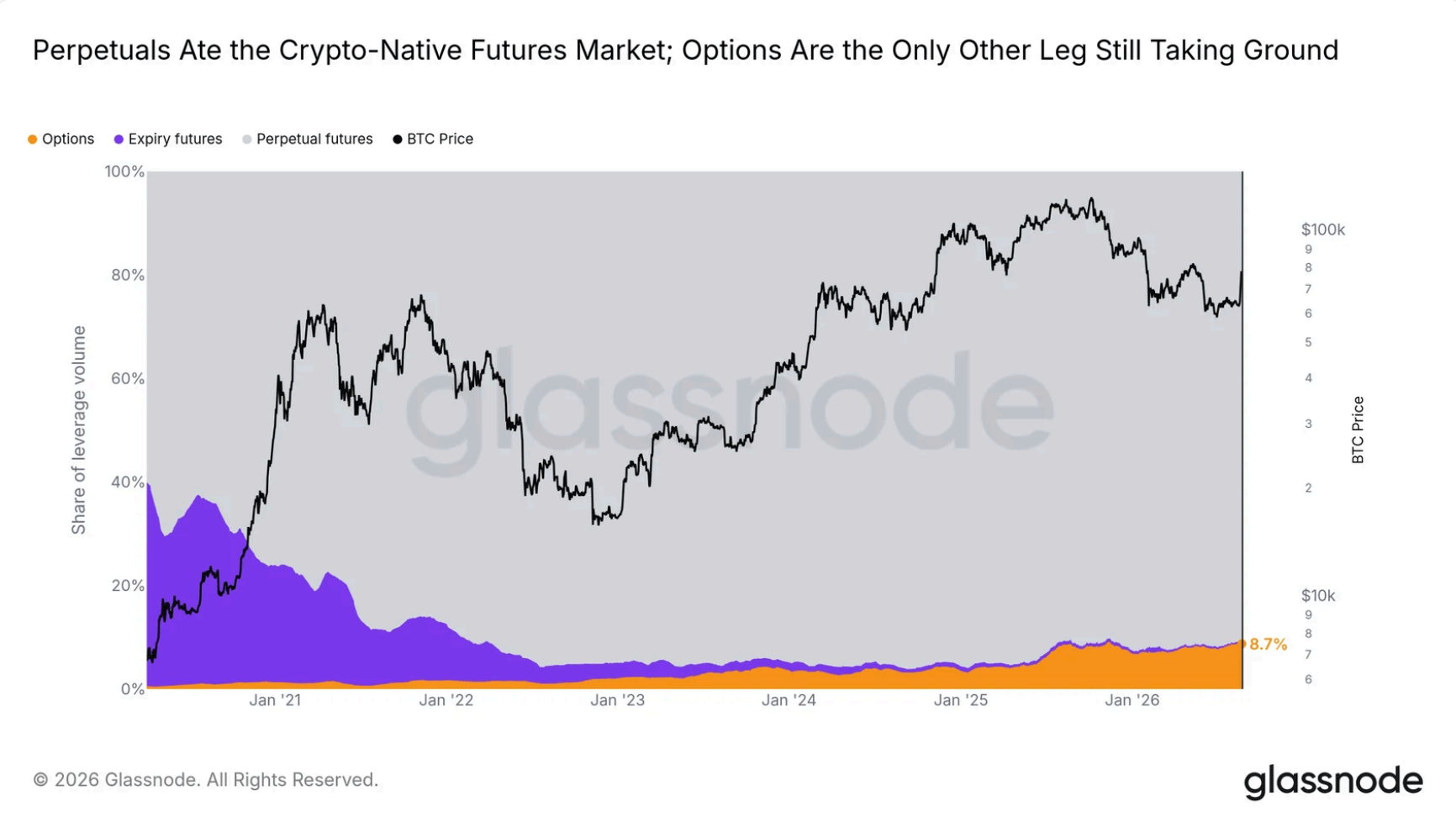
This model is difficult to beat for traders seeking leveraged Bitcoin exposure, as there is no contract roll to manage and no need to decide which maturity offers the deepest liquidity. The largest perpetual naturally becomes the default trading venue.
A September 18 snapshot of Binance’s market illustrates the extent of this preference. At approximately 03:25 ET, the exchange’s BTCUSDT perpetual held about 108,289 BTC in open interest, while the BTCUSDC perpetual held another 19,465 BTC. At their respective mark prices, these two contracts represented roughly $9.93 billion in outstanding positions.
In contrast, Binance’s two USD-margined dated Bitcoin contracts, expiring on September 25 and December 25, carried only about $77 million in combined open interest. This placed open interest in the two major stablecoin-margined perpetuals at roughly 129 times the amount found in the corresponding quarterly contracts.
While this represents data from a single exchange and a single snapshot, it should not be treated as a definitive market-wide ratio. Nevertheless, it demonstrates why the collapse in dated futures activity on crypto-native venues is not particularly surprising: traders seeking linear leverage already have access to another instrument with deeper liquidity and lower maintenance requirements.
Glassnode’s broader derivatives data supports this trend. Dated futures activity declined sharply from its 2021 peaks, while perpetuals absorbed much of the leverage that previously resided there. Options expanded alongside them, but they do not compete for the exact same trading needs.
This distinction is crucial because open interest can make very different products appear interchangeable. A dollar of perpetual open interest and a dollar of options open interest do not represent the same risk profile. A perpetual is primarily linear, whereas an option’s payoff depends on strike price, expiry, volatility, and Bitcoin’s price relative to all these factors.
This allows holders to protect large Bitcoin positions without selling them or cap downside while retaining upside potential. Traders expecting a large move but uncertain of the direction can isolate volatility itself rather than making a simple directional bet. Once the market became deep enough to support these trades, there was less need for dated futures to perform all functions simultaneously.
Why options became significantly more valuable
The simplest explanation for the growth of options is the change in Bitcoin ownership structures.
Related Posts
Earlier crypto cycles were dominated by participants making relatively direct bets. They bought because they anticipated price rises, shorted because they expected declines, or added leverage to either side. Futures were excellent tools for these strategies.
A market with large pools of Bitcoin held by owners who do not intend to sell creates different problems. US spot ETFs hold Bitcoin for investors who may maintain that exposure for years. Corporate treasuries hold it on their balance sheets. Funds run mandates around it, while market makers and structured-product desks carry inventory to provide liquidity or package returns for clients.
These holders do not always want to increase or decrease their Bitcoin exposure. Often, they simply wish to alter the risk profile of what they already own, which is where options become much more attractive.
Funds concerned about a drawdown can buy puts instead of selling their Bitcoin. Holdings willing to sacrifice some upside can sell calls against their positions. Desks expecting a large move but unsure of the direction can trade volatility rather than choosing long or short, providing the market with a way to separate the risk of owning Bitcoin from the decision to own it.
Options also influence broader market movements because dealers must hedge them. A market maker that sells options may end up buying or selling Bitcoin or futures as the option’s delta changes. This means the options book feeds directly into spot and perpetual liquidity.
This makes options increasingly important even when the buyer is not making a directional bet.
Glassnode’s data suggests this is not a phenomenon limited to bull markets. Options gained share in four of the five regimes studied since 2019, with some of the fastest expansion occurring during the long bear-market period.
This aligns with a product that does not require rising prices to become valuable; it becomes more critical when investors focus on the shape of their risk.
The collateral underlying the market has also changed. Early crypto derivatives were often margined in Bitcoin itself, creating a negative feedback loop during selloffs. A trader’s position could lose value simultaneously with the collateral backing it, making leveraged trades more fragile precisely when volatility was accelerating.
Stablecoin and cash-like margin separate these risks. Glassnode describes the derivatives market as shifting away from coin-backed leverage toward stable-value collateral. This allows professional desks to manage positions across products without the margin itself depreciating alongside Bitcoin.
Options venues have also become significantly deeper. Glassnode’s comparison of four venues found that Bybit’s share of tracked Bitcoin options volume reached 28%, up from below 10%, while its options book expanded from $529 million in its first month to $2.33 billion. Ethereum accounted for roughly one-third of Bybit’s options turnover over the previous 90 days.
These exchange-specific figures come from research produced in collaboration with Bybit and should be interpreted with that relationship in mind. However, the broader point is difficult to dismiss: liquidity is no longer concentrated in a single options venue to the extent it once was.
As spreads tighten and professional market makers operate across multiple exchanges, the product transitions from feeling exotic to functioning as ordinary market infrastructure.
Dated futures still have a role
There is an important boundary to the Glassnode data: its options comparison covers crypto-native venues, while the futures study focuses on offshore exchanges and explicitly excludes CME.
Therefore, the claim that dated futures are disappearing should not be extended to the entire Bitcoin market.
CME futures serve a different customer base and often a different purpose. A regulated asset manager, hedge fund, bank, or basis trader may prefer a standardized CME contract because it integrates seamlessly into established collateral, clearing, compliance, and risk systems.
Spot ETFs have further increased the relevance of this institutional futures market. Funds can hold spot exposure and short futures against it. Basis traders can buy Bitcoin or an ETF and sell a future when the spread is wide enough to cover financing and execution costs. Market makers can also use CME positions to hedge exposure held elsewhere.
This can create enormous short positions without necessarily indicating that traders are bearish on Bitcoin. This is why CFTC leveraged-fund shorts must be analyzed alongside basis conditions and the rest of the trade structure.
Dated futures are therefore not disappearing everywhere, but their role is becoming more specialized. Offshore crypto-native exchanges developed a superior instrument for continuous directional leverage, calling it the perpetual. Regulated institutions still have reasons to use standardized futures through CME. Options have expanded into the large space between these two markets, where investors need to manage volatility, downside, expiry-specific risk, and portfolios they do not wish to sell.
The result is a derivatives market that looks very different from it did five years ago. Perpetuals carry much of the raw leverage, options increasingly manage the complex risks associated with that leverage, and CME futures preserve a regulated route for institutions requiring standardized contracts and established clearing.
Dated futures did not lose all their business to a single replacement because their original role was fragmented. This shift reflects the maturation of Bitcoin trading more than the size of any single derivatives market. A market dominated by one leveraged contract is primarily built around making a bet. A market with deep spot ownership, perpetual liquidity, regulated futures, and a robust options surface is built around holding Bitcoin for longer periods while continuously deciding which parts of the risk are worth retaining.
The post Offshore Bitcoin futures crash 97% as traders abandon traditional risk appeared first on CryptoSlate.
