Disclaimer: Information found on CryptoreNews is those of writers quoted. It does not represent the opinions of CryptoreNews on whether to sell, buy or hold any investments. You are advised to conduct your own research before making any investment decisions. Use provided information at your own risk.
CryptoreNews covers fintech, blockchain and Bitcoin bringing you the latest crypto news and analyses on the future of money.


The financial sector has historically depended on conventional indicators to assess market vitality and forecast upcoming trends. Among these indicators, the 30-year fixed mortgage rates and the 30-year Treasury yield are essential benchmarks.
The gap between these two indicators has recently attracted considerable attention, reaching unprecedented levels and sparking discussions regarding its effects on the wider market.
The 30-year fixed mortgage rate denotes the interest rate that lenders impose for a 30-year loan utilized for real estate purchases. This rate is significant for various reasons.
Firstly, it has a direct effect on homeowners’ monthly payments, shaping choices related to home buying and refinancing.
Secondly, it reflects lenders’ confidence in the long-term stability of the economy. An elevated rate often signifies perceived risks in the housing sector or broader economic uncertainties.
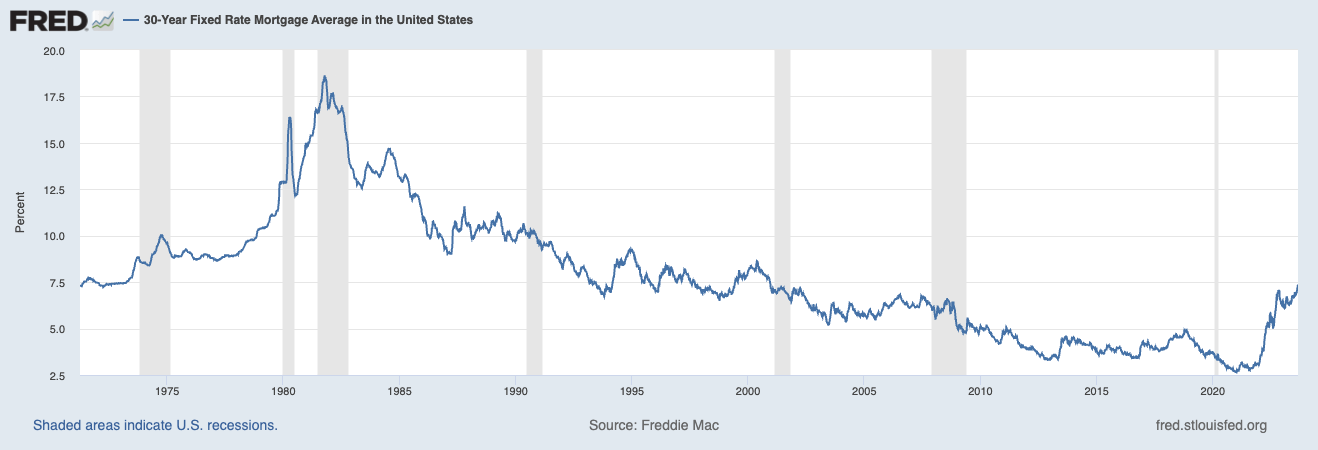 Graph illustrating the average 30-year fixed mortgage rate in the U.S. from 1971 to 2023 (Source: Federal Reserve)
The 30-year Treasury yield represents the return on investment for a U.S. government bond that matures in 30 years. Considered one of the safest investments, it is backed by the full faith and credit of the U.S. government. This yield serves as a benchmark for other interest rates and offers insights into investor sentiment regarding future economic conditions.
A lower yield generally indicates that investors are favoring safer assets, potentially due to worries about economic downturns or geopolitical tensions.
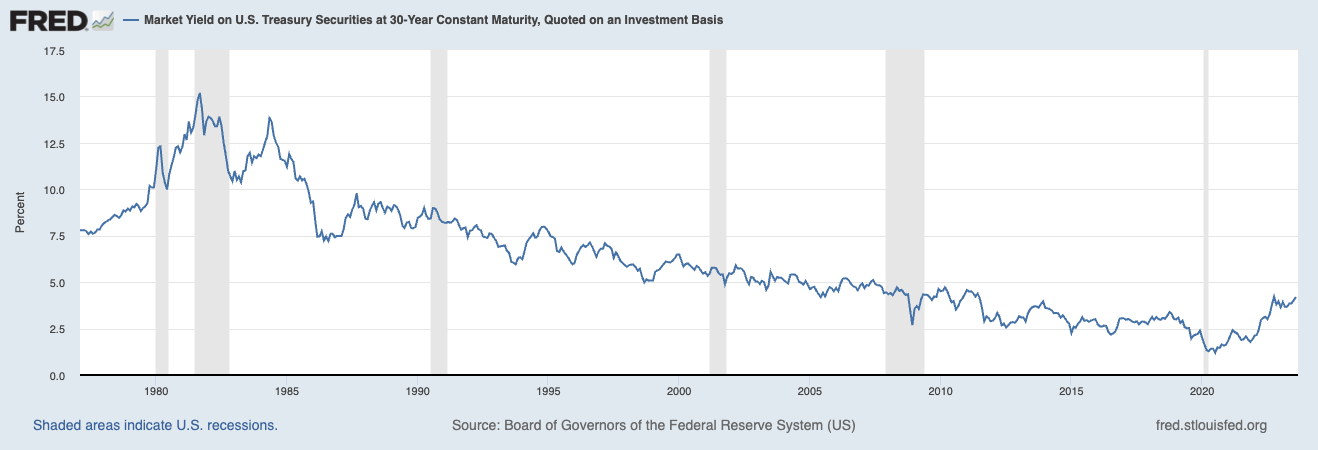 Graph depicting the 30-year Treasury yield from 1977 to 2023 (Source: Federal Reserve)
The disparity between the 30-year fixed mortgage rate and the 30-year Treasury yield is referred to as the ‘spread.’ This spread acts as a gauge for credit tightness within the system. An expanding spread suggests that while government securities remain a secure option, the housing market is viewed as riskier.
Related Posts
In contrast, a narrowing or low spread implies that the perceived risk between the two is minimal. This could indicate a stable housing market and a robust economy, where lenders regard mortgage lending as nearly as secure as government-backed securities.
The all-time low for the spread was 0.11%, achieved on June 1, 2011. More recently, on May 1, 2021, the spread fell to 0.67%, shortly after reaching a peak of 2.17% on March 1, 2021. Such lows indicate periods of increased confidence in the housing market, with lenders viewing it as almost equivalent to the safety of government bonds.
The spread reached a record high of 2.97% on Aug. 1, 2023, followed by a slight decrease to 2.88% on Sept. 5, 2023.
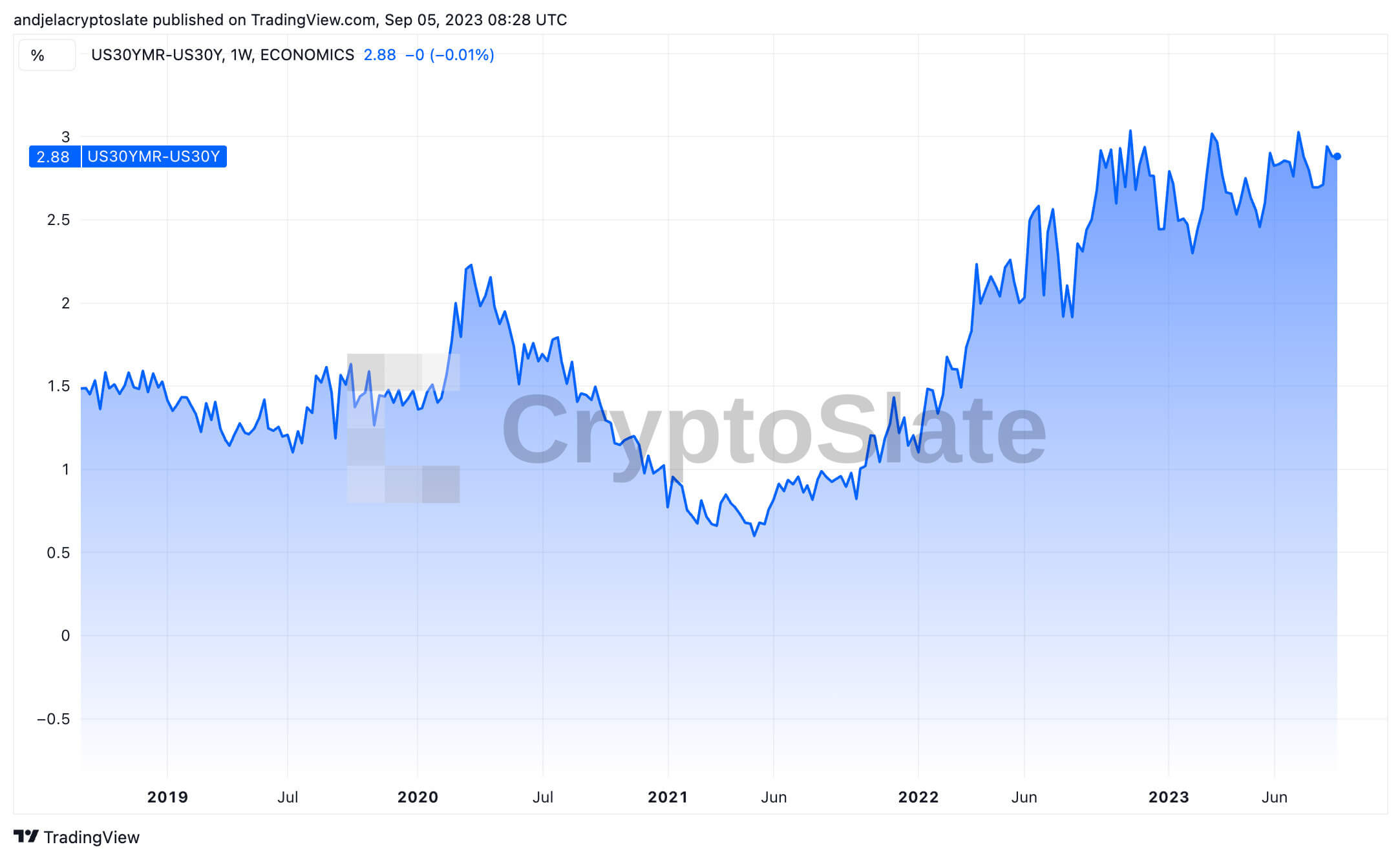 Graph showing the spread between the 30-year fixed mortgage rate and the 30-year Treasury yield from 2019 to 2023 (Source: TradingView)
Previous peaks include 2.91% on Oct. 1, 2022, 2.17% on March 1, 2020, 2.56% on Dec. 1, 2008, and 2.52% on May 1, 2000.
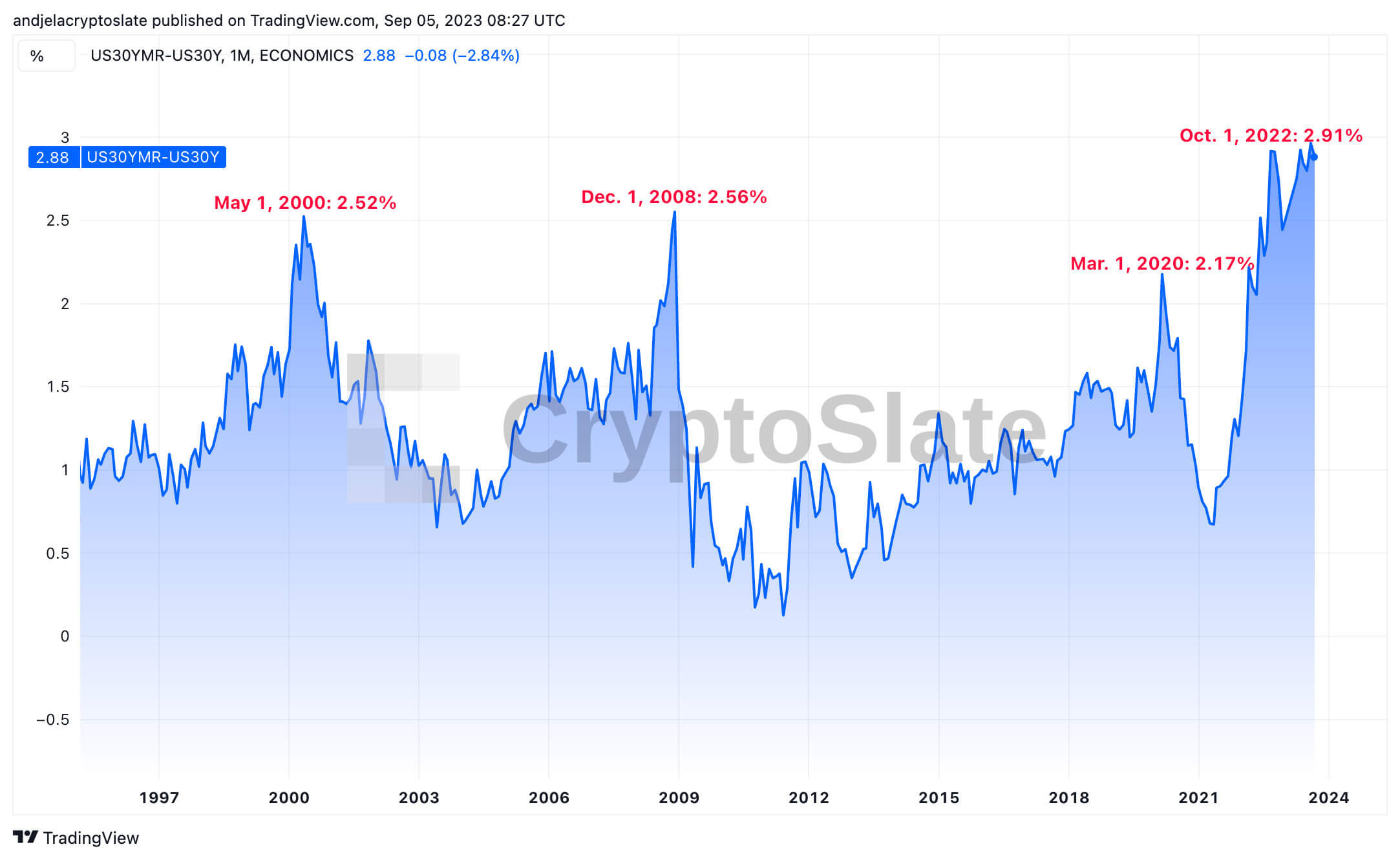 Graph illustrating the spread between the 30-year fixed mortgage rate and the 30-year Treasury yield from 1995 to 2023 (Source: TradingView)
- Oct. 1, 2022 (2.91%): The fact that the previous all-time high was recorded less than a year ago indicates that the trend of a widening spread has been ongoing for some time.
- Mar. 1, 2020 (2.17%): The global economic downturn and uncertainties related to the pandemic likely made lenders more risk-averse, resulting in a broader spread.
- Dec. 1, 2008 (2.56%): A significant increase in the spread was noted during the global financial crisis. The global economy experienced an unprecedented downturn, with banks and financial institutions facing severe challenges. The wider spread reflects the heightened risk and uncertainty of that time.
- May 1, 2000 (2.52%): An unusually wide spread was recorded when the dot-com bubble burst. The broader spread indicates that lenders perceived greater risks in the housing market, possibly due to economic uncertainties arising from the collapse of numerous tech companies.
The gap between the 30-year fixed mortgage rate and the 30-year Treasury yield provides critical insights into the economy’s condition and investor sentiment.
Its recent rise to near-historical highs suggests a cautious stance by lenders and may indicate a shift in investment strategies. In light of the uncertainties in traditional markets, investors might consider alternative assets such as cryptocurrencies.
Bitcoin, in particular, may experience heightened activity as it presents potential hedging opportunities against fluctuations in traditional markets.
The post Mortgage-treasury spreads hit historical highs revealing Bitcoin opportunity appeared first on CryptoSlate.
