Disclaimer: Information found on CryptoreNews is those of writers quoted. It does not represent the opinions of CryptoreNews on whether to sell, buy or hold any investments. You are advised to conduct your own research before making any investment decisions. Use provided information at your own risk.
CryptoreNews covers fintech, blockchain and Bitcoin bringing you the latest crypto news and analyses on the future of money.


The hash rate of Bitcoin denotes the total computational capacity utilized for mining and validating transactions on the network. More than just a measure of raw computing strength, the hash rate functions as an indicator of the network’s security and overall health.
A strong hash rate not only reflects significant miner participation but also highlights the network’s ability to withstand potential threats. Keeping an eye on this metric is essential, as its variations can reveal insights into miner attitudes, possible network weaknesses, and the general state and decentralization of the Bitcoin ecosystem. Essentially, the hash rate serves as a complex gauge, illustrating both the technical robustness and the shared trust in the Bitcoin network.
Bitcoin’s hash rate has been reaching new all-time peaks every week since December 2022, hitting a high of 501 EH/s on September 15. As of October 8, the hash rate is recorded at 418 EH/s.
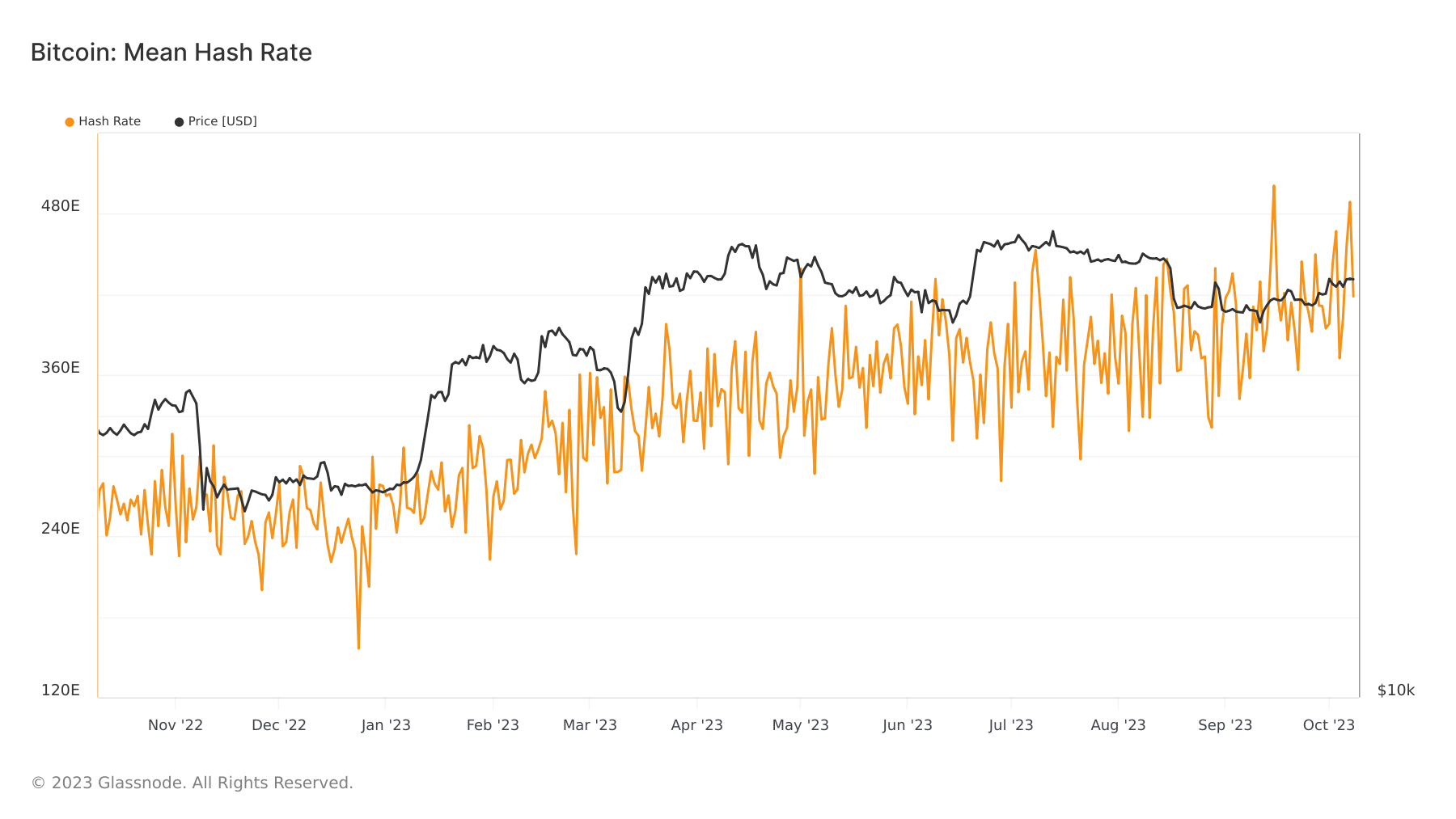 Graph illustrating Bitcoin’s hash rate from October 2022 to October 2023 (Source: Glassnode)
However, simply observing the hash rate does not provide sufficient context regarding market sentiment. To gain a clearer picture of miner health, we need to examine the convergence and divergence of the moving averages of the hash rate. Tracking this metric is vital, as variations can provide insights into miner attitudes, potential network weaknesses, and the overall condition and decentralization of the Bitcoin ecosystem. Hash ribbons serve as a complex indicator, reflecting both the technical integrity and the collective trust in the Bitcoin network.
Related Posts
Since mid-August, the 30-day moving average of Bitcoin’s hash rate has consistently exceeded the 60-day moving average. Importantly, the ribbons experienced compression in July and August, a trend that has historically signaled miner capitulation. Nonetheless, the gap between these two moving averages has been widening since early October 2023, coinciding with Bitcoin’s rise to $28,000. This divergence implies that miners are optimistic, increasing their operations in anticipation of rising prices.
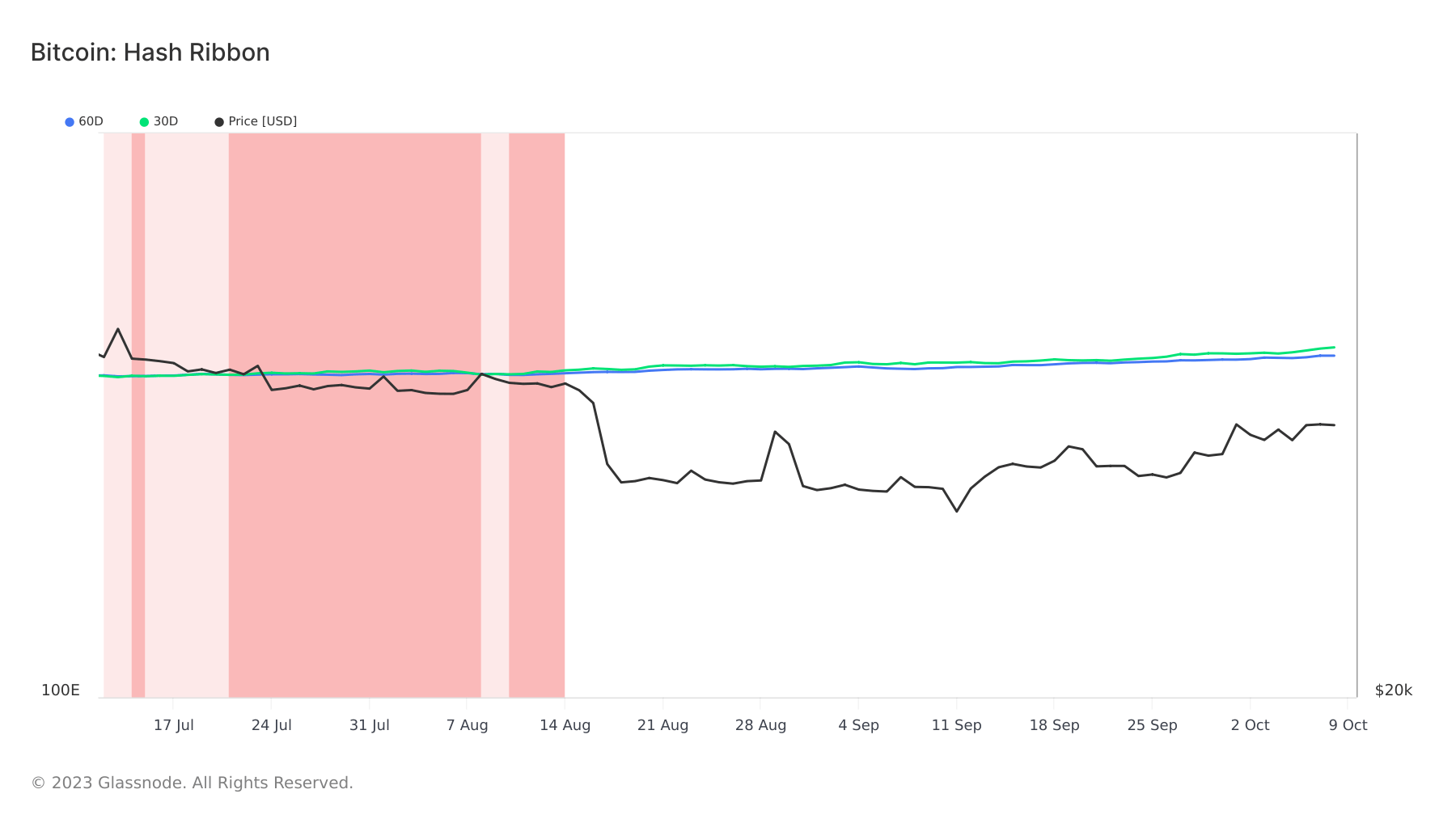 Graph depicting Bitcoin’s hash ribbons from July to October 2023 (Source: Glassnode)
Mining difficulty, another critical metric, adjusts roughly every two weeks to maintain a consistent interval for block additions to the blockchain. The Difficulty Ribbon Compression metric offers insights into miner selling pressure. Historically, significant compression zones, characterized by low values in this metric, have indicated profitable buying opportunities for Bitcoin. Conversely, increases in this metric have often coincided with Bitcoin’s price rallies. As of June 30, the difficulty ribbon compression was beneath the 0.05 threshold, and as of October 8, it was at 0.032, indicating potential upward price momentum.
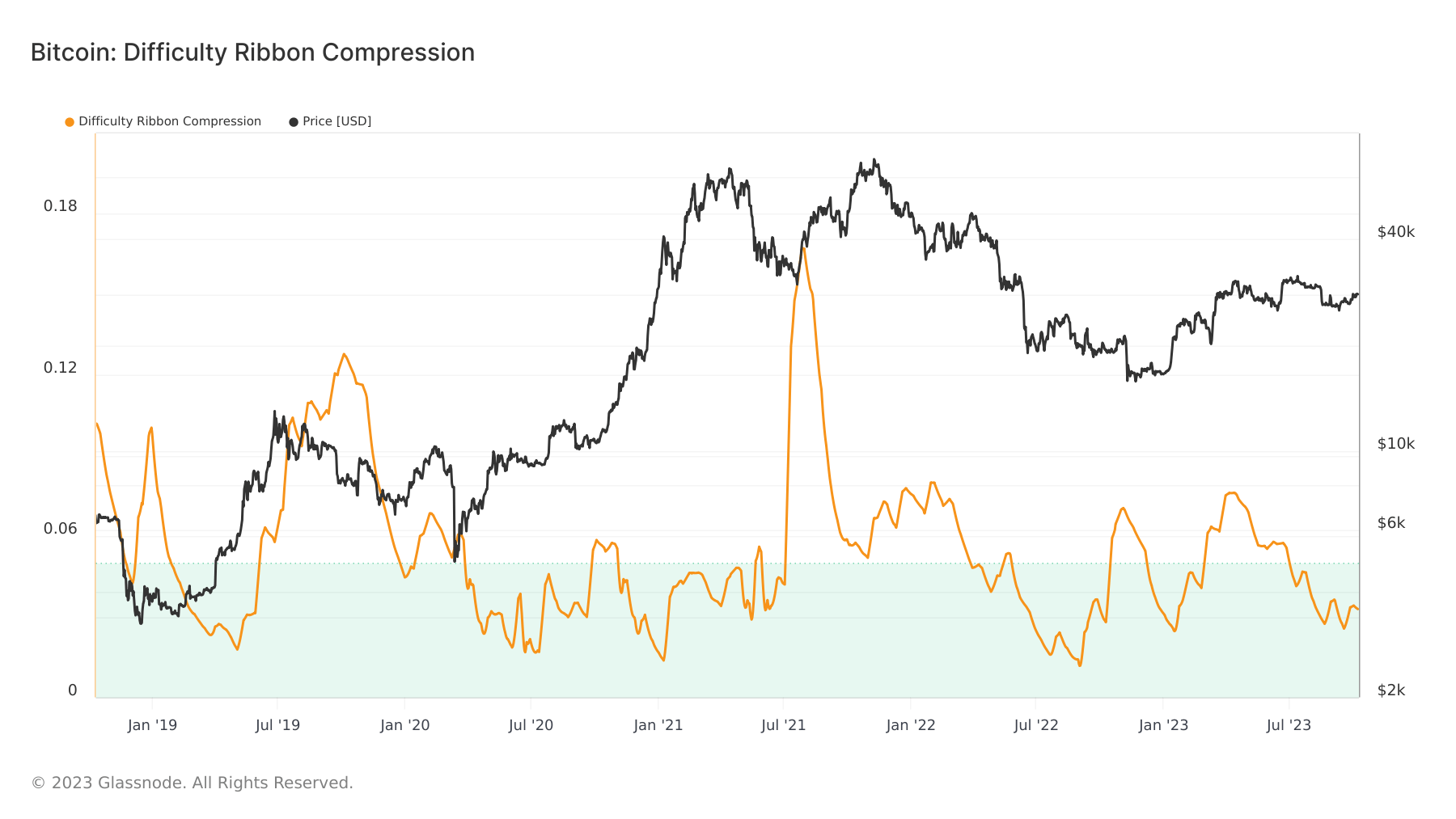 Graph representing Bitcoin’s mining difficulty compression from October 2018 to October 2023 (Source: Glassnode)
The increasing hash rate emphasizes a strong and secure network, while the hash ribbons and difficulty ribbon compression suggest optimistic miner sentiment and potential price growth.
The post Mining metrics suggest bullish sentiment for Bitcoin appeared first on CryptoSlate.
