Disclaimer: Information found on CryptoreNews is those of writers quoted. It does not represent the opinions of CryptoreNews on whether to sell, buy or hold any investments. You are advised to conduct your own research before making any investment decisions. Use provided information at your own risk.
CryptoreNews covers fintech, blockchain and Bitcoin bringing you the latest crypto news and analyses on the future of money.

MiCA Takes Effect in Europe as Crypto Regulatory Framework Launches with Focus on Stablecoins

MiCA is now live across the European Union, representing a significant achievement for the regulation of digital assets. Industry participants now operate under a unified EU framework that encompasses stablecoins, token issuances, and entities such as custody and trading firms.
As noted by the Bretton Woods Committee, the process involved years of discussions and negotiations, culminating in a regulatory framework that addresses oversight deficiencies and encourages transparency.
Companies issuing e-money tokens (EMTs) must be established within the EU or hold equivalent e-money licenses, while asset-referenced tokens are subject to more extensive disclosure and governance requirements once they meet certain volume or user thresholds. The regulations also introduce stricter guidelines on reserve management, redemption, and disclosure, highlighting the bloc’s focus on financial stability within digital asset markets.
Patrick Hansen, Policy Director at Circle, authored a detailed article explaining that stablecoin issuers have little option but to comply or forfeit access to the entire EU market. Tether, the leading stablecoin issuer globally, opted for the latter route, informing CryptoSlate that competitors are frustrated by its distinct approach to stablecoins. He stated,
“Every day you wake up, you scratch your head and you don’t understand why these couple of Italian guys are doing a much better job than you. Of course you become frustrated, right?
So you know, if your business model is called Kill Tether, then you know, you should rethink about your product.”
Expectations for crypto companies in the EU
Crypto-asset service providers (CASPs) engaged in activities such as brokerage, trading, or custody are subject to licensing requirements that permit them to operate across all member states once licensed in a single jurisdiction. This change replaces the previous fragmented national regulations, lowering barriers for companies seeking cross-border expansion and providing a passport-like mechanism similar to that used in traditional EU financial services.
Some firms are anticipated to consolidate or form partnerships as compliance requirements may be more challenging for smaller enterprises. Trading platforms must also implement controls to prevent market abuse and insider trading. Authorities can restrict token offerings if disclosures or risk management practices appear inadequate.
MiCA explicitly excludes protocols operating “in a fully decentralized manner” from its scope, yet many operations may not meet the criteria for true decentralization.
The same uncertainty arises around large-scale NFT collections, which the regulation may classify as fungible, necessitating compliance with white paper and issuer obligations. Ambiguity also surrounds “privacy coins,” which may face delisting if complete holder identification proves unfeasible.
Related Posts
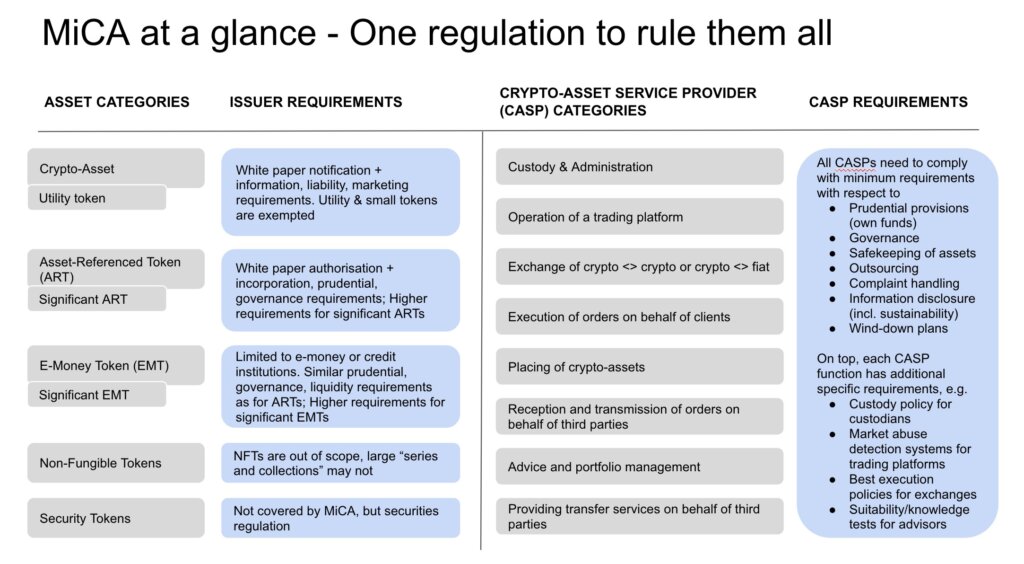 MiCA regulation (Source: Patrick Hansen Substack)
Overall anticipated impact of MiCA
Industry reactions from Bretton Woods and Circle indicate a consensus that the practical success of MiCA hinges on its technical standards and enforcement mechanisms. Companies are adjusting product offerings, focusing on clarity in disclosures and adherence to regulations for token issuance and reserve management. As Hansen noted, the adoption of the framework may attract projects seeking certainty, particularly if concerns regarding enforcement actions elsewhere persist.
There are broader considerations regarding global adoption. The U.S. has yet to formalize stablecoin regulation, and enforcement patterns, while seemingly progressive, vary widely across Asia. The European model may influence other jurisdictions, potentially initiating a “race to the top” in consumer protection and alignment with international standards.
According to Bretton Woods, a coordinated approach would enhance passportability for stablecoins and reduce the risks of regulatory arbitrage. Some lawmakers have mentioned a MiCA 2.0, suggesting that non-fungible tokens, DeFi, or additional technological solutions may eventually be revisited under an updated directive. Officials note that any new iteration will depend on the initial outcomes of the regulation.
Hansen points to MiCA’s parallels with other EU tech initiatives, where region-wide standards ultimately shaped industrial and legal frameworks abroad. Whether MiCA becomes a default global reference will depend on its real-world implementation, the role of national agencies, and how effectively the measures protect markets while allowing companies to innovate. Meanwhile, corporate efforts to secure a MiCA license continue, with major banks and exchanges adjusting business lines or acquiring smaller entities.
Many anticipate that MiCA will lead to increased institutional participation, supported by uniform licensing and consumer protections. However, the cost of compliance remains a factor that could shift activity toward well-capitalized platforms. Investors may witness broader adoption of regulated services, while smaller teams might concentrate on specialized niches or relocate to regions with less stringent obligations. Policymakers have committed to monitoring the outcomes, believing that a unified EU stance on crypto can enhance capital formation and user protections.
As the framework is implemented, stablecoin issuers and CASPs face earlier enforcement deadlines than other market participants, while the remainder of the rules will phase in over the year. Regulators can also issue binding implementation standards that clarify timelines, technical disclosures, and operational conditions for token projects.
Hansen confirms that companies planning to navigate the European landscape are engaging with authorities and preparing compliance strategies accordingly. He believes MiCA has established an environment of clear obligations for participants, and its ability to foster responsible growth under consistent rules will determine how it influences crypto markets.
Implementation continues in phases as the EU refines technical guidelines and oversees licensed entities. The outcome will reveal whether MiCA is a viable model that balances innovation with oversight.
The post MiCA goes live in Europe as the crypto regulatory framework begins with stablecoins appeared first on CryptoSlate.
