Disclaimer: Information found on CryptoreNews is those of writers quoted. It does not represent the opinions of CryptoreNews on whether to sell, buy or hold any investments. You are advised to conduct your own research before making any investment decisions. Use provided information at your own risk.
CryptoreNews covers fintech, blockchain and Bitcoin bringing you the latest crypto news and analyses on the future of money.


In the realm of finance, the term ‘smart money’ usually denotes institutional or professional investors believed to have superior market insights and resources. Nevertheless, an interesting trend becomes apparent when analyzing the leading holders across prominent DeFi platforms.
CryptoSlate examined the top 5 wallets (excluding exchanges and funds) alongside the top 5 fund wallets from significant DeFi platforms featured on the on-chain data site Cherry Pick. The platforms analyzed included Uniswap, Aave, Curve, Balancer, and 1inch.
Risk Tolerance and Diversification.
The findings indicate that individual wallets associated with institutions typically maintain lower balances compared to personal wallets. This observation could imply various possibilities.
Firstly, institutional investors might be spreading their investments to reduce risk. Conventional financial principles endorse diversification as a safeguard against market fluctuations, and it appears this strategy may be extending into the evolving DeFi landscape. This is evidenced by funds utilizing multiple wallets. Secondly, the reduced balances may suggest that institutions are still cautiously navigating DeFi, possibly harboring doubts about its long-term viability or operational hazards.
In this context, ‘smart money’ seems to be exercising prudence by avoiding concentration of investments or limiting their overall exposure to the DeFi sector.
For instance, the average balance in Aave for wallets is roughly $11.46 million, whereas funds average only about $528,635. This significant disparity may indicate that institutional investors are either diversifying their risks or are still in the exploratory phase within the DeFi space.
Increased losses from funds.
Despite these diminished balances, funds are experiencing greater realized and unrealized losses. Uniswap’s average realized loss for funds stands at approximately $470,000, in stark contrast to the staggering average loss of $68.6 million for individual wallets.
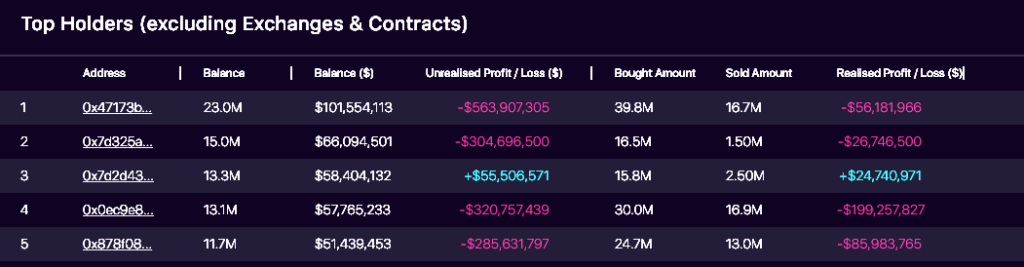 Top Holders of UNI tokens. (Source: CherryPick)
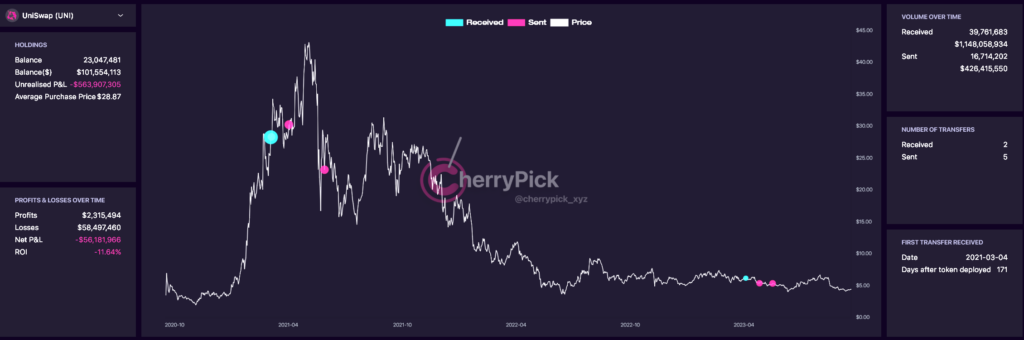
Remarkably, the leading UNI wallet has incurred over $500 million in unrealized losses, with all but one of the top five wallets experiencing nine-figure unrealized losses. A closer look at the top wallet reveals it is likely linked to the protocol itself, having received 39.7 million UNI in March 2021, valued at around $1.1 billion.
At Uniswap’s peak just two months later, its value reached approximately $1.68 billion.
Related Posts
 Top Holder of UNI (Source: CherryPick)
Currently, the wallet is valued at $101 million after transferring approximately 16 million UNI out over the past 36 months, having sold only once for a profit.
This divergence may indicate that while institutional investors are more cautious with their capital, they are more willing to accept short-term losses, potentially as part of a long-term investment approach.
A changing of the guard.
Both individual wallets and institutional funds exhibit a strong preference for Uniswap. With an average balance of $66.9 million for wallets and $104,821 for funds, it is clear that Uniswap continues to be a fundamental component in both retail and institutional DeFi portfolios.
While platforms like JustLend are making progress with a TVL of $4.611 billion, data indicates that ‘smart money’ remains predominantly invested in established platforms, with Lido, Maker, Aave, and Uniswap all retaining positions among the top 5 DeFi platforms by TVL.
However, the top 10, as monitored by DefiLlama, is now lacking several traditional DeFi players, including Balancer, PancakeSwap, SushiSwap, and Yearn Finance. Instead, newer protocols such as JustLend, Summer.fi, and Instadapp have filled these vacancies.
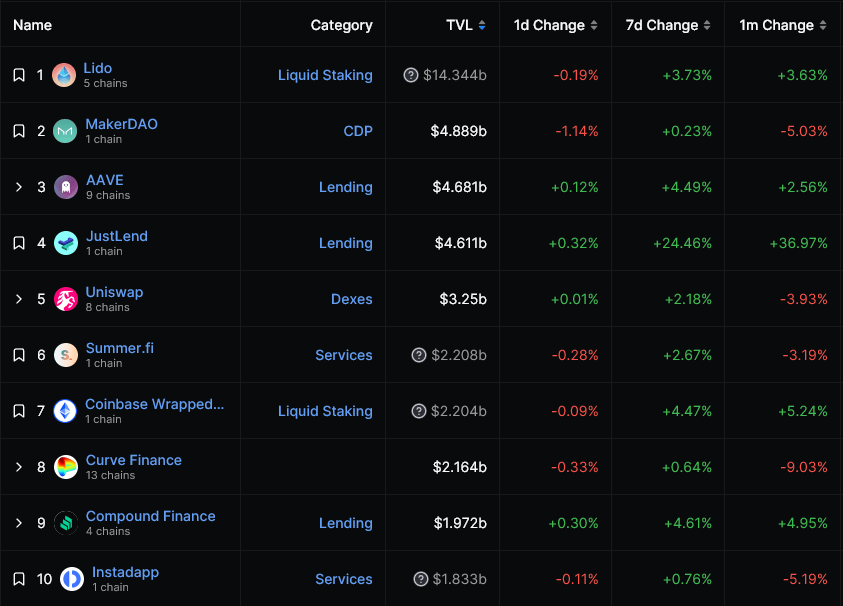 List of DeFi platforms by TVL (Source: DefiLlama)
Profitability and Efficiency
One might anticipate that ‘smart money’ would gravitate towards platforms generating higher revenues and fees. However, this is not necessarily the case. For instance, while Uniswap has accumulated fees totaling $3.254 billion, it has not shielded ‘smart money’ from incurring average realized losses exceeding $470,000.
Looking forward, data from DeFiLlama highlights intriguing trends in TVL fluctuations over time. Platforms like JustLend have experienced a 24.46% increase in TVL within just 7 days.
While our dataset does not establish a direct correlation, it raises the question: Is ‘smart money’ agile enough to take advantage of these swift changes?
The post Is ‘smart money’ that smart? Top 5 DeFi wallets have unrealized losses appeared first on CryptoSlate.
