Disclaimer: Information found on CryptoreNews is those of writers quoted. It does not represent the opinions of CryptoreNews on whether to sell, buy or hold any investments. You are advised to conduct your own research before making any investment decisions. Use provided information at your own risk.
CryptoreNews covers fintech, blockchain and Bitcoin bringing you the latest crypto news and analyses on the future of money.

Is any location secure as Bitcoin declines? Even the 2-year Treasury is beginning to show signs of instability.

Even the most secure areas of the market can begin to feel unstable when oil prices surge, conflicts persist, and investors start to question whether inflation is reverting to an unfavorable trend.
This was the takeaway from Tuesday’s auction of 2-year US Treasuries. These short-term government bonds are closely monitored as they indicate investor expectations for the upcoming years, particularly regarding Federal Reserve interest rates.
Strong demand for these short-duration Treasuries suggests that professional and institutional investors anticipate a decrease in inflation and a potential easing of policy.
Conversely, when demand diminishes, the message changes. Investors seek greater compensation and brace for a more turbulent period ahead.
Tuesday’s auction fell into this latter category. The Treasury issued $69 billion in 2-year notes at a high yield of 3.936%, with demand weaker than the previous month. The bid-to-cover ratio declined to 2.44 from 2.63 in February, while primary dealers acquired a significantly larger portion of the sale.
These figures indicate that investors exhibited less interest than usual in lending money to the US government for a mere two years at a 3.9% interest rate.
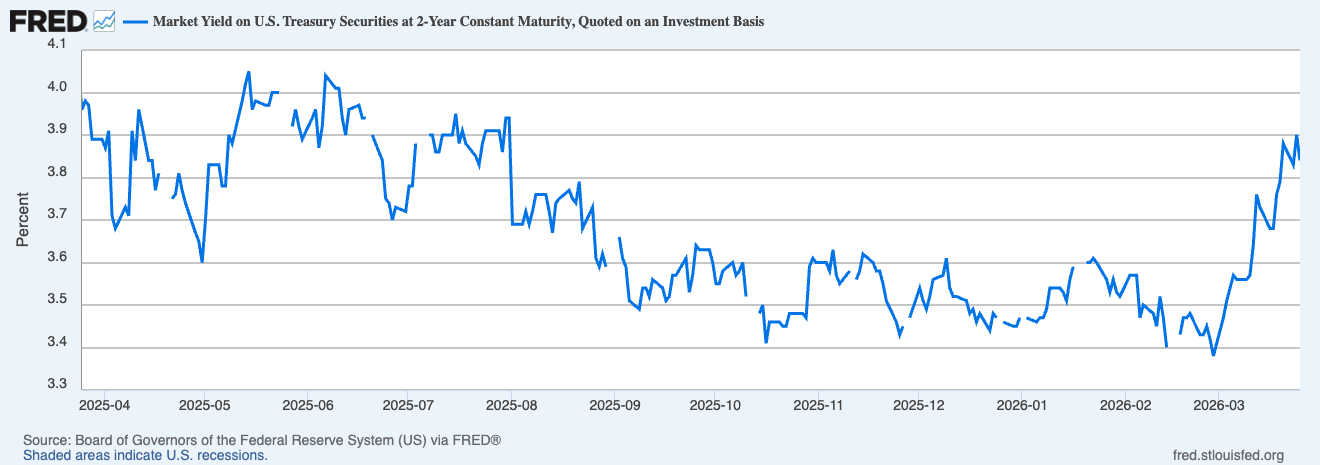 Graph showing the yield on 2-year Treasury securities from March 26, 2025, to March 25, 2026 (Source: The Federal Reserve Bank)
The lackluster sale coincided with rising oil prices due to the conflict in the Middle East, while expectations for swift Federal Reserve rate cuts began to diminish. US business activity fell to an 11-month low in March, even as costs and selling prices increased, creating an uncomfortable economic outlook for investors.
The 2-year Treasury serves as one of the market’s most reliable indicators of where investors believe interest rates are headed in the near term. A weak auction suggests that traders are not convinced the Fed will be able to ease policy in the near future. It may also indicate that concerns about inflation are beginning to overshadow the typical tendency to seek refuge in government debt during geopolitical turmoil.
Why this straightforward auction became a cautionary signal
For much of the past year, investors were optimistic about a light at the end of the tunnel. Inflation appeared to be decreasing, and growth was moderating in a manageable manner, which would allow the Fed to eventually lower rates. Short-term Treasury bonds seemed well-suited for this recovering market, providing a lucrative opportunity to position for more accommodating policy ahead.
However, this outlook was disrupted by the recent oil shock. As the situation in Iran threatens to escalate into a full-scale conflict in the Middle East, oil prices surged, impacting gasoline and overall business expenses. This effectively negated the softening seen in business activity, leaving markets grappling with the possibility of an economic slowdown alongside rising inflation. Such a scenario would hinder the Fed’s ability to provide any form of relief in the coming year.
As we begin to consider this as a genuine possibility, the perception of a “safe” asset shifts.
While the relative safety of an asset remains significant in these circumstances, inflation takes precedence.
Related Posts
Investors start to question whether holding a 2-year Treasury at a specific yield truly offers sufficient protection when energy prices are rising, and the likelihood of lower rates appears uncertain. This is why the weak demand observed this week garnered considerable attention: it indicated that the market was seeking higher returns before committing.
Fed communications have further contributed to this unease. Fed Governor Michael Barr stated that policymakers may need to maintain steady rates for an extended period due to inflation remaining above target and the Middle East conflict introducing additional risks through energy prices.
Such remarks help clarify the importance of 2-year Treasuries: they are the segment of the Treasury market most closely tied to the forthcoming direction of Fed policy. When this segment begins to falter, investors typically respond to their perceptions of what the central bank may or may not be able to do next.
What the signal indicates about the economy moving forward
This month’s auction served as a warning signal for the upcoming months.
Investors are beginning to question whether any of the previous assumptions still hold: Can inflation continue to decline if oil prices remain high? Can the Fed lower rates if energy costs begin to drive prices higher?
The answers to these inquiries will impact everyone, not just Treasury investors.
Increased short-term yields can maintain tight financial conditions, pressure valuations in other markets, and elevate the threshold for risk-taking across equities and speculative assets. They can also alter borrowing conditions, as expectations regarding the Fed’s future policy influence various pricing decisions.
This is why a weak auction at the front end of the curve can convey a broader narrative about confidence, apprehension, and how investors perceive the next phase of the economy unfolding.
There remains potential for this signal to stabilize. Hopes for a ceasefire have contributed to a slight decline in oil prices, which could alleviate some of the pressure on inflation expectations.
Nevertheless, the market continues to engage in internal debate, with discussions reflected in every new oil headline, every Fed statement, and every fresh data point on prices and growth.
At present, the message from the auction is unmistakable: investors are evaluating the next two years and envisioning a more challenging path than they did a month ago. They are confronted with war, rising oil prices, inflation, slowing activity, and a Federal Reserve that has less capacity to intervene than markets had anticipated. This has led to a glimpse of a market beginning to factor in a more difficult environment.
The post Is anywhere safe as Bitcoin weakens? Why even the 2-year Treasury is starting to crack appeared first on CryptoSlate.
