Disclaimer: Information found on CryptoreNews is those of writers quoted. It does not represent the opinions of CryptoreNews on whether to sell, buy or hold any investments. You are advised to conduct your own research before making any investment decisions. Use provided information at your own risk.
CryptoreNews covers fintech, blockchain and Bitcoin bringing you the latest crypto news and analyses on the future of money.

Iran Speaker anticipates pre-market “reverse signal” as Bitcoin rises ahead of the S&P 500.

Mohammad Bagher Ghalibaf, the speaker of Iran’s parliament, shared a notable market commentary on X prior to the recent futures fluctuation. His remarks contributed to the ongoing online propaganda proxy conflict on social media, emphasizing allegations of insider trading concerning Polymarket war wagers.
“Pre-market so-called ‘news’ or ‘Truth’ is often just a setup for profit-taking,” he stated. “If they pump it, short it. If they dump it, go long.”
The market subsequently behaved almost precisely as he described.
The Kobeissi Letter monitored the movement chronologically, noting that S&P 500 futures opened significantly lower on Sunday evening, recovered by late evening, and then continued to rise after President Trump announced on Truth Social that “great progress” had been made regarding Iran peace discussions.
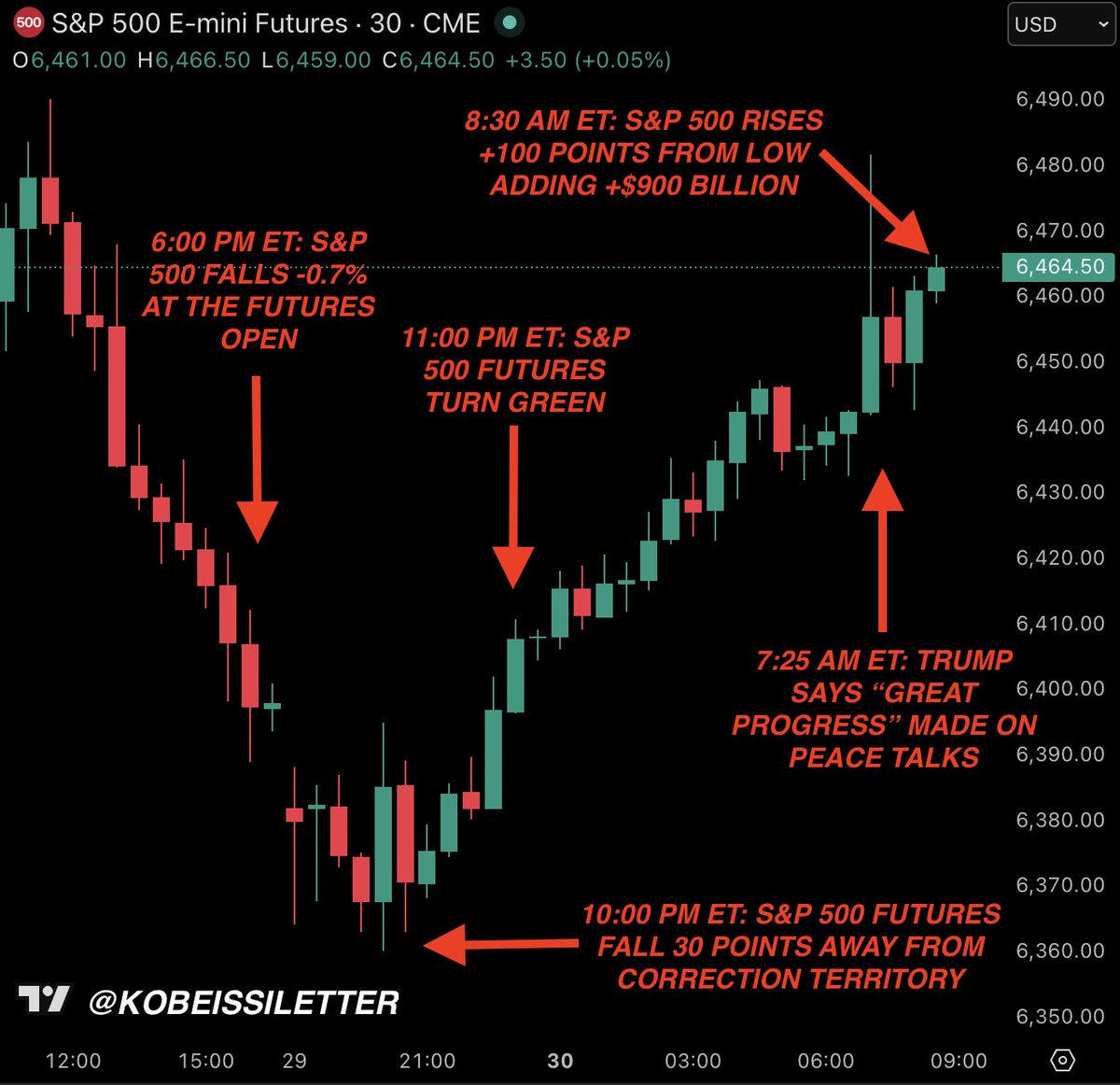 Annotated 30-minute S&P 500 E-mini futures chart showing a sharp overnight rebound after headlines about Trump’s comments on Iran peace talks, with markers highlighting key time-stamped moves from the futures open to the morning recovery.
MarketWatch verified the authenticity of the account that had publicly provided contrarian trading guidance to U.S. investors just before the Sunday futures opening, while Barron’s characterized Monday’s rebound as another early-morning market surge influenced by Trump’s social media commentary on Iran.
Trump’s statements regarding Iran have consistently impacted short-term pricing across equities, oil, and cryptocurrency.
A week prior, markets experienced a surge after Trump indicated that a resolution with Iran was imminent.
 Related Reading
Bitcoin price confirms recovery hitting highest price since start of Iran war and Trump tariff chaos
Bitcoin is rising while war and oil disruptions complicate pricing for other assets.
Mar 16, 2026 · Liam 'Akiba' Wright
Bloomberg reported that billions of dollars in oil and stock-index futures exchanged hands shortly before one of Trump’s posts about Iran caused crude prices to drop and equities to rise, while The Wall Street Journal noted a surge in futures activity ahead of another Trump message that attracted attention across trading desks.
The economic landscape for the upcoming week is set against this backdrop.
The market is contending with a geopolitical risk premium in oil, an increasing likelihood of slower growth, and a political communication channel that now acts as an immediate pricing factor.
Monday’s cross-asset movement illustrates this interaction clearly.
S&P 500 futures added to their gains after Trump stated that the U.S. was engaged in “serious discussions” with a “new, and more reasonable regime” in Iran.
This same message cycle has also included a warning to “completely obliterate” Iran’s energy and water infrastructure if a settlement does not materialize.
This combination of conciliatory language on one side and escalation risk on the other influenced the trading session. The Wall Street Journal reported WTI exceeding $100 a barrel and Brent surpassing $108, with Brent later rising above $116 as the conflict escalated.
Investors are currently navigating both diplomacy and disruption, with the energy sector remaining the primary conduit for inflation, interest rates, and growth.
Bitcoin enters this scenario with a structural advantage over every major U.S. risk asset.
It trades continuously, through weekends, during Asian hours, and during periods when Wall Street’s core cash market is closed.
Bitcoin tracked the same macro shock as equities, then formed its own pattern while Wall Street was offline
Bitcoin’s significance in this context arises from its timing.
It trades around the clock, functioning as a live macro market when U.S. equities are not active.
This dual role allows it to respond to the same geopolitical factors that influence the S&P 500 while also providing a real-time perspective on how those factors are being processed outside of U.S. cash hours.
The patterns observed in the charts during this latest Iran-Trump sequence clearly reflect this distinction.
Bitcoin experienced a sharp decline leading into the weekend and around the U.S. market close, then entered a prolonged stabilization phase while U.S. equities were offline.
Bitcoin’s price fell to the March 27 close, then remained within a broad range around the mid- to upper $66,000s for much of the closing period, before strengthening as the U.S. market opened on Monday.
The S&P’s intraday movement was more abrupt and distinct.
Bitcoin’s movement was earlier, more continuous, and more gradual.
This overall structure aligns with broader market reporting from earlier in the month.
 Related Reading
Where is Bitcoin price headed this week? BTC falls to $65,000 but starts the week in recovery mode
Bitcoin drops to $65k but shows early recovery. Key levels, scenarios, and what must hold for BTC to regain upside momentum.
Related Posts
Mar 30, 2026 · Liam 'Akiba' Wright
Bitcoin was the first liquid asset to respond to the Iran war when the initial attack cycle commenced on a Saturday, dropping 8.5% while traditional markets were closed.
In the subsequent days, Bitcoin fell to as low as $67,300 before rebounding after Trump announced that the U.S. had initiated talks with Iran. Bitcoin then rose back above $71,000 as war concerns subsided.
Bitcoin also dipped below $68,500 last week due to another round of mixed messaging from Iran that caused market volatility. A straightforward interpretation can be made.
Bitcoin has been trading as a macro-sensitive asset throughout this conflict, influenced by oil, interest rates, and political signals.
The latest charts provide a more nuanced perspective.
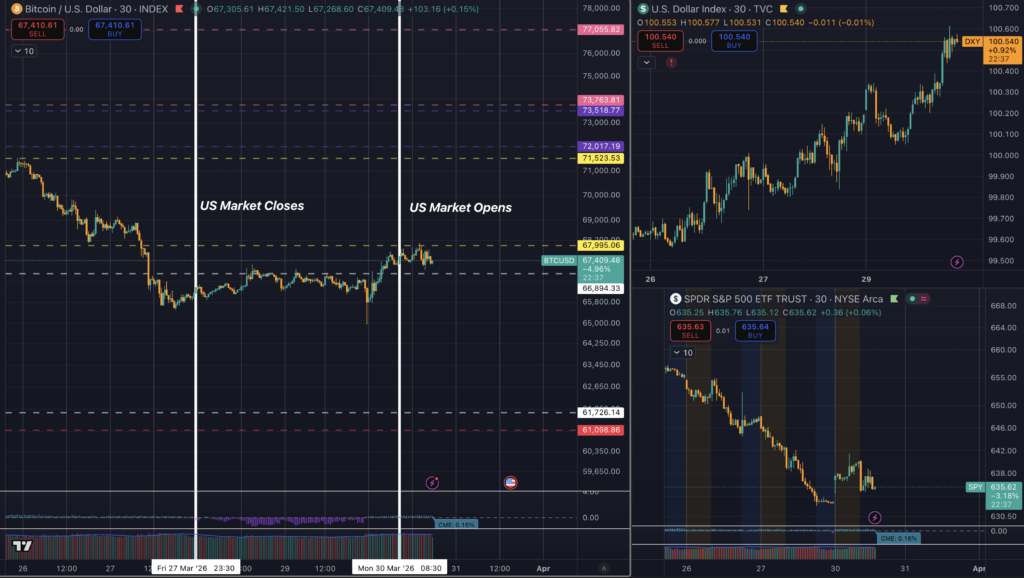 Three market charts showing Bitcoin, the U.S. Dollar Index, and the 10-year Treasury yield around the U.S. market open.
Bitcoin mirrored the S&P at the regime level, with both assets weakening under geopolitical pressure and strengthening when Trump’s rhetoric shifted toward negotiations. Within that regime, the paths diverged.
During the hours when the S&P cash market was inactive, Bitcoin spent more time absorbing losses and establishing a base than executing a strong relief rally.
The noticeable increase occurred closer to the U.S. market opening.
This timing implies that Bitcoin acted as a pre-open sentiment indicator for the Monday rebound in equities, with the most significant upward movement appearing from around 00:01 UTC on Monday into the U.S. session.
The U.S. Dollar Index also steadily increased into Monday, adding further context to the movement.
A stronger dollar typically tightens the environment for BTC and other risk assets.
Bitcoin’s ability to stabilize and then rise alongside a strengthening DXY indicates a move driven by repricing related to Iran and Trump’s messaging, supported by positioning and relief, with less influence from the currency aspect of the macro landscape.
Oil, payrolls, retail sales, and Bitcoin’s 24/7 signal define the week ahead
The macro calendar now arrives with crude oil at the forefront.
The Wall Street Journal reported that WTI had risen approximately 50% since the U.S. and Israel began bombing Iran in late February.
Axios noted that the OECD now anticipates U.S. inflation reaching 4.2% in 2026, an increase of 1.2 percentage points from previous expectations in December, due to the war and the energy shock altering the inflation trajectory.
This transforms this week’s economic releases into a concentrated stress test.
- The Bureau of Labor Statistics states that the March Employment Situation will be released on Friday, April 3, at 8:30 a.m. ET.
- The Census Bureau indicates that the delayed February advance retail sales report will be available on April 1.
- The Institute for Supply Management will publish the March Manufacturing PMI at 10:00 a.m. ET on Wednesday, April 1.
- The Bureau of Economic Analysis has scheduled the next U.S. international trade release for Thursday, April 2.
Each of these reports now carries an additional layer. Investors will evaluate growth through the lens of oil. This increases the pressure on every risk asset, including Bitcoin.
Bitcoin has already outperformed many major assets at various points during the stress.
The immediate setup for the upcoming week is narrower and more practical.
Bitcoin is acting as a high-beta macro instrument during geopolitical repricing, while also serving as a 24/7 venue for sentiment shifts that occur outside U.S. cash hours.
This combination renders Bitcoin particularly valuable at this moment.
If Trump posts over a weekend, Bitcoin trades first.
If oil surges during Asian hours, Bitcoin absorbs that information before New York reacts.
If a diplomatic shift occurs in the early morning, Bitcoin can begin revaluing risk before the S&P cash market has a chance to respond.
The unresolved question for the week lies precisely here.
Trump’s posts regarding Iran have demonstrated sufficient market impact to function as a working transmission channel, and traders have been closely monitoring these moments, including spikes in trading activity that occurred shortly before some of the posts.
Markets still require confirmation from real-world events, oil, and the forthcoming U.S. data.
Bitcoin provides one of the clearest real-time insights into how investors are interpreting that uncertainty.
The recent pattern suggests a sequence with three phases: initial risk repricing, stabilization during the closure, followed by a stronger advance into the U.S. reopening.
If this sequence repeats during the next round of Iran-related messaging, Bitcoin’s weekend and overnight behavior will offer one of the earliest indicators of whether traders anticipate another temporary relief move or if the energy shock will dominate the week.
The post Iran Speaker predicts pre-market “reverse indicator” then Bitcoin climbed before the S&P500 appeared first on CryptoSlate.
