Disclaimer: Information found on CryptoreNews is those of writers quoted. It does not represent the opinions of CryptoreNews on whether to sell, buy or hold any investments. You are advised to conduct your own research before making any investment decisions. Use provided information at your own risk.
CryptoreNews covers fintech, blockchain and Bitcoin bringing you the latest crypto news and analyses on the future of money.

If BlackRock maintains daily purchases of 6,000 BTC, a supply shortage could occur within 18 months, explained here.

Expanding on CryptoSlate’s recent examination of the contrasting Bitcoin inflows and outflows involving BlackRock and Grayscale, I further analyzed the data to determine how long BlackRock might maintain its current average Bitcoin accumulation rate.
At a broad level, BlackRock’s entry into the Bitcoin market via ETFs marks a significant development for Bitcoin’s standing in the United States. Alongside the other ‘Newborn Nine‘ ETFs, BlackRock’s support is expected to reduce both liquid and very liquid supplies as more investors are introduced to Bitcoin as a long-term asset. Additionally, it will bolster investor confidence among those less familiar with blockchain technology and enhance Bitcoin’s legitimacy as an asset class, thus influencing its liquidity and volatility characteristics.
Before proceeding, I would like to clarify that the following analysis is a theoretical exploration of potential accumulation levels from spot Bitcoin ETFs. I have utilized the initial inflows for BlackRock as a benchmark. There is no assurance that these levels will be sustained, and if they were, it would likely lead to an increase in Bitcoin’s price. The demand for Bitcoin is not expected to remain stable at any price point, making it unlikely that the same BTC inflows could be maintained over an extended period.
That being said, examining the figures from a purely theoretical perspective does uncover some noteworthy data points, which can be used in conjunction with other analyses to ascertain if and when a supply shortage may be imminent for Bitcoin.
The longer these new ETFs persist in acquiring Bitcoin at these heightened levels, the more advantageous it is for long-term holders and dedicated investors.
At this juncture, it seems that holding Bitcoin has a tangible purpose. The fewer Bitcoins available for purchase within ETFs, the closer we approach a MOASS (Mother Of All Supply Squeezes), where Bitcoin experiences significant price increases, not due to short positions needing to be covered, but because institutions must purchase Bitcoin on the open market like other investors.
Liquidity in Bitcoin and BlackRock’s immediate influence.
Since the launch of spot Bitcoin ETFs in the US last week, BlackRock has been acquiring an average of 6,266 BTC daily, accumulating a total of 25,067 BTC as of the time of this report. The total acquired by the Newborn Nine over just four trading days has reached 70,000 BTC ($2.9 billion). When Grayscale is included, the total Bitcoin under management amounts to 660,540 BTC ($27.6 billion).
To clarify the analysis, I will first outline the categories utilized, as defined by Glassnode data.
“The liquidity of an entity is defined as the ratio of cumulative outflows and cumulative inflows over the entity’s lifespan. An entity is considered to be illiquid / liquid / highly liquid if its liquidity L is ≲ 0.25 / 0.25 ≲ L ≲ 0.75 / 0.75 ≲ L, respectively.”
Further details on calculating L can be found on Glassnode’s blog.
- Current Supply: The total number of bitcoins that have been mined and are presently in circulation.
- Illiquid Supply: Bitcoins stored in wallets with minimal movement, indicating a long-term investment approach.
- Liquid Supply: Bitcoins that are actively traded or utilized, reflecting higher market activity.
- Very Liquid Supply: This category encompasses bitcoins that are not only traded but are also readily available for trading on exchanges within a short timeframe.
- Exchange Supply: Bitcoins held in exchange wallets, prepared for trading or selling.
The chart below illustrates the various liquidity cohorts for Bitcoin over time. The illiquid supply is by far the largest segment. Interestingly, the highly liquid portion exceeds the liquid portion, indicating a division among investors. Bitcoin holders tend to be either long-term holders or traders, with few remaining undecided about whether to hold or transact with Bitcoin.
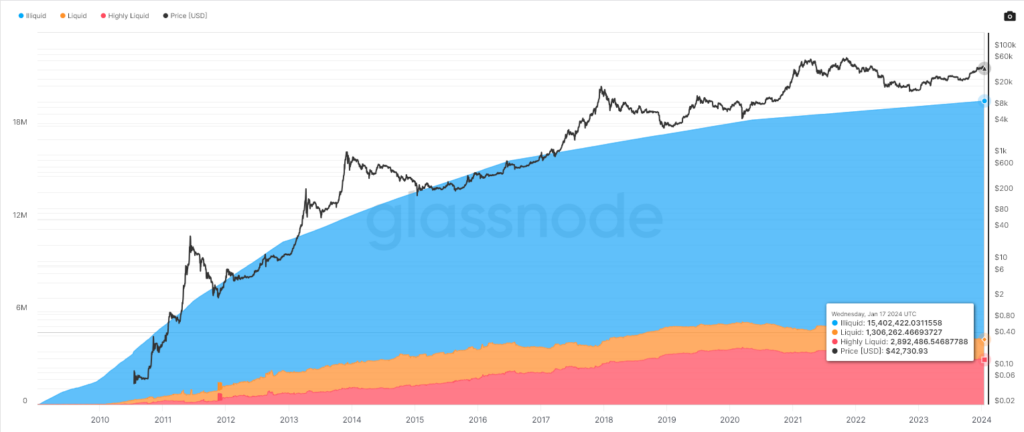 Bitcoin liquidity supply (Source: Glassnode)
Now that we have a grasp of the liquidity situation, let’s examine how the different cohorts compare. The official maximum supply of Bitcoin is 21,000,000 coins. The current circulating supply stands at 19,600,000. According to Glassnode, the estimated total of lost coins is approximately 1,400,000, which includes Satoshi’s coins, among others. While there are higher estimates of lost coins, this figure has remained relatively stable since 2012, making it the most reliable estimate.
Interestingly, this indicates that when we exclude the lost coins from the maximum supply, we arrive at the same figure as the current circulating supply. Although this is purely coincidental at this specific moment, it provides insight into how the market liquidity will feel once all coins have been mined. Naturally, after all coins are mined, the absence of block rewards for miners will introduce another factor that I will not delve into at this time. I will mention that I believe transaction fees will be sufficient to continue securing the network given Bitcoin’s current trajectory.
| Metric | Value |
|---|---|
| Max Supply | 21,000,000 |
| Current Supply | 19,600,000 |
| Adj. Max Supply | 19,600,000 |
| Adj. Current Supply | 18,200,000 |
| Illiquid Supply | 15,402,422 |
| Liquid Supply | 1,306,262 |
| Very Liquid Supply | 2,892,486 |
| Exchange Balance | 2,360,087 |
The current supply can also be adjusted to exclude lost coins. The three primary cohorts to analyze are the liquidity levels, as detailed below, and the balance of Bitcoin on cryptocurrency exchanges. The total liquid and very liquid coins combined amount to just 4,198,748 BTC ($175 billion), representing approximately 21% of the $815 billion Bitcoin market capitalization.
What if BlackRock continues to acquire all the Bitcoin?
Now, for the intriguing aspect that you are all interested in: What if BlackRock’s inflows were to persist at the levels observed during its launch? While some have criticized the introduction of spot Bitcoin ETFs as unsuccessful, and Bitcoin’s price has even declined to $0.0413 million from its recent peak of nearly $49,000, I believe they will ultimately find themselves with ‘egg on their face,’ as the saying goes in the UK. Here’s why!
Currently, 900 new Bitcoins are mined each day, and this figure is projected to decrease to 450 BTC around April 18, 2024. Furthermore, as previously mentioned, BlackRock is acquiring approximately 6,266 BTC daily. If BlackRock were to attempt to purchase directly from miners, this would create a net deficit of 5,266 BTC.
Thus, it must source Bitcoin from alternative avenues. So far, the Coinbase OTC desks have provided adequate liquidity to meet the demand. However, this situation cannot continue indefinitely; there is no infinite liquidity. The table below illustrates what would occur if BlackRock purchased from each cohort with miner participation.
Related Posts
 BlackRock Bitcoin inflow rate
At its current pace, over the next 10 days, BlackRock would acquire approximately 81,481 BTC with minimal impact on any cohort. So, is the launch a failure?
I don’t believe so.
If we extend this analysis to September 6, 2024, and BlackRock is solely purchasing from the liquid supply, with miners contributing to this cohort and mitigating the impact, the entire cohort would be absorbed.
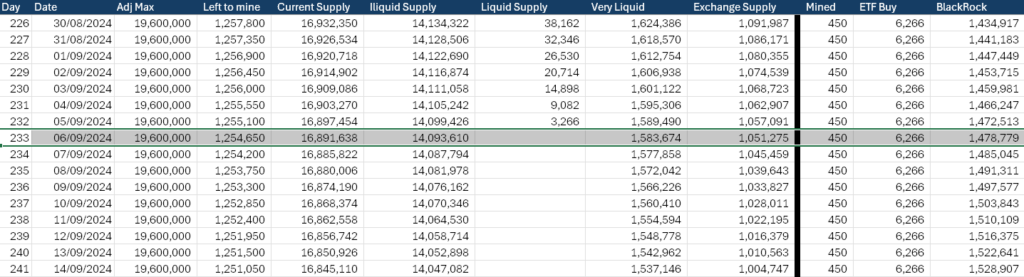 BlackRock acquisition day 233
Let’s proceed.
To maintain clarity, each subsequent table will be based on the following hypothetical scenario.
What if BlackRock exclusively acquired from this cohort at the rate it has during the initial four days, while also including newly mined Bitcoin, thereby lessening the impact of BlackRock’s purchases?
By March 3, 2025, the Bitcoin held on exchanges would be depleted, and BlackRock would possess 2.6 million BTC.
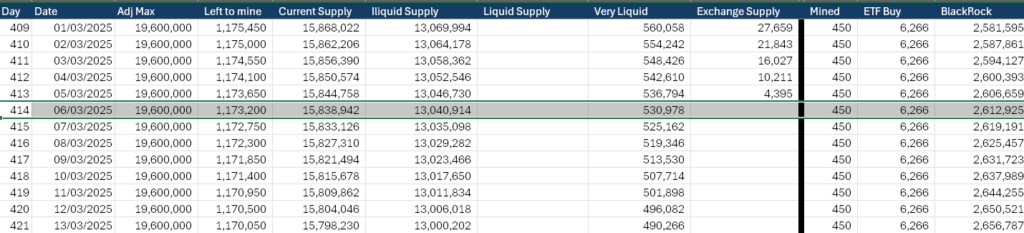 Exchange balance absorbed.
The ‘very liquid’ cohort would be fully absorbed by June 6, 2025. This group is likely the most accessible for BlackRock to find liquidity, and this scenario is only 18 months away.
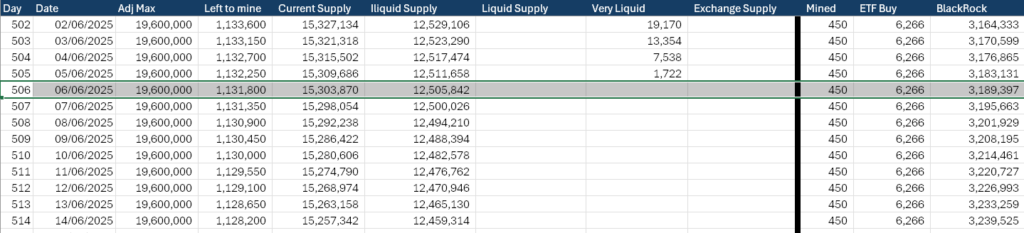 Very liquid supply absorbed.
In just eight years, by 2032, BlackRock’s Bitcoin holdings could be valued at $686 billion based on today’s standards, comprising 16,404,391 BTC. This would necessitate that it successfully acquires all Bitcoin from the ‘illiquid’ supply, granting it approximately 79% of all Bitcoin in circulation under its management.
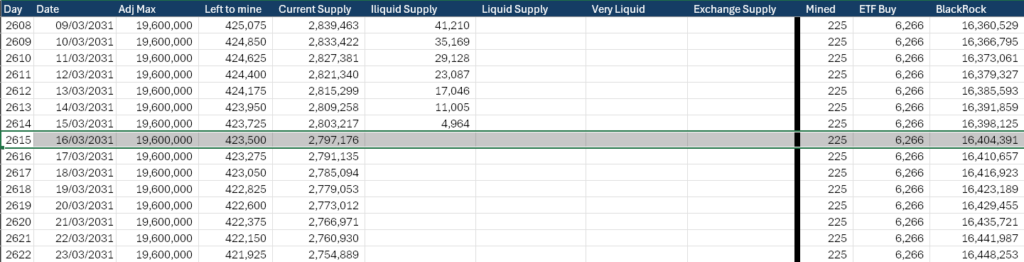 Illiquid supply absorbed
Ultimately, in just 3,073 days, on June 16, 2032, BlackRock would have purchased all Bitcoin in circulation and would need to cease its acquisition of 6,266 BTC per day. Moving forward, only 113 BTC would be available daily from newly mined Bitcoin, with 327,538 BTC remaining to be mined.
 BlackRock owns Bitcoin
Of course, it is unlikely that many of the scenarios outlined above will materialize. BlackRock is not expected to sustain these inflow levels in Bitcoin terms without either a significant drop in Bitcoin’s price or an increase in demand alongside rising prices.
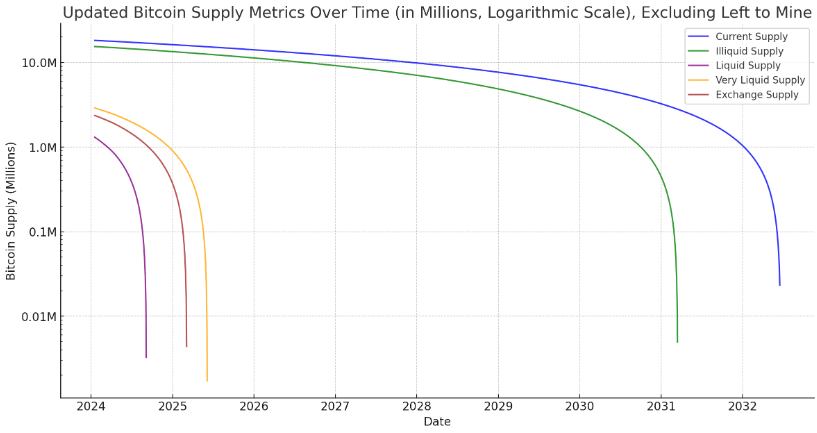 Hypothetical Bitcoin supply absorbed by BlackRock
For instance, 6,266 BTC is valued at $262 million at $0.04184 million per Bitcoin. At $0.2 million per Bitcoin, this amount escalates to $1.25 billion daily. Conversely, at $0.01, it equates to only $62.6 million.
Thus, unless Bitcoin maintains a price around $0.04 million for the next eight years, BlackRock can persuade investors to purchase its ETF at the same rate, and it can locate holders willing to sell, we are unlikely to witness BlackRock taking custody of all Bitcoin.
However, we can begin to understand the potential impact that consistent Bitcoin ETF inflows may have on various segments of the supply. Personally, my Bitcoin remains illiquid and will continue to do so. I recognize the advantages of spot Bitcoin ETFs, and I also acknowledge the impending supply crunch that will manifest in some form. Certainly not today, likely not this quarter, but after that…
CryptoSlate will persist in analyzing the data and exploring on-chain metrics for you, so if you found this investigation into Bitcoin supply insightful, please let us know on our X account @cryptoslate or contact me directly @akibablade. Additionally, a shout-out to Samson Mow for the ‘M’ notation for Bitcoin!
The post If BlackRock continues 6k BTC daily buys we get a supply crunch within 18 months, here’s why appeared first on CryptoSlate.
