Disclaimer: Information found on CryptoreNews is those of writers quoted. It does not represent the opinions of CryptoreNews on whether to sell, buy or hold any investments. You are advised to conduct your own research before making any investment decisions. Use provided information at your own risk.
CryptoreNews covers fintech, blockchain and Bitcoin bringing you the latest crypto news and analyses on the future of money.

Huobi experiencing heightened withdrawals to rival platforms based on recent dependency indicators.

The collapse of FTX has highlighted the counter-party risks that exchanges can present to the market. As traders and investors proceed with increased caution, there is a clear need for dependable metrics to assess the stability of these platforms.
Utilizing the FTX data set as a reference point, Glassnode has introduced three new indicators aimed at identifying high-risk situations among prominent exchanges: Coinbase, Binance, Huobi, and the now-defunct FTX.
One of these indicators is the exchange reliance ratio, which reveals when a substantial portion of an exchange’s balance is frequently moved to or from another exchange. A considerable amount of an exchange’s balance being consistently transferred to or from another platform may indicate a significant dependence or interdependence on liquidity.
A positive ratio reflects net inflows to the exchange, whereas a negative ratio indicates net outflows. Extended periods of large negative values can serve as a warning sign, suggesting that assets are swiftly leaving the exchange in favor of another platform.
While Binance and Coinbase demonstrate a relatively low reliance ratio, indicating minimal fund movements relative to their large balances, Huobi’s data presents a contrasting scenario. Recent statistics revealed notable negative reliance ratios across all Huobi assets, indicating a significant rise in transfers from Huobi to other exchanges.
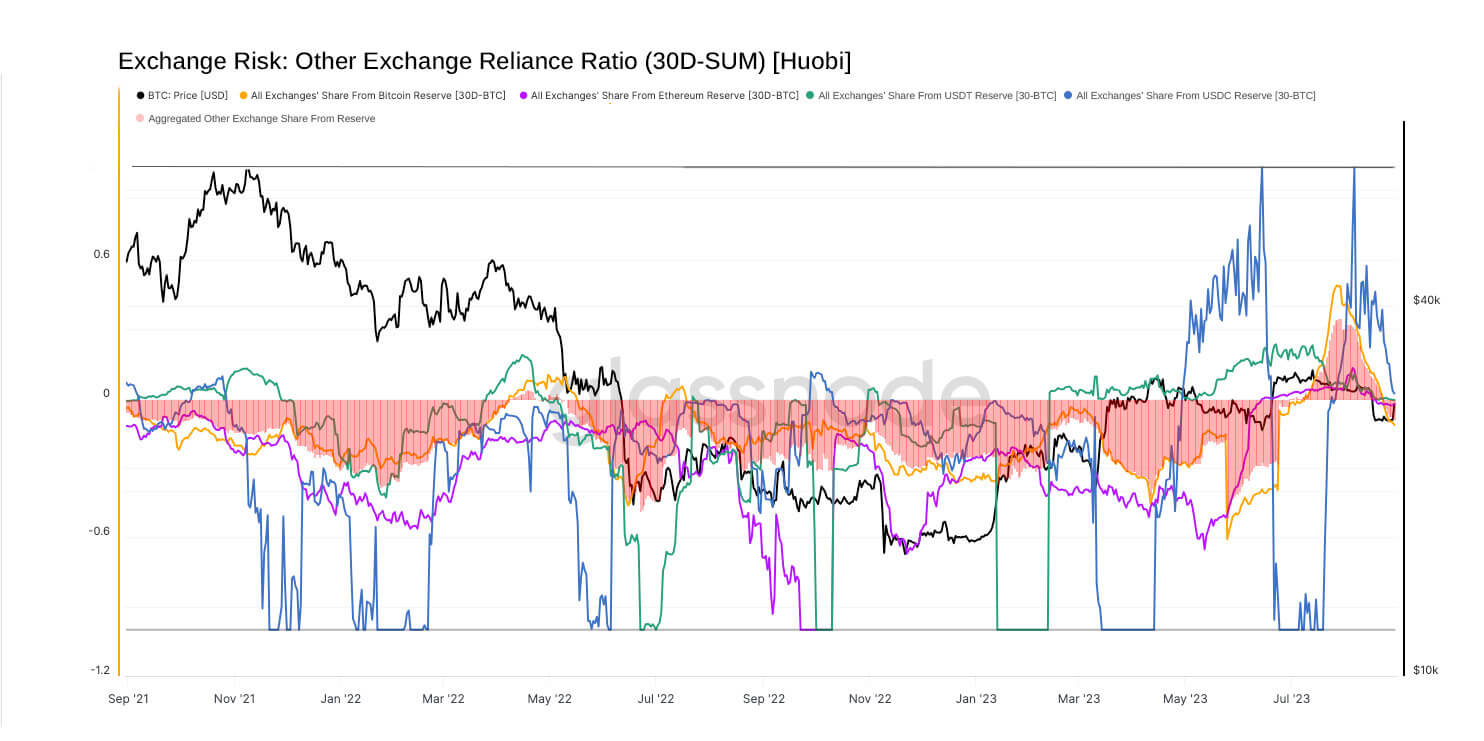 Graph illustrating the exchange reliance ratio from Huobi from Aug. 30, 2021, to Aug. 30, 2023. (Source: Glassnode)
Related Posts
Huobi’s internal reshuffling ratio, which indicates the percentage of an exchange’s balance transacted internally over a specified timeframe, aligns with that of Binance.
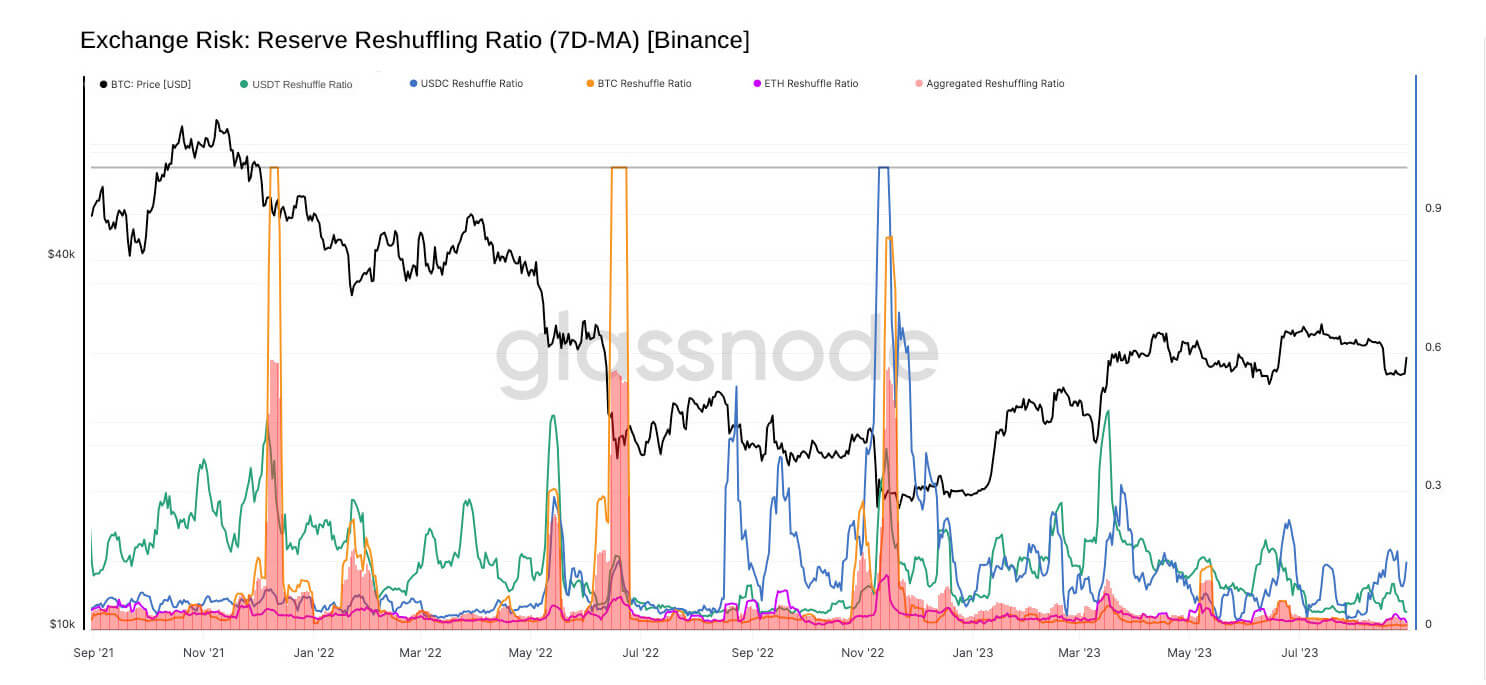 Graph depicting Binance’s exchange reserve reshuffling ratio from Aug. 30, 2021, to Aug. 30, 2023 (Source: Glassnode)
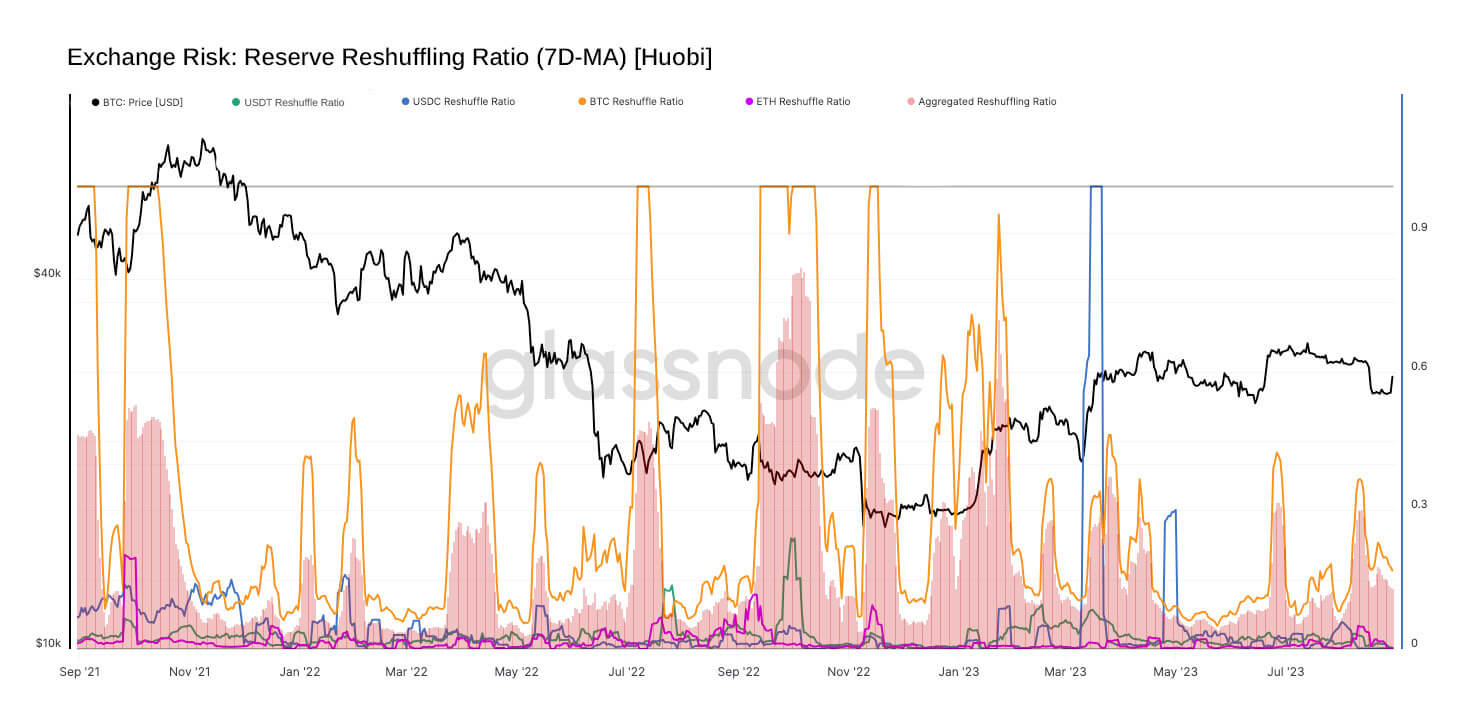 Graph showing Huobi’s exchange reserve reshuffling ratio from Aug. 30, 2021, to Aug. 30, 2023 (Source: Glassnode)
However, context is essential in this situation. Binance, being the largest and most widely used exchange in the market, significantly surpasses Huobi in all metrics. Consequently, the reshuffling spikes observed with Huobi may be amplified due to its declining reserves.
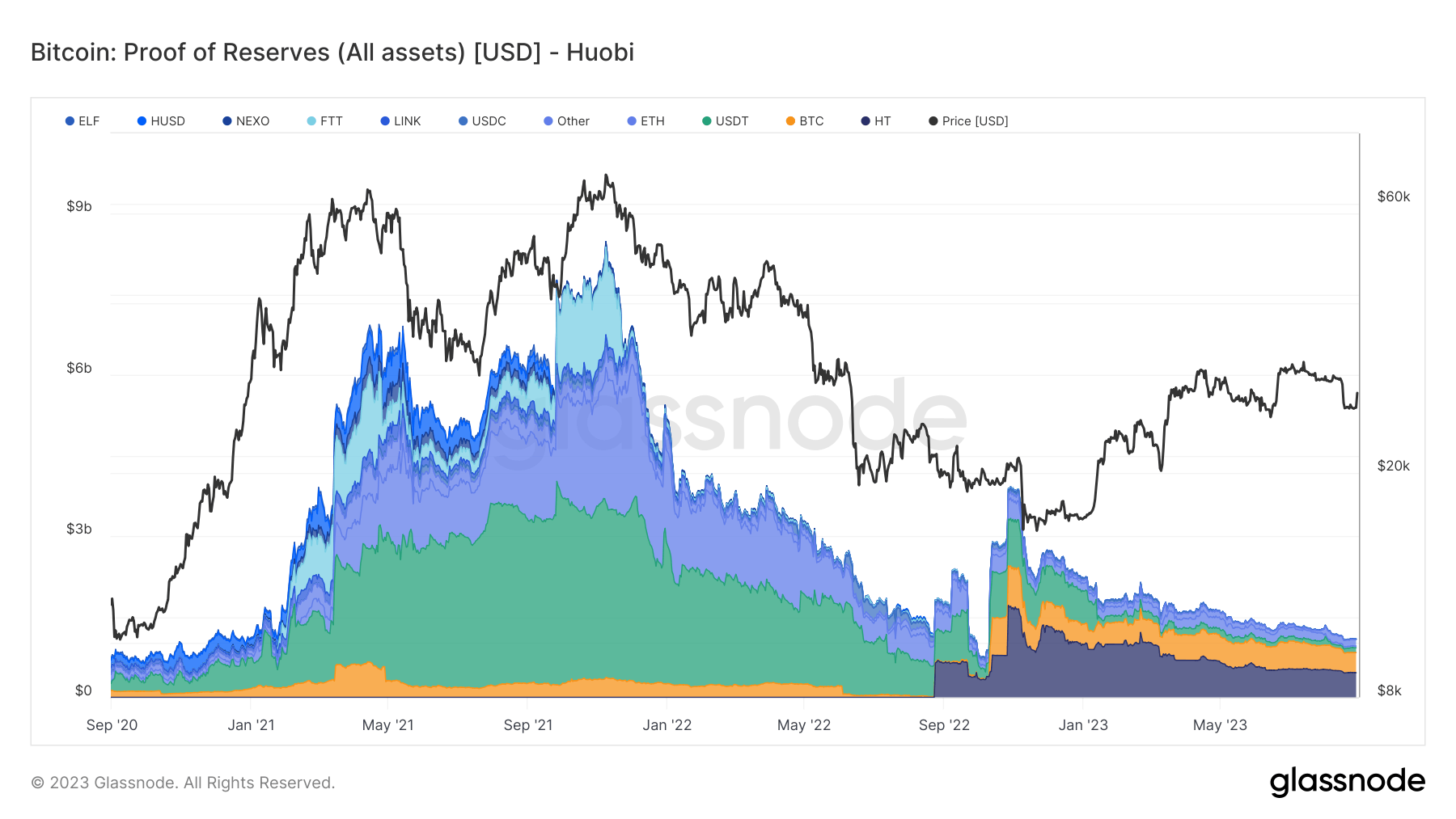 Graph illustrating the total balance (in USD) of Huobi’s holdings from Aug. 2020 to Aug. 2023 (Source: Glassnode)
This relationship between decreasing reserves and significant negative reliance ratios could be alarming. It implies that assets are being moved internally with increasing frequency and are being transferred out of Huobi at an accelerating rate.
The link between Huobi’s shrinking reserves and its notable negative reliance ratios may suggest diminishing confidence in the platform. While these metrics do not categorically classify an exchange as high-risk, the upcoming months will reveal whether these indicators are mere anomalies or signs of a more substantial shift.
The post Huobi seeing increased outflows to competitors according to new reliance metrics appeared first on CryptoSlate.
