Disclaimer: Information found on CryptoreNews is those of writers quoted. It does not represent the opinions of CryptoreNews on whether to sell, buy or hold any investments. You are advised to conduct your own research before making any investment decisions. Use provided information at your own risk.
CryptoreNews covers fintech, blockchain and Bitcoin bringing you the latest crypto news and analyses on the future of money.


Last week, Bitcoin’s value fell from $29,400 to a low of $25,000. Although this decrease may seem minor considering Bitcoin’s historical fluctuations, it marks a significant shift from the narrow trading range seen over the previous two months.
Nevertheless, even in the face of this volatility, the assurance of long-term holders remains intact, a sentiment that is essential to observe as it frequently acts as an indicator of the market’s fundamental health.
This steadfast confidence is reflected in Bitcoin’s reserve risk, a frequently overlooked on-chain metric.
Reserve risk is a measure utilized to assess the risk/reward ratio of investing in Bitcoin at any specific moment. It is determined by dividing the price of Bitcoin by the HODL Bank. The HODL Bank signifies the value of all coins based on their age (i.e., the duration they have been held without being sold). The longer coins are retained, the greater the HODL Bank.
This metric essentially evaluates the confidence of long-term holders in relation to the current price of the coin. A low Reserve Risk indicates that long-term holders are optimistic about the asset, viewing the current price as appealing for investment. In contrast, a high Reserve Risk implies that long-term holders may be less assured, and the price could be regarded as elevated in relation to that confidence.
From August 14 to August 23, Bitcoin’s reserve risk decreased from 0.0011 to 0.00098. During this same timeframe, Bitcoin’s price also fell, dropping from $29,400 to $26,400. To provide context, the last time Bitcoin’s reserve risk reached these levels was on March 15, when the price was $25,050.
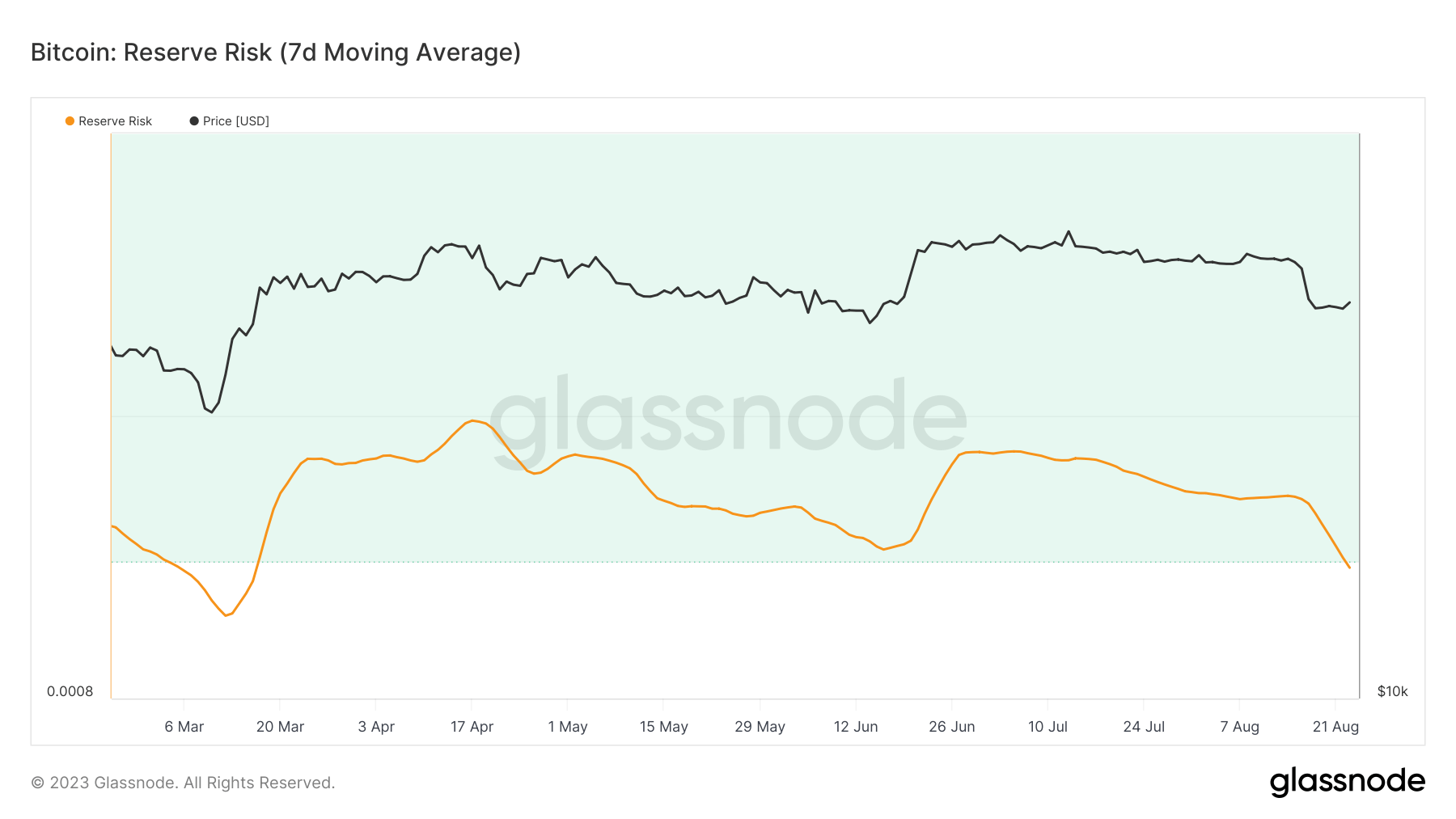 Graph illustrating Bitcoin’s reserve risk from February 24 to August 24, 2023 (Source: Glassnode)
Related Posts
The decline in both Bitcoin’s price and reserve risk suggests that even as the price fell, the confidence of long-term holders increased. This can be interpreted as long-term holders viewing the price drop as an attractive buying opportunity, reinforcing their conviction in Bitcoin’s long-term worth.
Additional on-chain data further corroborates this, particularly the supply of Bitcoin held by long-term holders.
Despite the price decline, the quantity of Bitcoins held by long-term holders has risen, increasing from 14.62 million to 14.64 million over the past week. It is noteworthy that this rise continues an upward trend that commenced in July 2022.
 Graph depicting the long-term Bitcoin supply from March 2022 to August 2023 (Source: Glassnode)
The reduced reserve risk and the heightened long-term supply suggest a prevailing sentiment that the current price presents a favorable risk/reward ratio for investment.
While market variations are intrinsic to the volatile nature of cryptocurrencies, metrics such as reserve risk provide a deeper understanding of the underlying sentiments. The recent data highlights a positive outlook for Bitcoin, indicating that its long-term holders remain resolute in their belief in its enduring value, even amid short-term price drops.
The post How Bitcoin’s falling reserve risk counters its price decline appeared first on CryptoSlate.
