Disclaimer: Information found on CryptoreNews is those of writers quoted. It does not represent the opinions of CryptoreNews on whether to sell, buy or hold any investments. You are advised to conduct your own research before making any investment decisions. Use provided information at your own risk.
CryptoreNews covers fintech, blockchain and Bitcoin bringing you the latest crypto news and analyses on the future of money.


In the last month, Bitcoin’s value has varied in response to significant macroeconomic events and regulatory updates, including the recent lawsuits from the SEC against Coinbase and Binance, which allege several securities infractions and include language that could alter the landscape of the industry.
These occurrences have only added to the volatility, and while Bitcoin’s price fluctuations have not been as severe as they might have been, they have contributed to a tumultuous and uncertain market environment.
Nonetheless, this has not discouraged long-term holders from increasing their holdings.
Diamond hands forever
Long-term holders are defined as addresses that have retained their coins for a minimum of 155 days without transferring them, reflecting a more patient and enduring investment strategy regarding Bitcoin. Consequently, they act as a crucial gauge of market sentiment, as short-term market variations are less likely to impact them.
In spite of the prevailing market uncertainty, holders have persisted in their Bitcoin accumulation. Data from Glassnode indicates that holders have been augmenting their BTC positions since the start of the year, with each day reflecting a positive adjustment in their holdings.
A significant spike in accumulation was noted in early May, triggering a new wave of buying. As of June 12, hodlers were increasing their positions at a rate of 39,233 BTC monthly.
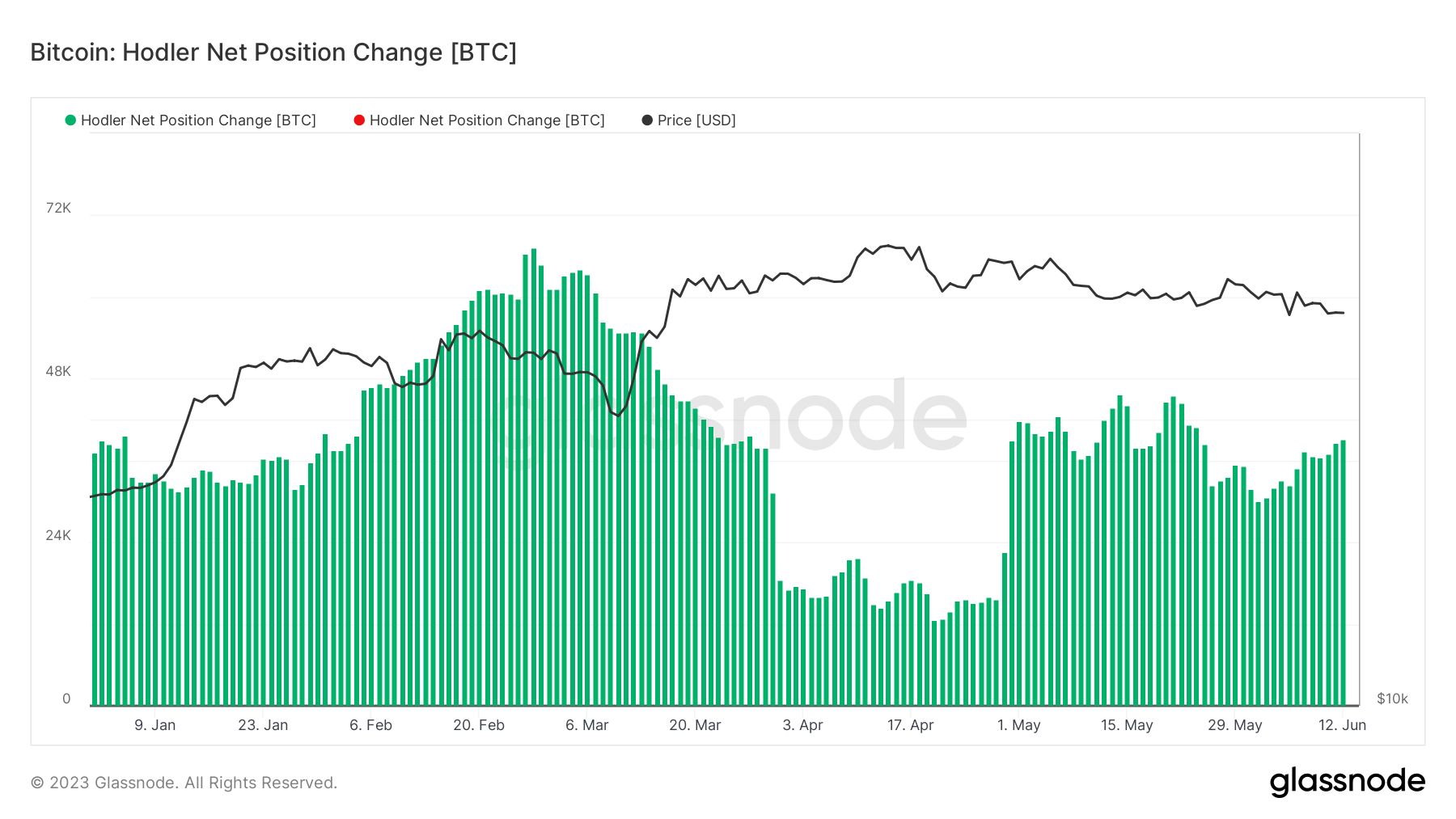 Graph illustrating the hodler net position change YTD (Source: Glassnode)
Related Posts
Historically, net changes in hodler positions have shown an inverse relationship with Bitcoin’s price movements — when Bitcoin’s price reaches a peak, long-term hodlers tend to reduce their positions. This suggests that seasoned market participants generally buy more Bitcoin when its price is low and sell when it rises.
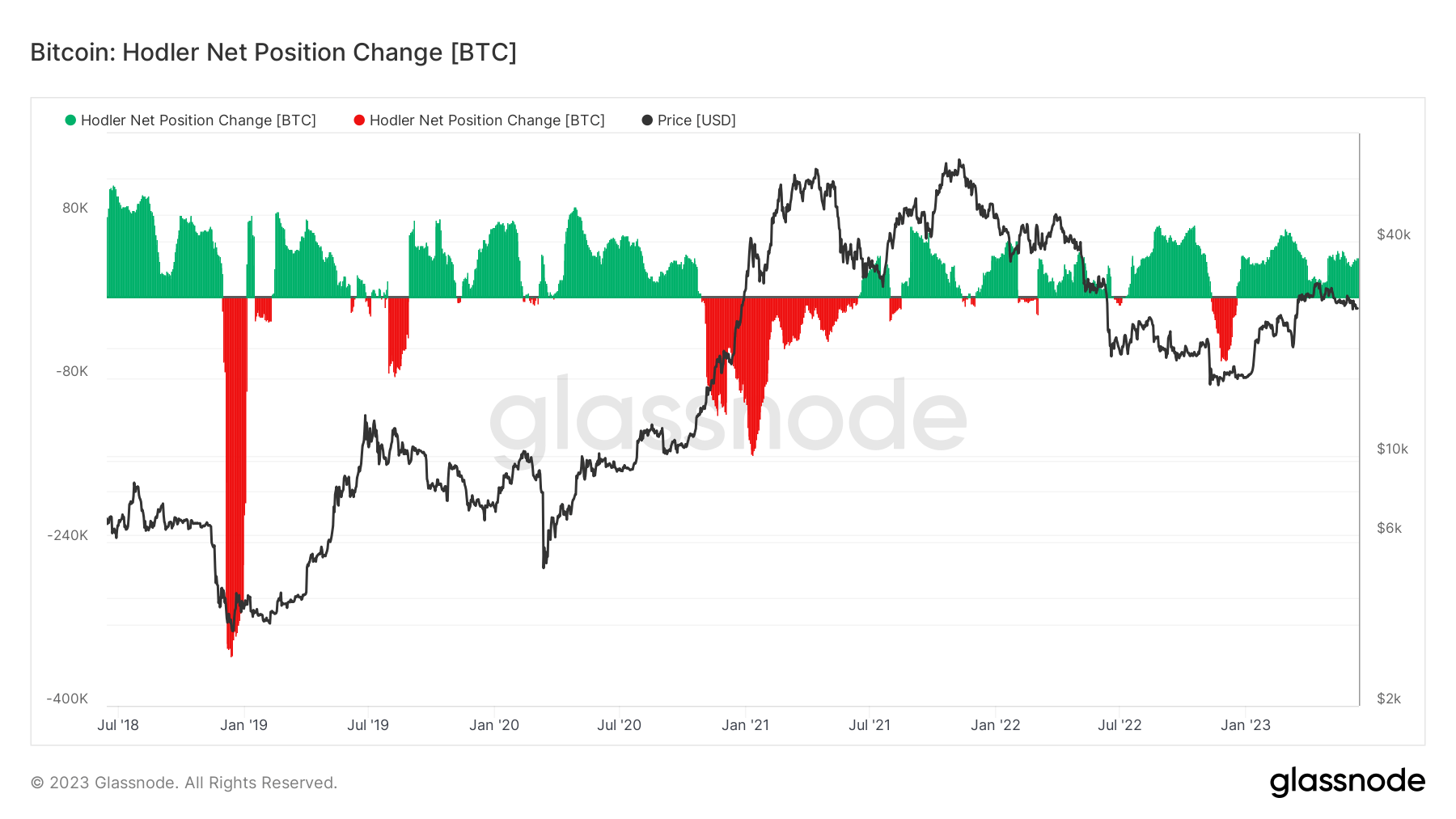 Graph depicting the holder net position change alongside Bitcoin’s price from July 2018 to July 2023 (Source: Glassnode)
Another on-chain metric, Coin Days Destroyed 90 (CDD-90), further corroborates this accumulation trend.
Coin Days Destroyed measures the movement of older coins. Holding one Bitcoin for a day generates one coin day, while transferring the Bitcoin eliminates the coin day. CDD tracks the cumulative age of all Bitcoins moved on a specific day, offering insights into how many older coins held by long-term holders are being transferred.
While CDD provides a comprehensive overview of the status of older coins, CDD-90 is a more pertinent metric. This measure aggregates all the CDD from the preceding 90 days, yielding better insights into Bitcoin’s economic activity over a more extended timeframe. An upward trend in CDD indicates that holders with long-held coins are selling, while a downward trend signifies a decline in interest.
Since February 21, the CDD-90 has remained relatively stable. This indicates that hodlers have reduced their spending and are increasing their Bitcoin holdings. This accumulation diminishes the amount of Bitcoin accessible in the market, tightening supply.
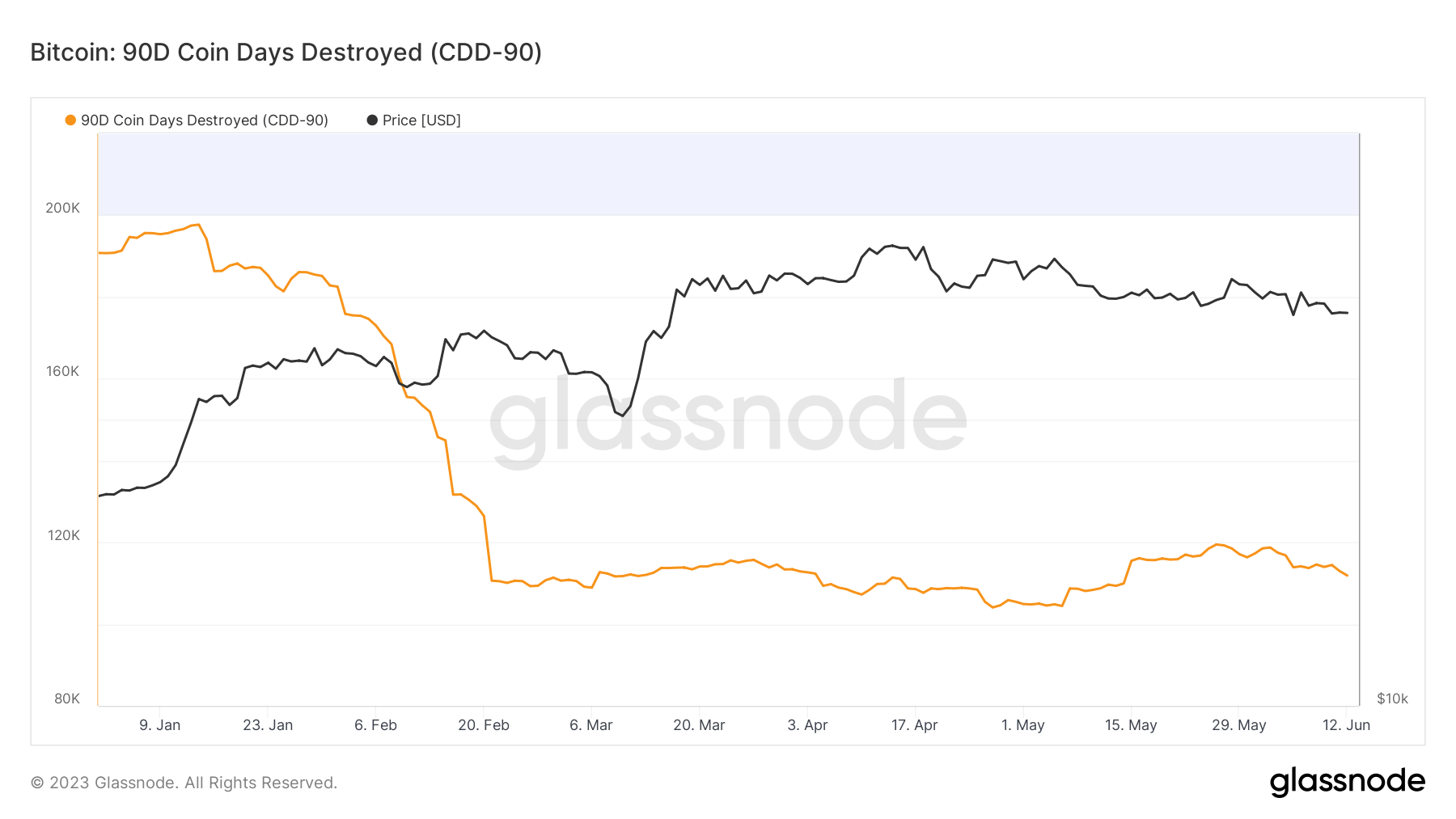 Graph showing Coin Days Destroyed 90 (CDD-90) YTD (Source: Glassnode)
The accumulation by long-term hodlers and the stable trend of the CDD-90 imply a sustained interest in Bitcoin that persists despite the market’s uncertain conditions. While the immediate outlook for Bitcoin remains unclear due to the intricate macroeconomic and intra-industry factors involved, these metrics suggest a quiet yet solid confidence in the asset.
The post Hodlers keep accumulating Bitcoin in wake of US regulation onslaught appeared first on CryptoSlate.
