Disclaimer: Information found on CryptoreNews is those of writers quoted. It does not represent the opinions of CryptoreNews on whether to sell, buy or hold any investments. You are advised to conduct your own research before making any investment decisions. Use provided information at your own risk.
CryptoreNews covers fintech, blockchain and Bitcoin bringing you the latest crypto news and analyses on the future of money.


Grayscale’s Bitcoin Trust (GBTC) has emerged as a vital tool in the cryptocurrency sector since its inception by Grayscale Investments. As one of the early innovators in bridging the gap between traditional investments and the emerging cryptocurrency market, GBTC enables investors to engage with Bitcoin without the need to directly purchase, store, or manage it. Observing GBTC’s price fluctuations has become essential, particularly for analysts seeking to assess market sentiment.
Designed similarly to a conventional investment trust, GBTC’s distinctive offering is its approach to holding Bitcoin. Rather than having individual investors deal with cryptographic keys and wallets, Grayscale centralizes the custody process, employing robust security measures, including cold storage systems, to safeguard the assets.
Shares of GBTC, which signify ownership of a portion of the trust’s underlying Bitcoin, are traded on the OTCQX market. The OTCQX, or Over-The-Counter QX, is a premier, regulated marketplace for stocks and securities that do not trade on traditional, large-scale exchanges. It provides a venue for companies to reach U.S. investors while adhering to stringent financial standards and disclosure requirements.
A notable characteristic of GBTC, distinguishing it from certain ETFs (Exchange Traded Funds), is its absence of a redemption mechanism. In straightforward terms, investors cannot directly exchange their GBTC shares for Bitcoin. Instead, they can only trade these shares on the open market. This structural decision contributes to greater price stability, preventing large investors from suddenly liquidating their positions and significantly impacting market dynamics.
The distinctiveness of GBTC is reflected in its premium, which refers to the disparity between the market price of GBTC shares and the actual value of the Bitcoin it holds, known as the Net Asset Value (NAV).
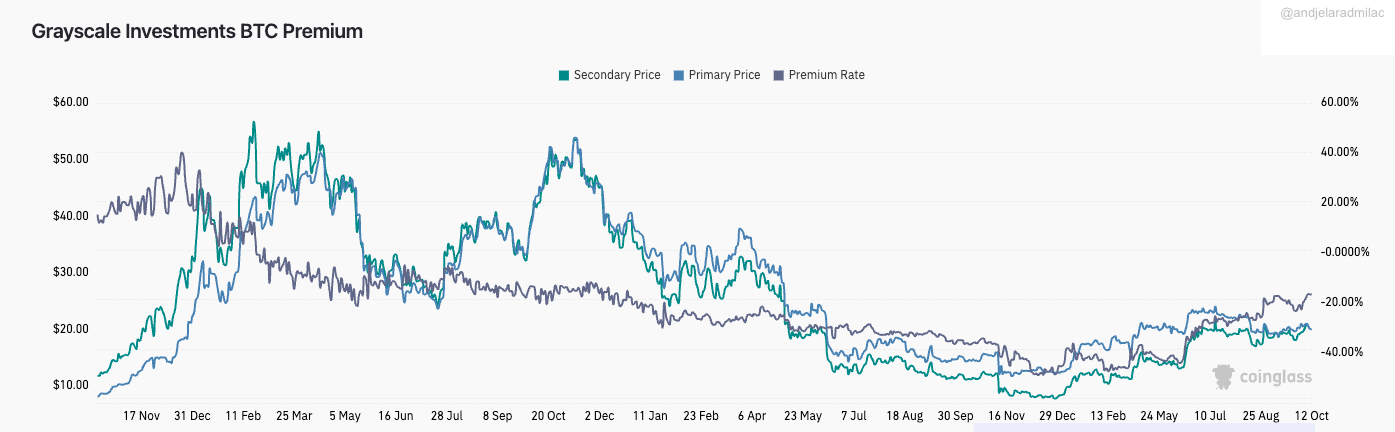 Graph illustrating the GBTC Bitcoin premium from Oct. 11, 2022, to Oct. 11, 2023 (Source: CoinGlass)
This premium is influenced by various factors. Initially, GBTC was one of the limited avenues for institutional investors to gain Bitcoin exposure, particularly in jurisdictions with restrictions. This exclusivity resulted in GBTC trading at a significant premium. Additionally, GBTC’s liquidity and convenience enhanced its attractiveness, creating a gap between its price and the actual Bitcoin value. However, this premium is not fixed and can fluctuate based on market conditions, potentially turning into a discount.
Related Posts
Historically, GBTC has demonstrated a strong correlation with Bitcoin (BTC). This is anticipated since the primary asset backing GBTC is Bitcoin. As BTC prices fluctuate, the value of the Bitcoin held by the trust also changes, impacting GBTC’s NAV. Nevertheless, the market price of GBTC, influenced by supply and demand for its shares, can diverge from this NAV, resulting in the aforementioned premium or discount.
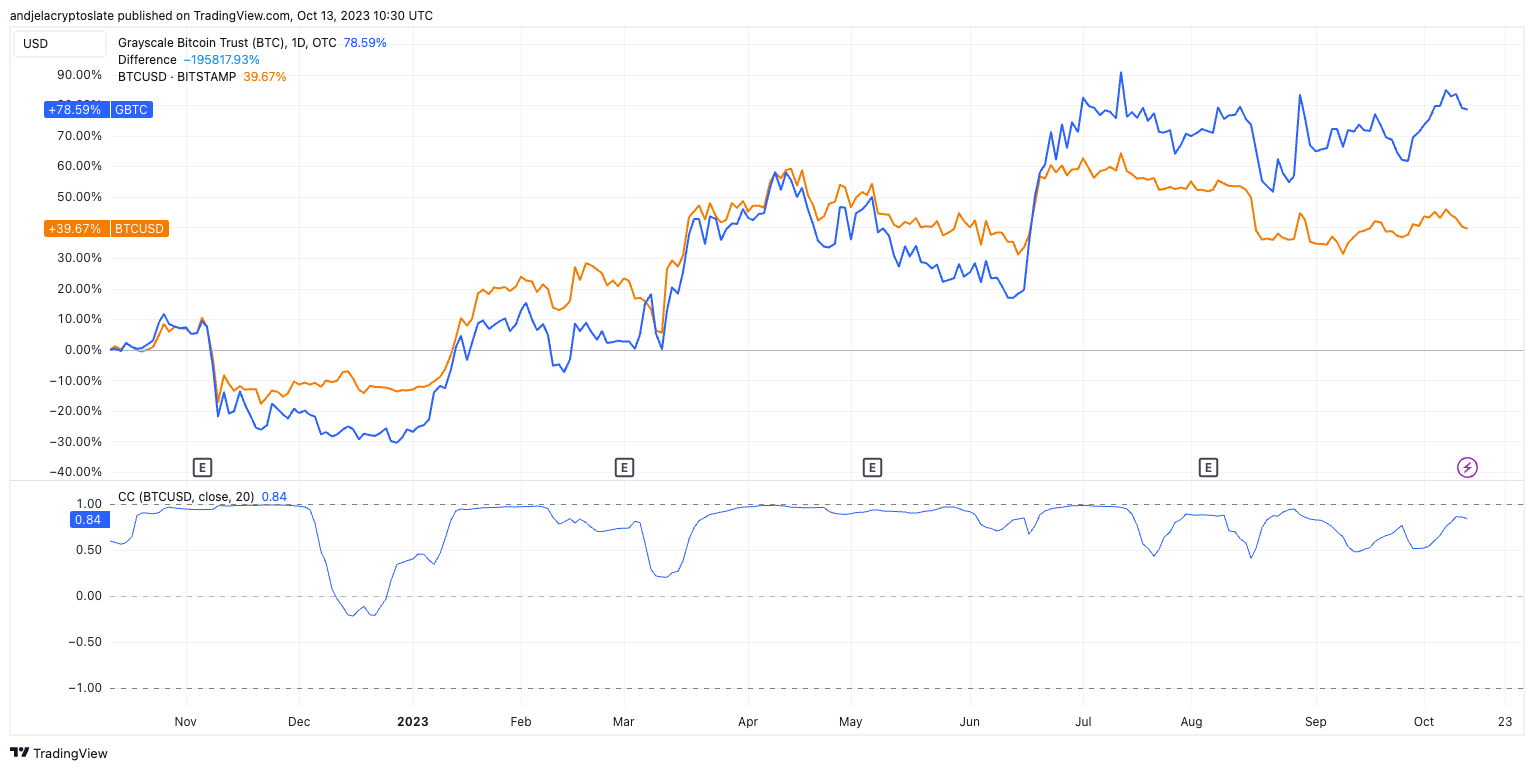 Graph depicting the percent increase and correlation between GBTC and BTC from Oct. 11, 2022, to Oct. 11, 2023 (Source: TradingView)
Should regulations surrounding cryptocurrency investment vehicles evolve, it could impact GBTC’s appeal to investors, leading to price movements that are independent of Bitcoin’s price. As additional cryptocurrency investment vehicles are introduced, particularly those offering features that GBTC lacks (such as redemption options), it could diminish demand for GBTC, thereby affecting its correlation with BTC.
One significant regulatory decision on the horizon is the potential approval of a Grayscale spot Bitcoin ETF. The market is rife with speculation, with many believing that Grayscale may be in a prime position to secure this approval. This change would address the long-standing premium/discount issue and represent a significant advancement in integrating cryptocurrencies into mainstream finance.
The potential advantages are numerous. An ETF structure would simplify the trading process, potentially attracting a new wave of institutional investment. Furthermore, it would further establish Bitcoin as a legitimate and recognized asset class.
However, a Grayscale Bitcoin ETF could also bring about increased volatility, particularly in its early days, as the market adapts to the new dynamics. While the GBTC premium has historically served as an indicator of market sentiment, a conversion to an ETF might lessen the effectiveness of this measure.
The post Grayscale’s GBTC: Understanding its premium and market impact appeared first on CryptoSlate.
