Disclaimer: Information found on CryptoreNews is those of writers quoted. It does not represent the opinions of CryptoreNews on whether to sell, buy or hold any investments. You are advised to conduct your own research before making any investment decisions. Use provided information at your own risk.
CryptoreNews covers fintech, blockchain and Bitcoin bringing you the latest crypto news and analyses on the future of money.


The allocation of Ethereum’s supply provides significant insights into market sentiment, potential price fluctuations, and the overall health of the ecosystem. Understanding which addresses—whether they are whales (large holders), sharks (moderate holders), or shrimp (small holders)—possess varying amounts of ETH can yield critical information regarding market trends and possible future shifts.
For comparison, consider Bitcoin (BTC). Traditionally, the actions of Bitcoin whales and other major holders have been regarded as a key indicator of market direction. When they begin to liquidate their assets, it frequently indicates a bearish trend. In contrast, accumulation by these holders can suggest bullish movements in the market.
Ethereum, on the other hand, features a more intricate ecosystem. While Bitcoin mainly serves as a store of value, Ethereum’s role as a platform for decentralized applications implies that its holders may have diverse motivations. Therefore, although both cryptocurrencies might exhibit similar holding patterns, the underlying reasons and consequences can differ markedly.
Since the start of the year, there has been a notable decline in ETH held by whales and other significant holders.
Data from Glassnode indicates that addresses with balances exceeding 100,000 ETH experienced a drop from 28.9 million ETH in October 2022 to merely 20.7 million ETH a year later. This represents a significant reduction of 4.7 million ETH in 2023. Likewise, addresses holding between 10,000 and 100,000 ETH lost 3.5 million ETH, while those with balances ranging from 1,000 to 10,000 ETH decreased their holdings from 13.8 million ETH to 12.9 million. Additionally, addresses with 100 to 1,000 ETH and those with 10 to 100 ETH saw declines of approximately 800,000 ETH and 200,000 ETH respectively this year.
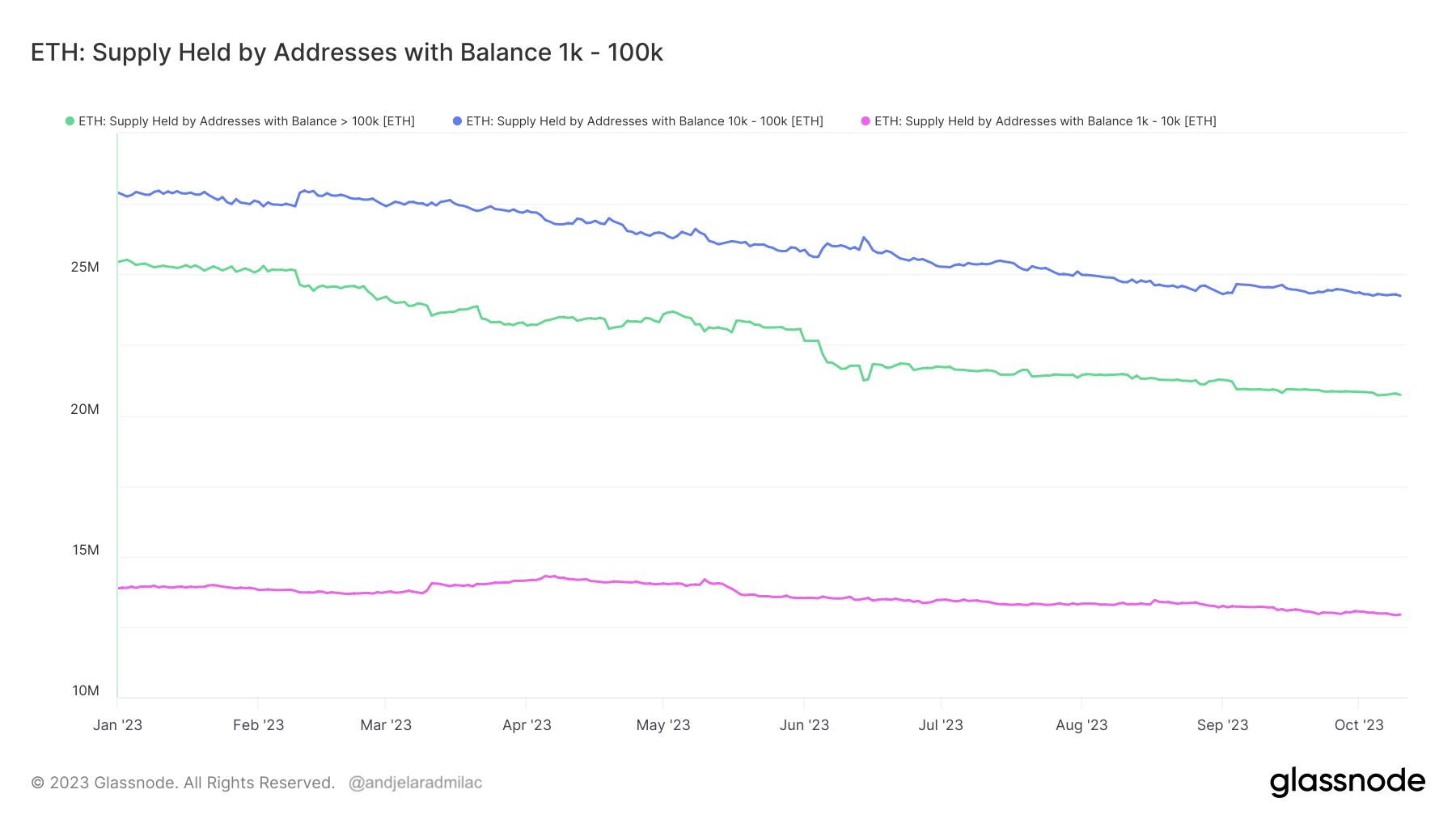 Graph illustrating the reduction in Ethereum supply held by addresses with balances from 1,000 ETH to over 100,000 ETH in 2023 (Source: Glassnode)
Examining the smaller participants in the Ethereum market reveals a different dynamic. Holders with balances between 1 and 100 ETH have remained relatively stable throughout the year, showing only slight increases. However, the smallest holders, those with less than 0.01 ETH, experienced a significant rise, accumulating an additional 21,860 ETH since January.
Related Posts
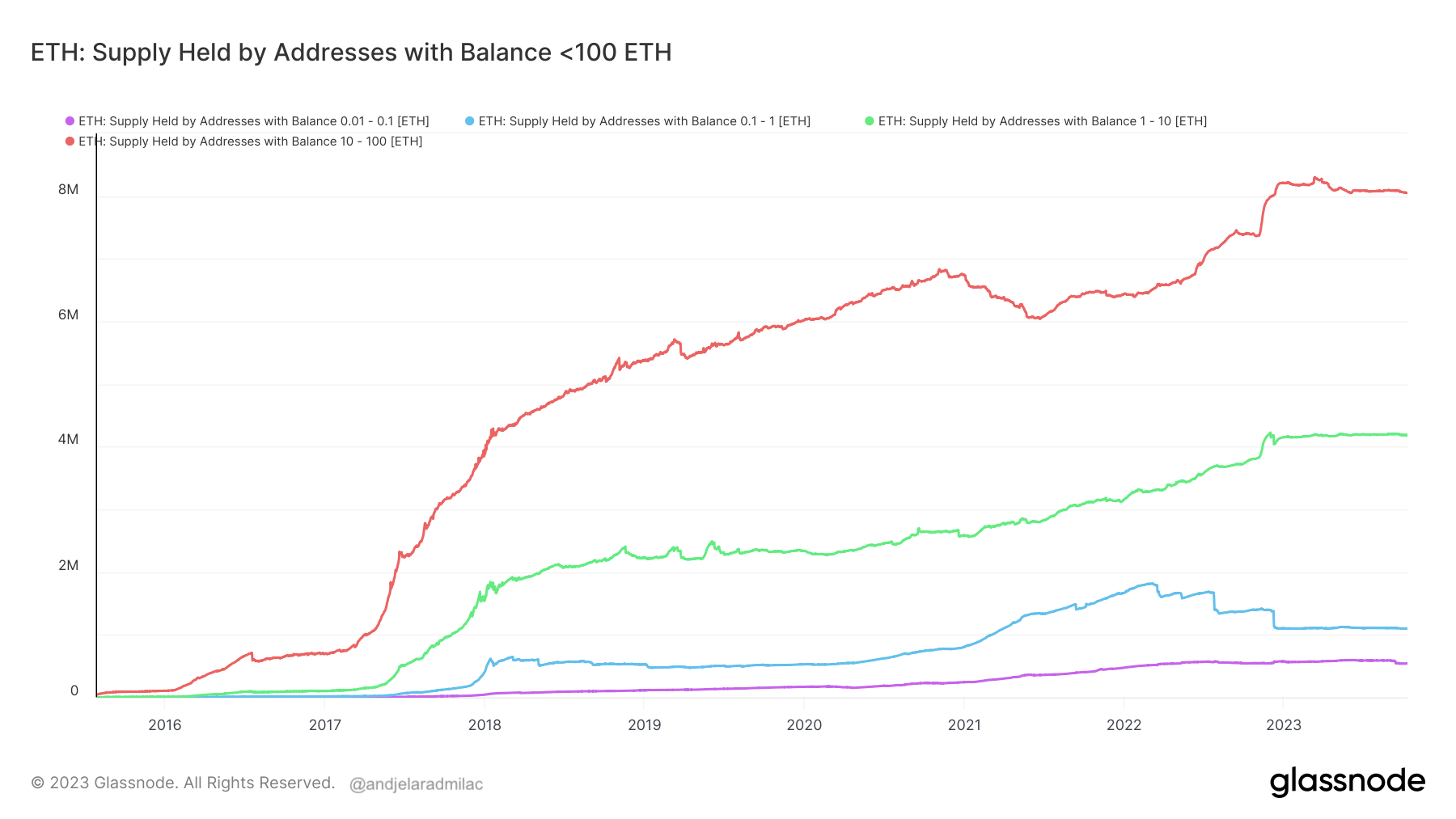 Graph depicting the supply of Ethereum held by addresses with balances from 0.01 ETH to 100 ETH from 2016 to 2023 (Source: Glassnode)
Despite the reductions among larger holders, the supply distribution still indicates that a significant portion of Ethereum’s supply is concentrated in the hands of substantial addresses. As of October 10, 29.5% of Ethereum’s supply is held by addresses with balances between 10,000 and 100,000 ETH. In contrast, 25.2% of its supply resides in the wallets of whales, those with over 100,000 ETH.
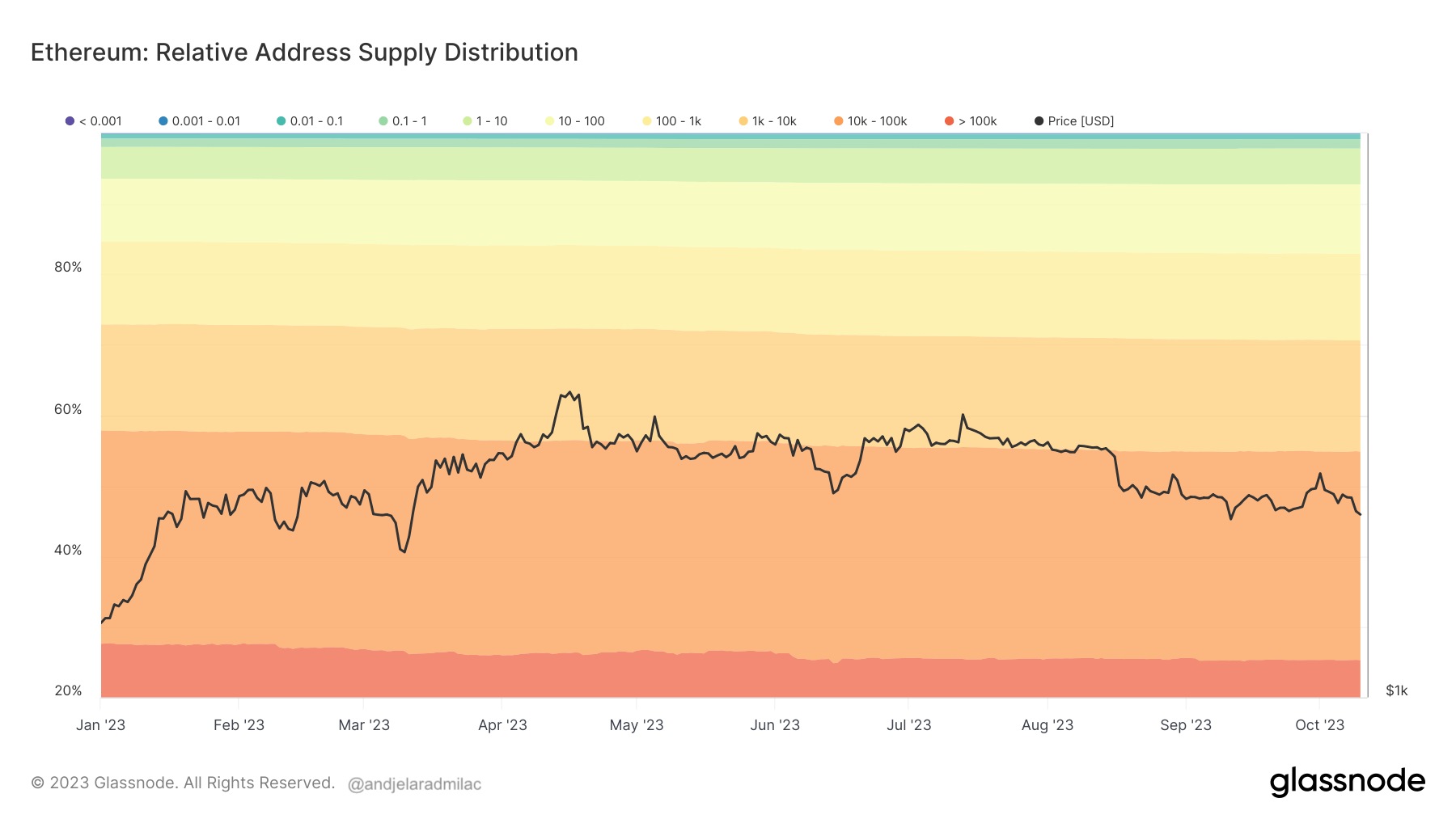 Graph showing the distribution of Ethereum’s supply in 2023 (Source: Glassnode)
What does this shift imply? One might simply conclude that whales are divesting. However, a closer examination of on-chain metrics provides an alternative viewpoint. The proportion of Ethereum’s supply secured in smart contracts has increased this year, rising from 25.6% to 31.9%.
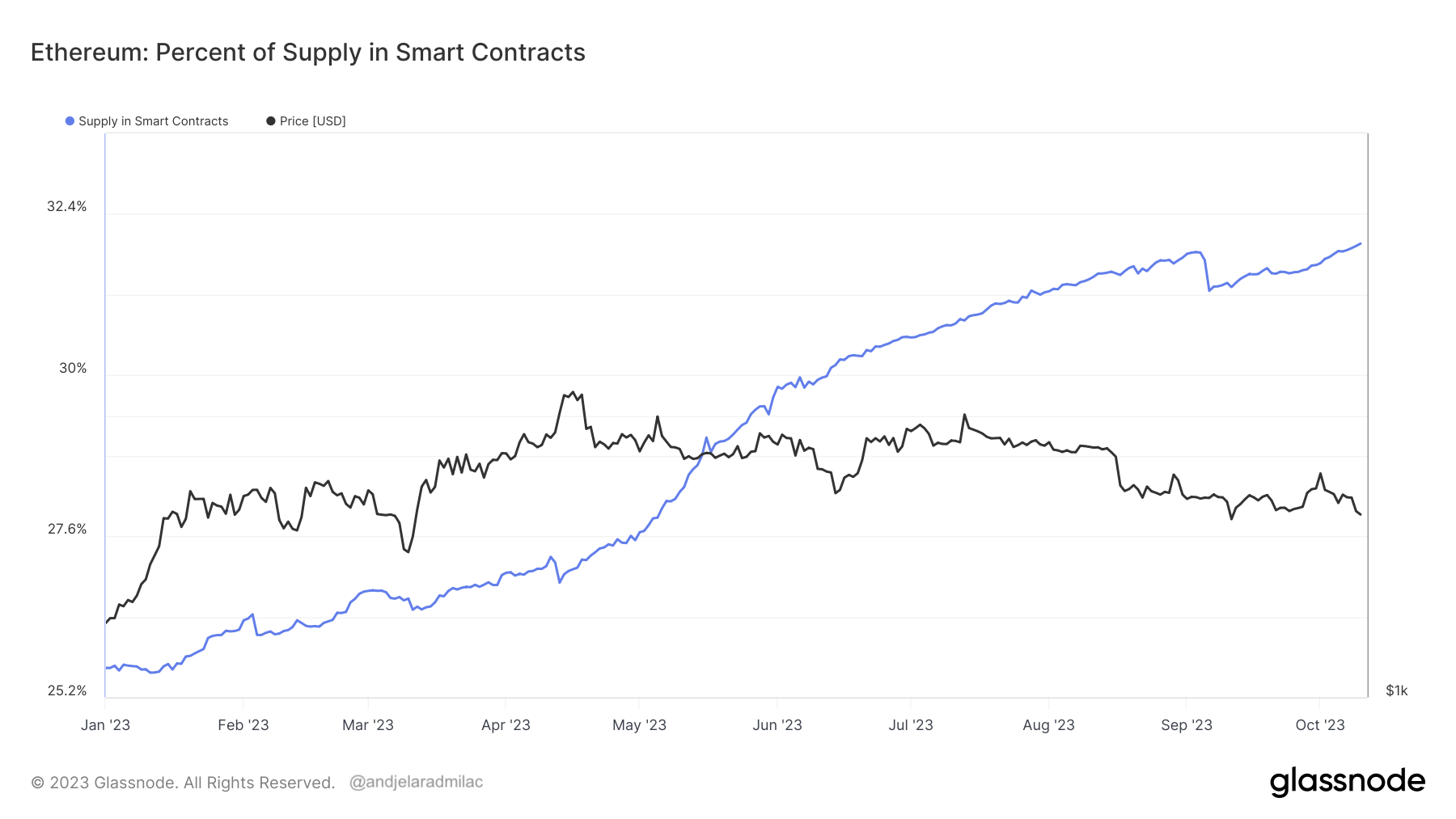 Graph illustrating the percentage of Ethereum’s supply in smart contracts in 2023 (Source: Glassnode)
This growth indicates that while large holders may be reducing their liquid ETH reserves, they are not necessarily exiting the Ethereum ecosystem. Instead, they could be locking their assets into DeFi projects, staking, or other initiatives driven by smart contracts.
The post Diving into Ethereum’s changing supply landscape appeared first on CryptoSlate.
