Disclaimer: Information found on CryptoreNews is those of writers quoted. It does not represent the opinions of CryptoreNews on whether to sell, buy or hold any investments. You are advised to conduct your own research before making any investment decisions. Use provided information at your own risk.
CryptoreNews covers fintech, blockchain and Bitcoin bringing you the latest crypto news and analyses on the future of money.

Ethereum has reduced its supply to an 18-month low after burning $2.5 billion in ETH since the merge.

An examination of Ethereum’s latest financial metrics on Ultrasound Money indicates an ongoing transformation in its economic framework since the significant merge in September 2022.
The reduction in Ethereum’s supply amounts to 309,663 ETH, which is roughly $686.2 million. This decrease signifies a deflationary trend, contrasting with the earlier inflationary phase where new ETH was regularly generated. This change can be attributed to the incineration of 1,195,238 ETH, valued at approximately $2.65 billion. The permanent removal of tokens from circulation is vital in lowering the total supply and may enhance ETH’s scarcity and value over time. Additionally, despite the issuance of 885,581 ETH, worth about $1.96 billion, Ethereum’s total supply has seen a net decline, demonstrating that the rate of ETH burning continues to exceed the rate of new issuance.
Currently, Ethereum’s total supply is at its lowest since the merge, standing at 120,211,380 ETH, which corresponds to a market capitalization of around $266.39 billion, reinforcing its prominent position in the cryptocurrency market.
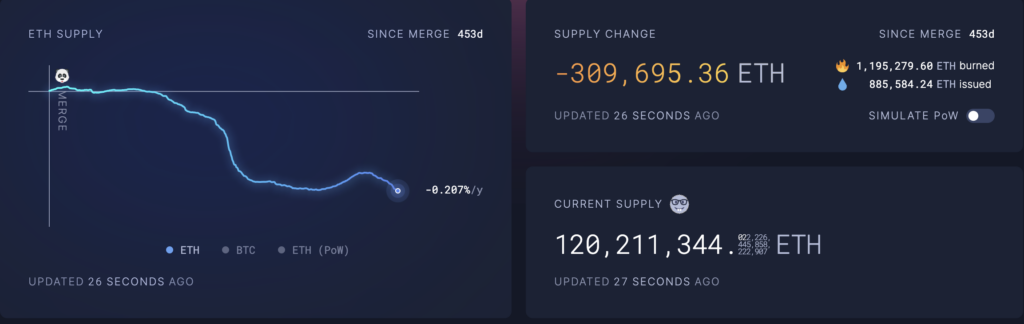 Ethereum Supply Metrics (Source: ultrasound.money)
An analysis of the ETH burning leaderboard provides additional insights by examining the primary contracts responsible for the burning of ETH. The leading contributors to this activity include significant dApps and services, particularly Uniswap in its various forms, Tether, and OpenSea. Uniswap’s notable position indicates a high transaction volume within the DeFi sector, with $543.8 million burned across four contracts in the top 10.
The presence of Tether signifies considerable stablecoin transactions on Ethereum’s network, while OpenSea’s inclusion underscores the persistent nature of NFT transactions even during the bear market. This variety, which includes DeFi platforms, stablecoins, NFT marketplaces, and Layer 2 solutions like Arbitrum, highlights the diverse applications of Ethereum.
| Burned ETH | Entity | Value (USD) |
|---|---|---|
| 84,006.46 | Uniswap Universal Router | $186,158,315.36 |
| 75,926.77 | Uniswap V2 | $168,253,722.32 |
| 74,739.31 | ETH transfers | $165,622,310.96 |
| 58,030.71 | Uniswap Universal Router 2 | $128,596,053.36 |
| 53,626.72 | Tether | $118,836,811.52 |
| 27,441.92 | Uniswap V3 | $60,811,294.72 |
| 26,935.76 | New contracts | $59,689,644.16 |
| 23,405.50 | OpenSea | $51,866,588.00 |
| 22,891.92 | Arbitrum | $50,728,494.72 |
| 22,201.66 | MetaMask | $49,198,878.56 |
Related Posts
Source: ultrasound.money
The top 10 contracts collectively account for $1,039,762,113.68 worth of ETH burned, representing nearly half of the total burn since the merge.
Ethereum’s shift to a deflationary model may continue to draw investors looking for a store of value, particularly when compared to inflationary fiat currencies. The increased activity in decentralized exchanges and DeFi applications suggests a strong trend toward decentralized finance.
Notably, under its current proof-of-stake (PoS) model, the Ethereum network has burned an average of 1.83 ETH/min since the merge. However, since the burn mechanism was introduced as part of the EIP-1559 upgrade in August 2021, the average burn rate has nearly doubled to 3.09 ETH/min. Nevertheless, due to the significant reduction in supply issuance following the elimination of proof-of-work mining, the total supply has consistently decreased.
If Ethereum had maintained its PoW model, the supply would have reached an enormous 124,941,176 ETH, approximately 4.7 million ETH more than the current figure. Theoretically, at the present price of $2,228, this would have resulted in a market cap $12 billion higher than the current $266 billion. However, due to the increased supply, this is purely theoretical given the nature of supply/demand market dynamics.
Looking forward, these dynamics may shape Ethereum’s path in various ways. Ongoing deflationary trends could lead to heightened demand and potentially increased ETH prices, assuming steady or rising demand as the market emerges from the bear phase. However, it is crucial to recognize that market volatility and external factors such as regulatory changes or macroeconomic trends can significantly influence these dynamics, particularly with ongoing actions from the SEC in the U.S. regarding the classification of PoS tokens as securities.
In conclusion, Ethereum’s post-merge data indicates a significant shift towards a deflationary model, highlighted by robust network usage, especially in the DeFi and NFT sectors, and the potential for increased value due to a diminishing supply. Nonetheless, these trends require ongoing analysis and comprehension of macroeconomic factors to fully understand their long-term implications and sustainability.
The post Ethereum burns $2.5B worth of ETH since merge as supply drops to 18 month low appeared first on CryptoSlate.
