Disclaimer: Information found on CryptoreNews is those of writers quoted. It does not represent the opinions of CryptoreNews on whether to sell, buy or hold any investments. You are advised to conduct your own research before making any investment decisions. Use provided information at your own risk.
CryptoreNews covers fintech, blockchain and Bitcoin bringing you the latest crypto news and analyses on the future of money.

Cryptocurrency treasury firm liquidates $20 million in Bitcoin at a loss following a decline in stock value after acquiring at $118,000.

Bitcoin begins April with a price influenced by macroeconomic factors, corporate financial statements, and the trustworthiness of the public entities surrounding it.
CryptoSlate has previously outlined the overarching framework: public equities established a new avenue for balance-sheet demand, the premium on that demand facilitated additional issuance, and the cycle began to sustain itself.
Subsequent analysis of declining purchase volumes and the implications of being underwater on treasury holdings focused on which firms could continue financing the trade as price and sentiment became less favorable.
Recent revelations regarding the Bitcoin treasury firm, Nakamoto, have intensified that focus.
Bitcoin treasury firm sells Bitcoin at a loss
As of March 31, Bitcoin is trading around $66,200, while NAKA is priced near $0.21, resulting in an equity market capitalization of approximately $8.1 million. In May 2025, the stock reached an all-time high of $34.77, but subsequently fell to about $8 by early September and to $0.93 by the end of October.
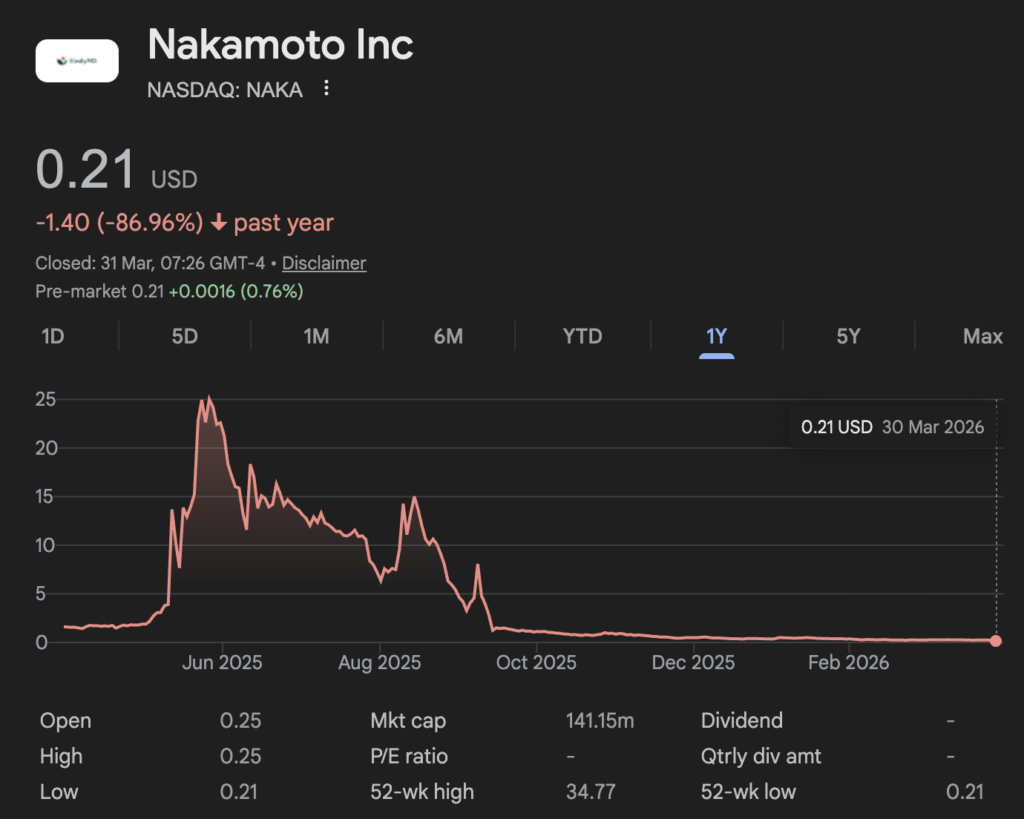 Google Finance chart showing Nakamoto Inc. (NASDAQ: NAKA) stock down 86.96% over the past year to $0.21.
The disparity between the underlying asset and its associated wrapper now shapes the conversation.
The cryptocurrency continues to function as a globally acknowledged liquidity instrument. Conversely, the stock behaves like a distressed claim on a strategy whose financing assumptions no longer inspire the same level of confidence.
This gap became more significant following the circulation of figures from Nakamoto’s annual filing on March 30 across crypto markets.
A post from Wu Blockchain, later shared by Justin Bechler, revealed that the company sold around 284 BTC in March for approximately $20 million, at an average sale price of $70,422 per coin, after net purchasing 5,342 BTC in 2025 at a weighted average price of $118,171.
Consequently, a company that advocated for Bitcoin treasury accumulation executed a sale at a price significantly lower than the weighted average price from its previous buying initiative.
This shift alters the economic perspective. Unrealized losses are inherent in the treasury-company model. They reside on the balance sheet, exert pressure on equity valuations, and complicate access to capital, yet they still position the company for recovery if Bitcoin stabilizes and funding opportunities reopen.
Realized sales modify the sequence. They decrease the treasury, crystallize the disparity between acquisition cost and exit value, and prompt a more rigorous evaluation of how management plans to finance operations, defend the stock, and maintain any premium the wrapper once held.
NAKA exemplifies the most evident stress case, as the company has also been expanding its corporate presence in recent months.
In February, Nakamoto finalized its acquisition of BTC Inc. and UTXO Management, issuing approximately 364.8 million shares in an all-stock transaction valued at around $81.6 million based on a closing price of $0.248 on February 19.
This acquisition enhanced the company’s role within Bitcoin media, events, and advisory infrastructure.
It also linked the public wrapper more closely to the institutional Bitcoin narrative at a time when the equity itself had already lost much of the market value investors previously assigned to that narrative.
Bechler’s separate post on March 30 on X further pushed the credibility issue, highlighting insider ownership, the lack of open-market insider buying, the absence of recent treasury growth, and the stock’s decline from previous levels.
Social media posts do not resolve filing-level inquiries such as “Is this a managed treasury adjustment, or the first visible indication of funding stress?”, but they do influence how the market interprets the capital structure.
In this instance, the response is clear. Bitcoin remains the primary asset.
The public vehicle surrounding it has entered a phase where every treasury action, every financing decision, and every disclosure is being scrutinized for survivability rather than ambition.
Macro pressure shapes the upcoming week, and Bitcoin treasury firms must finance through it
The timing raises the stakes as the first week of April places Bitcoin back into a complex macroeconomic calendar.
The March employment report from the Bureau of Labor Statistics is set to be released on Friday, April 3. U.S. equity markets will be closed that day for Good Friday.
This combination creates an unusual scenario, with one of the month’s most significant macro releases coinciding with a holiday-shortened market structure that features thinner price discovery across related assets.
Treasury wrappers associated with Bitcoin enter this period from a position of already heightened vulnerability.
In addition to payrolls, the market will also receive the Federal Reserve’s minutes from the March 17 to 18 FOMC meeting on April 8.
This release will influence the discussion around rates concerning growth, labor, inflation persistence, and the threshold for any policy adjustments later in the quarter.
For Bitcoin itself, these discussions often filter through familiar channels, including dollar liquidity, real yields, overall risk appetite, and institutional portfolio construction.
For treasury firms, the channel is even more constrained, as the effects are directly reflected in financing costs, dilution sensitivity, and the equity market’s willingness to continue underwriting balance-sheet accumulation.
Energy adds another dimension.
Euro-area inflation increased to 2.5% in March from 1.9% in February, driven by rising energy costs as the conflict involving Iran disrupted flows through the Gulf. Brent crude also reached approximately $106 a barrel during this escalation.
Bitcoin seldom trades in isolation during such episodes.
The asset becomes part of a broader reevaluation of inflation expectations, growth concerns, and cross-asset liquidity.
Treasury firms linked to Bitcoin then face an additional layer of pressure, as the same macro shift raises the bar for equity issuance and compresses the market’s willingness to pay a premium over net asset value.
This is the economic environment for the week ahead, with the issue lying at the intersection of inflation risk and funding discipline.
Related Posts
A treasury firm can maintain a substantial Bitcoin reserve through volatility if it possesses sufficient cash, commands enough investor confidence, or retains access to external capital on favorable terms.
Once those buffers diminish, each macro shock necessitates a narrower set of choices.
The equity can dilute at lower prices.
The balance sheet can restrict spending.
Treasury assets may be liquidated.
Management might pursue a new corporate action to reset optics and compliance.
Under these circumstances, Bitcoin itself remains the focal point, as every treasury wrapper ultimately reverts back to the coin.
The corporate layer still influences market structure, particularly when public companies aggregate demand at scale.
The weekly inquiry now runs in the opposite direction.
Instead of questioning how much Bitcoin public companies can absorb, the market is beginning to ask how much stress those companies can endure before their treasury becomes a source of supply.
This threshold carries broader implications, as it alters the direction of the flow.
Accumulation bolsters the institutional Bitcoin narrative.
Realized sales at significant losses introduce a new variable, whether forced or strategic distribution from the very entities designed to represent long-term conviction.
Nakamoto intensifies the next challenge for Bitcoin as the wrapper is evaluated on durability, liquidity, and trust
Nakamoto’s situation does not encompass the entire sector, but a company centered around a Bitcoin treasury strategy, which later expanded through the acquisition of Bitcoin-native operating businesses, has now been linked to a disclosed BTC sale significantly below its previous weighted average purchase price, while the equity trades near twenty-one cents.
This combination provides a clearer perspective on the status of the treasury model following the initial wave of enthusiasm.
The premium era rewarded ambition, scale, and proximity to Bitcoin.
The current phase rewards durability, financing discipline, and the capacity to maintain treasury optionality during periods of stress.
This is why Bitcoin remains the appropriate focal point. The coin continues to serve as the reference value for the entire trade.
A balance-sheet strategy is only effective if the market believes the treasury can be sustained, financed, and ultimately leveraged into a stronger capital-markets position.
The moment the wrapper starts to reduce its Bitcoin holdings due to weakness, investors begin to assess the company through a different lens.
Future potential from Bitcoin still exists.
The pathway to that potential becomes more conditional. Execution, liquidity, and trust move closer to the center of valuation.
Recent coverage by CryptoSlate has already laid the groundwork for that transition. Public companies doubled their Bitcoin holdings in 2024, and subsequent reporting illustrated how aggressive corporate accumulation altered the supply landscape.
The 2025 phase continued to carry that momentum. However, data on declining purchase volumes indicated a slower marginal buyer.
The latest disclosures from Nakamoto add another layer; weaker wrappers may now be transitioning from a realm of paper losses into a reality of realized sales.
This distinction holds operational significance for every investor attempting to gauge where treasury-company demand stands in the current cycle.
None of this necessitates dramatic language. The capital structure already conveys enough.
A stock priced at $0.21 with a market cap around $8.1 million and a public identity linked to Bitcoin treasury expansion enters a much more challenging discussion once treasury reduction is evident in the annual filing.
Social commentary has already begun to lean toward speculation about delisting, expectations of reverse splits, and inquiries regarding insider alignment.
The market is rapidly repricing the quality of the wrapper. The next test is now clearly visible.
If Bitcoin stabilizes, stronger treasury firms with healthier balance sheets and broader financing access may retain their premium and continue to absorb supply.
If macro pressure continues and funding opportunities remain limited, the market could start to differentiate between two groups: vehicles that can endure through the cycle and those that must navigate it by selling coins, issuing equity from a position of weakness, or restructuring the capital stack.
Nakamoto has brought that distinction closer to the forefront.
Bitcoin remains the central asset.
The public company ecosystem surrounding Bitcoin has entered a phase where conviction must be funded, not merely declared.
The post Bitcoin treasury company sells $20M BTC at a loss as its stock collapses after buying at $118k appeared first on CryptoSlate.
