Disclaimer: Information found on CryptoreNews is those of writers quoted. It does not represent the opinions of CryptoreNews on whether to sell, buy or hold any investments. You are advised to conduct your own research before making any investment decisions. Use provided information at your own risk.
CryptoreNews covers fintech, blockchain and Bitcoin bringing you the latest crypto news and analyses on the future of money.


The typical Bitcoin retail investor who has recently entered the crypto space may not have previously contemplated a stablecoin that generates yield on an inactive balance. However, this issue, which is embedded within Senate discussions regarding the CLARITY Act, is poised to become significant for them nonetheless.
According to a report from Politico this week, senators and White House officials have come to a preliminary agreement on stablecoin-yield provisions, which had been the primary reason for the bill’s stagnation.
This reported consensus revitalizes the CLARITY Act, transitioning it from a state of inactivity to one of potential progress, directly linking it to the narrative of institutional demand for Bitcoin.
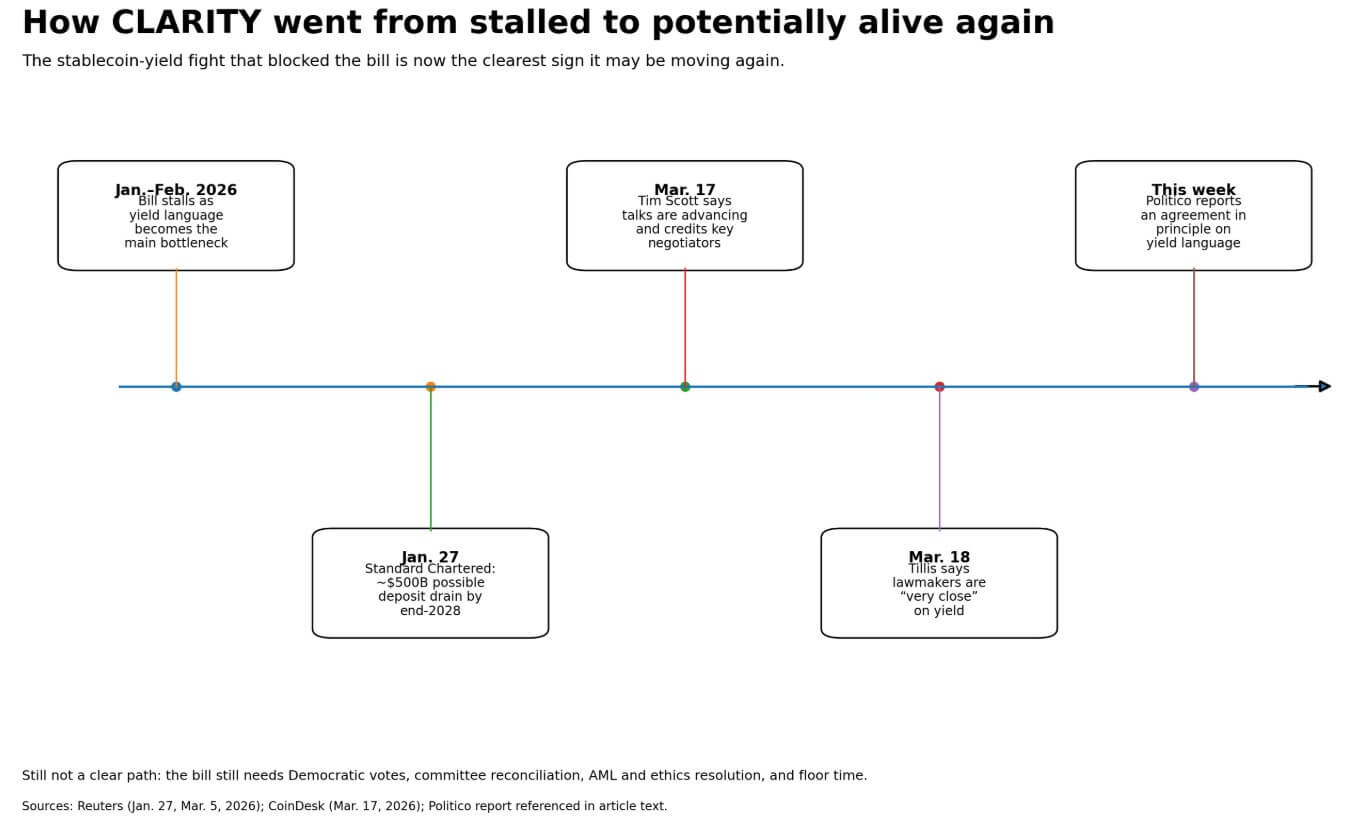 A timeline graphic illustrates the CLARITY Act’s halt over stablecoin-yield provisions from January 2026 to this week’s reported preliminary agreement.
Reasons for the blockage
The CLARITY Act aims to establish permanent federal regulations that govern the operations of crypto exchanges, brokers, dealers, and custodians, and to grant the CFTC formal authority over spot markets—something that no agency interpretation can achieve.
SEC Chair Paul Atkins has consistently stated on Mar. 17 that no action by the Commission can future-proof the crypto regulatory framework in the same way that legislation can. The underlying message in both instances was that agency guidance serves as a temporary solution, while the statute represents the ultimate goal.
The stablecoin-yield provision became the vulnerable point of this bridge.
Banks cautioned that crypto companies providing rewards on stablecoin balances could siphon deposits from the traditional banking sector. Standard Chartered projected that stablecoins might withdraw approximately $500 billion from US bank deposits by the end of 2028.
This perspective provided Senate opponents with a credible argument regarding systemic risk, causing the bill to stall from February into March, despite bipartisan interest in the broader market structure framework.
Senate Banking Chairman Tim Scott mentioned as recently as Mar. 17 that negotiations were progressing, specifically acknowledging Senators Angela Alsobrooks, Thom Tillis, and White House adviser Patrick Witt regarding yield discussions.
Tillis indicated that lawmakers were “very close” to reaching an agreement on Mar. 18. The reported preliminary agreement is the strongest indication yet that the central bottleneck may be easing.
However, the bill requires the support of at least seven Senate Democrats, faces unresolved issues concerning elected officials profiting from crypto ventures and stricter anti-money-laundering requirements, must reconcile the drafts from the Senate Banking and Senate Agriculture committees, and must compete for time on the legislative calendar, which is steadily shrinking as midterms approach.
Improved odds and clear odds are not the same.
Wall Street’s current pricing
The most evident indication that CLARITY is a significant factor for Bitcoin emerged from Citi in March, when it lowered its 12-month Bitcoin target from $143,000 to $112,000.
Citi explicitly stated that stalled US legislation had reduced the timeframe for the regulatory catalysts it anticipated would drive ETF demand and broader institutional adoption. Its bullish scenario is $165,000, while its bearish scenario in a recession is $58,000.
The difference between these figures is partly attributed to legislative developments.
JPMorgan’s perspective was more directional than target-specific. In February, JPMorgan noted that crypto markets could experience a substantial boost in the latter half of 2026 if market structure legislation is enacted by midyear, as it would end regulation-by-enforcement, encourage tokenization, and facilitate greater institutional participation.
This is a bank advising clients to monitor the Senate calendar as a potential catalyst for the second half of the year.
VanEck translated policy optimism into observable flow behavior in its January Bitcoin ChainCheck.
Related Posts
The firm reported that Bitcoin’s strength that month was partly a reflection of optimism surrounding the CLARITY Act, coinciding with a shift from $1.3 billion in ETP outflows in the preceding 30 days to $440 million in inflows.
Between Jan. 12 and 14 alone, Bitcoin ETP inflows reached $1.66 billion. Policy sentiment influenced capital movement through registered products in significant volumes, with prices rising as a result.
The Coinbase and EY-Parthenon survey of 351 institutional investors in March quantifies the reasons behind this trend.
Among firms intending to increase their holdings this year, 65% identified improved regulatory clarity as a crucial factor. Additionally, 66% expressed that regulatory uncertainty was their primary concern, and 78% indicated that market structure was the area most in need of clear guidelines.
For this group, regulation is a decision regarding allocation size. The proportion of firms allocating over 5% of AUM to digital assets is projected to rise from 18% to 29% by year-end.
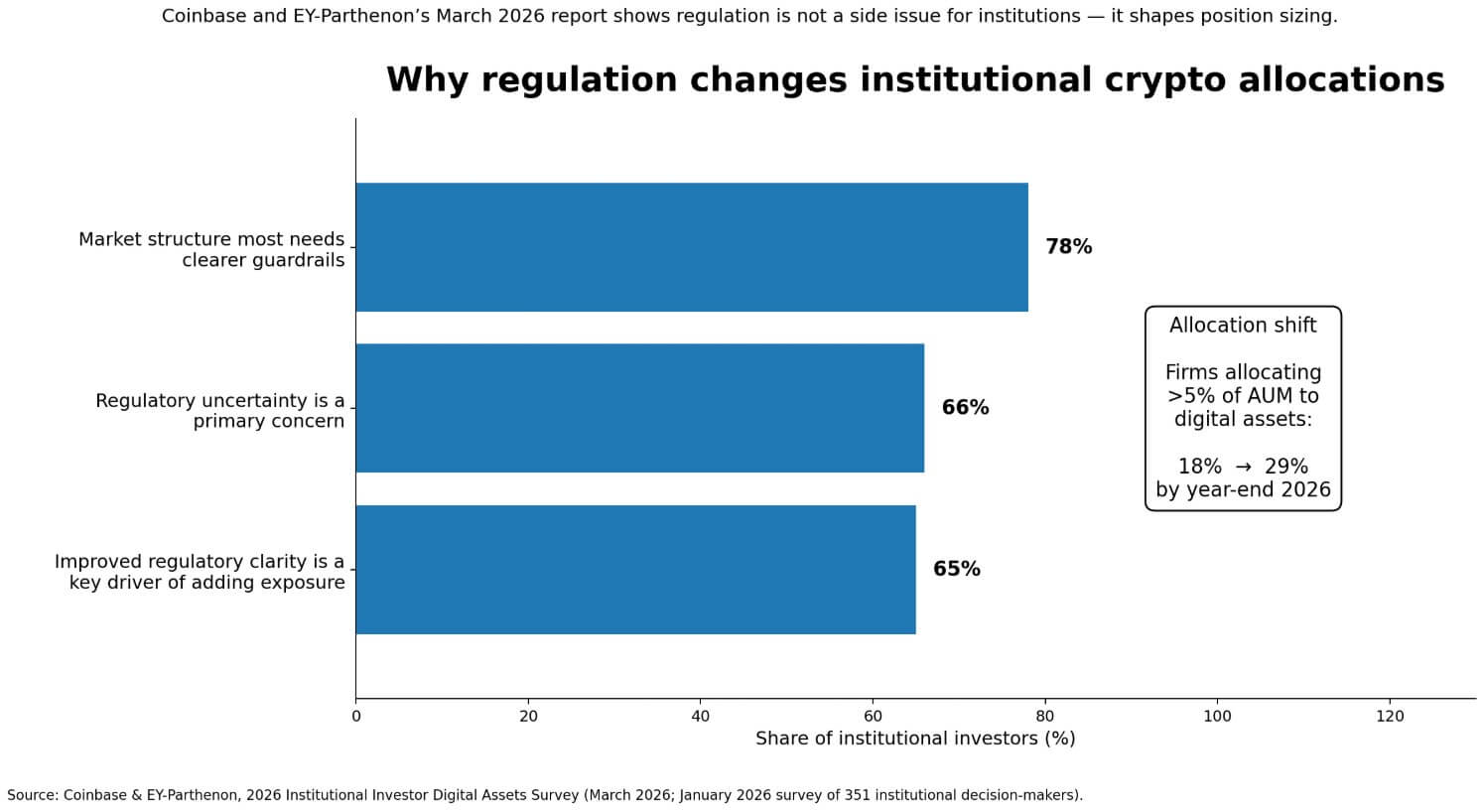 A Coinbase and EY-Parthenon survey of 351 institutions reveals that 78% desire clearer market structure guidelines, with significant crypto allocators expected to nearly double by year-end.
Treasury Secretary Scott Bessent articulated the same point for a broader audience when he stated to CNBC in February that CLARITY would provide “great comfort to the market.”
Grayscale’s 2026 outlook went further, suggesting that a breakdown in bipartisan legislative progress poses a downside risk, as regulatory clarity could integrate public blockchains more deeply into mainstream financial systems.
Expectations for investors
The bullish scenario does not necessitate passage this week. It requires the market to begin assigning higher probabilities to eventual passage, as Wall Street prices in likelihood before it prices in legislation.
If the stablecoin-yield compromise remains intact and Senate Banking progresses again, the most immediate impact would be a stronger demand for ETF expectations, driven by increased institutional comfort, greater platform willingness, and enhanced custodial confidence.
JPMorgan’s second-half catalyst perspective becomes pertinent. Citi’s adjustment appears overly cautious. The data from the Coinbase/EY survey regarding planned increases in allocations for 2026 transforms into a flow narrative rather than merely a survey outcome.
The bearish scenario only requires that the compromise begins to unravel. Ethical disputes, AML requirements, or calendar congestion could once again stall momentum, even if the yield provision remains intact.
In such a case, the legal standing of crypto would depend on the interpretive progress of the SEC and CFTC without the statutory certainty that Atkins asserts only Congress can provide.
Citi’s reasoning would reassert itself: the window for a regulatory catalyst narrows, and Bitcoin would trade based on macroeconomic factors, interest rates, and positioning rather than legislative developments.
The average crypto investor should not anticipate a Senate compromise to cause an immediate vertical movement in Bitcoin the following day, as the mechanism is slower and more structural: reduced regulatory friction over time enhances institutional comfort, which supports ETF inflows, market depth, and liquidity.
| Scenario | What happens in Washington | What changes for institutions | What retail should expect |
|---|---|---|---|
| Bull case: odds improve materially | The stablecoin-yield compromise holds, Senate Banking progresses again, and markets begin to assign higher probabilities to eventual CLARITY passage | Increased confidence in ETF demand, custody, broker/dealer participation, and platform readiness to expand crypto exposure | Supportive for Bitcoin over time, but not an immediate vertical shift |
| Base case: progress, but still messy | Negotiations improve, but the bill remains unresolved and passage is still uncertain | Institutions perceive the backdrop as more favorable, but still await clearer legal durability before aggressively increasing their positions | Bitcoin receives some regulatory support, but continues to trade heavily influenced by macroeconomic factors, liquidity, and ETF flows |
| Bear case: compromise frays or stalls again | Ethical disputes, AML requirements, committee differences, or calendar pressures could freeze momentum once more | No statutory certainty; institutions remain cautious and depend on existing ETFs and current agency guidance rather than expanding exposure aggressively | Bitcoin reverts to trading more on interest rates, macroeconomic factors, and positioning rather than on optimism from Washington |
| What the mechanism actually is | Legislative friction decreases, even prior to final passage | Increased legal clarity can enhance institutional comfort, custodial confidence, and the utilization of regulated market infrastructure | The impact is gradual: improved ETF flows, deeper liquidity, and a broader market over time rather than a sudden spike |
BlackRock indicates that Bitcoin’s trajectory in 2026 is influenced by liquidity conditions and the adoption by institutional and wealth-advisory sectors, with any single headline being a secondary factor.
Recent ETF flow data supports this observation. US spot Bitcoin ETFs attracted $199.4 million on Mar. 17, then reversed to outflows of $163.5 million on Mar. 18 and $90.2 million on Mar. 19.
If the odds for CLARITY continue to improve, the effect for the average investor will be a broader, deeper, and more institutionally committed market for the asset already held in their accounts.
The post CLARITY Act gets deadlock breakthrough that also opens the door to more Bitcoin demand appeared first on CryptoSlate.
